



In AOI optical inspection applications, micro-vibration is an invisible precision killer. Even sub-micron jitter can cause image smearing and coordinate offset, directly triggering false positives and missed defects. Many equipment manufacturers repeatedly optimize parameters when tuning optical lenses and motion platforms, yet often overlook the governance of vibration sources for the whole machine. Vibrations do not only come from external workshop environments. Start-stop of internal moving components, airflow disturbance and reciprocating movement of platforms in the AOI unit will all generate compound micro-vibrations. To control the overall vibration error within an acceptable range, relying merely on passive buffering via vibration isolation pads is insufficient. The inherent structural damping property of the base substrate serves as the fundamental solution. This is the core reason why high-end AOI equipment widely adopts ultra-precision granite bases.
1. Intrinsic Material Damping: Absorb Vibration Energy at Source and Prevent Resonance Amplification
Though cast iron and aluminum alloy bases feature high rigidity, they have low damping coefficients. When the linear motors and XY motion stages inside AOI operate at high speed in reciprocating motion, the excited vibration energy continuously reflects within the metal structure, which easily triggers resonance and multiplies tiny vibrations. Ordinary marble has abundant internal pores and uneven material texture with unstable residual stress, leading to uncontrollable vibration transmission performance. It cannot stably absorb high-frequency micro-vibrations.
UNPARALLELED® black granite has a dense and uniform crystal structure with a density close to 3100kg/m³ and naturally high damping properties. Once vibration waves enter the stone matrix, energy dissipates rapidly at the interfaces between crystal particles instead of continuous transmission or reflection. Unlike external shock absorbers that only isolate low-frequency vibration, the granite substrate can attenuate both medium and high-frequency micro-vibrations generated during AOI operation and weaken the transmission path of vibration toward the optical imaging module. The base itself acts as a natural vibration-damping substrate, consuming vibration energy at the source and suppressing resonance formation.
2. Stress Relief Process: Eliminate Hidden Vibration Sources Inside Substrate
For many stone bases, precision keeps drifting after months of service. One easily overlooked cause is residual stress trapped inside the stone. Stress releases slowly over time and triggers minor structural deformation accompanied by persistent subtle micro-vibrations, which constantly disturb the AOI imaging reference.
UNPARALLELED conducts long-term static aging treatment on raw stone blocks to fully release native internal stress. Subsequent cutting, rough grinding and fine grinding processes are carried out in separate phases, with a stabilization period reserved after each processing step to avoid accumulation of machining stress. Granite bases treated by aging will not spontaneously produce deformation vibration over time. After forming, the bases are inspected for flatness and dynamic vibration in a shockproof constant-temperature workshop to ensure no hidden stress-induced vibration sources exist within the substrate, maintaining stable reference for the whole machine during long-term operation.
3. Integrated Monolithic Structural Design: Cut Down Vibration Transmission Nodes
Vibration transmission of the complete AOI unit often generates vibration refraction at joints and bolted interfaces. If the base adopts a multi-section spliced structure, seams become weak points for vibration transfer. Vibrations produced by high-speed motion oscillate back and forth at splicing gaps and amplify errors at the imaging end.
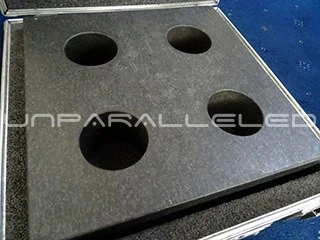
Leveraging large-scale CNC machining capability, UNPARALLELED supplies integrated monolithic granite bases supporting one-piece forming in large dimensions and minimizing spliced joints. The integrated base mounts AOI optical modules, XY motion stages and light source systems on one continuous reference plane. All components share the same rigid substrate, reducing relative vibration differences between individual parts. When the motion platform generates vibration, the whole granite block absorbs energy simultaneously, cutting relative displacement between components and greatly lowering the overall relative vibration error.
4. Collaborative Shockproof Supporting Structure: Build Multi-layer Vibration Reduction System
Material properties alone cannot cope with complex workshop working conditions. Low-frequency vibration transmitted upward from the foundation, caused by factory floor movement and operation of surrounding equipment, can propagate to the AOI main unit.
During base design, UNPARALLELED delivers customized shock mitigation solutions according to factory foundation conditions. The engineering experience of building shock trenches and ultra-thick load-bearing floors in its constant-temperature workshop is applied to AOI base design. The granite base works with customized vibration isolation components to form a dual-layer vibration reduction system: foundation vibration isolation plus granite matrix vibration absorption. Low-frequency vibration coming from outside is first filtered by isolation assemblies, and residual micro-vibration is then dissipated by the inherent damping of granite. The dual-layer structure blocks the transmission path of external vibration to the optical inspection unit and constrains overall vibration within the nanometer range.
5. Ultra-precision Grinding and Metrology Verification: Lock Reference Plane under Vibration Load
The adverse effect of vibration ultimately manifests as dynamic offset of the reference plane. Even if static flatness meets specifications, minor deflection of the base under vibration load will shift the AOI coordinate reference.
After finishing, the base is not only tested for static flatness. UNPARALLELED uses laser interferometers and high-precision electronic levels to simulate real motion conditions of AOI equipment and perform dynamic vibration tests to verify plane stability of the base under vibration load. Drawing on decades of accumulated grinding expertise, craftsmen control surface micro-topography to ensure the base will not suffer local deflection under vibration excitation. Every base undergoes dynamic vibration verification before delivery. It guarantees that the reference plane remains stable during continuous production operation and no extra inspection error is introduced by vibration.
Conclusion
Reducing overall vibration error of AOI equipment is a systematic project rather than simply installing vibration pads. With natural high damping characteristics, thorough aging stress relief technology, integrated rigid structure, multi-layer vibration mitigation scheme and dynamic metrology validation, UNPARALLELED granite base establishes a complete vibration control solution. It integrates vibration energy absorption, resonance suppression and relative displacement reduction, continuously stabilizing AOI optical imaging, minimizing false detection and missed detection, and providing reliable reference support for mass production inspection scenarios in PCB and semiconductor industries.