



Many precision equipment integrators have such concerns: if equipment is installed in production workshops with high dust levels, can the accuracy of granite mechanical systems remain stable over time? Many people assume granite is hard and immune to particle contamination. In fact, dust causes gradual damage to this reference system, which is hard to detect in the short run. Over time, it disrupts motion performance and may even permanently damage reference surfaces.
Dust exerts harmful effects in two ways. First, hard particles get trapped between air bearing guides, motion stages and granite reference surfaces. Air bearing platforms rely on an ultra-thin air film for suspension. Once dust enters the air-film gap, it scratches the granite working surface and ruins its nano-level flatness. Meanwhile, particles can partially block the air film, causing fluctuations in suspension height, positioning jitter and repeat positioning errors. Second, dust accumulates in assembly gaps and leveling support points, gradually altering supporting stress and introducing minor additional stress on the machine bed, resulting in geometric reference shift.
Compared with metal bases, granite does not rust or oxidize, so dust will not create corrosion pits as on steel. This is its natural advantage, yet this advantage does not equal full immunity. Ordinary machined granite parts have tiny surface pores where dust can get embedded, making later cleaning extremely difficult and continuously abrading reference surfaces.
In the final processing stage, UNPARALLELED granite components undergo densification and fine grinding to seal surface micropores and reduce dust adsorption and embedding. Even in dusty working conditions, most particles stay on the surface instead of penetrating deep into the stone, lowering the risk of permanent scratches. Still, even with optimized substrate properties, dust remains a threat to motion pairs, especially air bearing structures. Therefore, in dusty environments, we cannot only rely on the stone itself; supporting protection solutions are required.
Three simple and effective protection strategies are available. The first is local isolation: install dust covers over granite motion reference zones to block most production dust from landing directly on working surfaces. The second is regular standardized maintenance: clean reference surfaces with dust-free soft tools and avoid scrubbing with hard cloths. The third is multi-stage pre-filtering for air supply. For air bearing guides, compressed air passes through multi-level filters to prevent dust carried by air sources from entering air-film gaps.
Tolerance varies for different applications. For granite measuring tools used in metrology, dust impacts are relatively manageable with regular cleaning. However, granite systems equipped with air bearing guides and linear motors for high-speed motion have very low dust tolerance. A small amount of hard dust is enough to compromise motion stability.
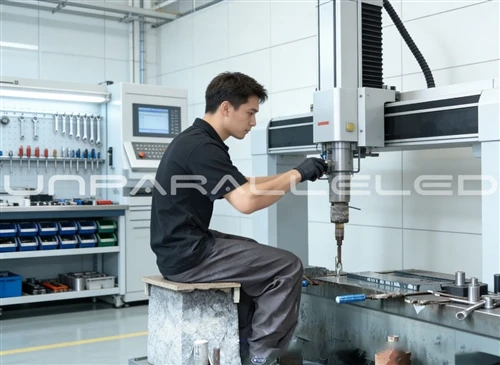
Many clients fall into a misunderstanding: high-performance granite systems eliminate the need for workshop dust control. Granite serves as a stable reference carrier, yet it cannot offset mechanical scratching caused by hard particulate matter. At the early project stage, UNPARALLELED provides customers with supporting protection recommendations for dusty working conditions to maximize the long-term accuracy life of granite mechanical systems.
Conclusion
Workshops with heavy dust will negatively affect granite mechanical systems. The degree of impact depends on motion structure type, dust particle hardness and protective measures. Thanks to its densely fine-ground surface, UNPARALLELED granite reduces risks of dust embedding. To permanently protect nano-level reference surfaces, substrate performance and dust protection must work together to sustain system accuracy in complex production environments.