



Precision granite surface plates rely on nanometer-level lapped surfaces as measurement benchmarks. When facing oil contamination, rust marks or cutting fluid residues, many workshop operators tend to adopt cleaning solutions used for ordinary stone or equipment casings. These seemingly efficient stain removal methods can silently damage the micro benchmark of precision plates. UNPARALLELED® granite surface plates are formed by ultra-precision lapping, and their working surfaces are extremely sensitive. Once damaged by improper operations, most defects become irreversible and the plate has to be sent back for re-lapping. Learning forbidden cleaning methods is not merely memorizing a checklist, but understanding the hidden harm each operation brings to the reference plane.
1. Do not scrub directly with abrasive or hard wiping tools
When tackling stubborn stains, many operators use steel wool, scouring pads, polishing powder, sandpaper or stiff brushes for scrubbing. Such tools have cutting capabilities and can quickly remove contaminants from ordinary tabletops. However, the lapped surface of precision granite surface plates features nanoscale micro-topography. Hard particles will leave numerous micro-scratches on the surface. These scratches may be invisible to naked eyes yet alter local planar contours. Metal debris will get trapped inside scratches, continuously abrading the reference plane during subsequent measurements and gradually degrading flatness. Even local partial scrubbing will create error zones, impairing precision inspection tasks such as AOI and coordinate measurement.
2. Strong acid, strong alkali and bleaching chemical cleaners are strictly prohibited
White vinegar, citric acid, descaling agents, bleach, ammonia and heavy-duty alkaline detergents fall into the forbidden category. Many people mistakenly believe granite resists chemical corrosion and arbitrarily apply industrial degreasers. Such chemicals penetrate the natural micro-pores of stone, erode crystal boundaries, resulting in surface dullness, local etch pits and permanent dark spots. Corrosion damage does not show up immediately but expands slowly. The damaged surface easily absorbs oil and dust afterward, leading to recurring stains that grow harder to remove. Some strong solvents such as banana oil and gasoline can dissolve the surface layer of stone and change surface stress states, potentially inducing minor deformation over time and ruining the planar benchmark.
3. Do not flood or soak the plate, nor leave water stains for long periods
Some workshops rinse the plate directly with water to wash away iron filings and stains. Granite contains inherent micro-pores. Large volumes of water penetrating into the substrate evaporate slowly. Trapped moisture oxidizes internal mineral components gradually and forms deeper rust marks that are difficult to clean. Meanwhile, heavy water flushing triggers abrupt local temperature changes on the plate and causes temporary deformation, interfering with ongoing measurement accuracy. Even when wiping with clean water, never allow water to stay on the lapped surface for long, let alone pour water directly onto the plate.
4. Do not apply wax, oil or polishing compound for stain treatment
When encountering oil stains, some operators coat machine oil, anti-rust oil, paraffin or polishing paste on the surface, hoping to cover stains or improve gloss. Grease deposits inside granite micro-pores and cannot be eliminated completely, altering micro height differences of the working surface. Oil films attract dust and metal chips, which stick to measuring tools and workpiece bottoms and bring extra contamination. Polishing compound contains abrasives. Unauthorized polishing destroys the original uniform lapping texture, causing inconsistent local flatness and breaking the unified benchmark of the whole plate.
5. Do not forcibly strip stains via scraping or grinding
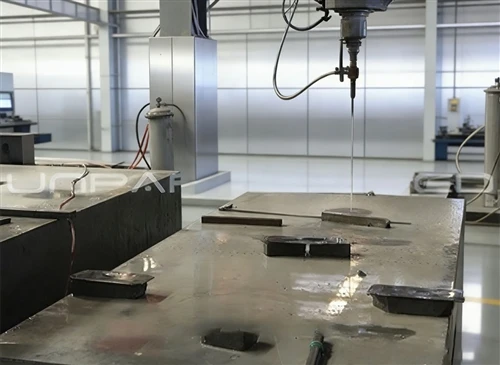
For dried and solidified cutting fluid or metal deposits, using blades and scrapers or performing on-site grinding and polishing is high-risk. Granite is brittle. Scraping easily chips edges and leaves grooves on the surface. Forced grinding changes the original lapping benchmark of local regions and makes the overall plate flatness out of tolerance. This kind of damage is structural and cannot be fixed by simple cleaning. The plate must be returned to the manufacturer for re ultra-precision lapping, greatly raising maintenance costs and downtime.
6. Do not mix multiple cleaning agents for enhanced decontamination
To quickly eliminate composite stains, some workshops mix bleach, descaling chemicals and degreasers. Once blended, different agents may react chemically, generating corrosive substances or precipitated crystals. Crystal particles trapped inside micro-pores continuously erode the stone. Chemical reactions may also produce partial temperature fluctuation on the surface and trigger slight deformation. Damage caused by mixed cleaners is concealed. Benchmark drift is usually detected after repeated measurements, making root cause tracing difficult.
Conclusion
The core principle for stain handling on precision granite surface plates is: remove contaminants gently without modifying the original lapped benchmark. Steel wool, strong acids and alkalis, heavy water rinsing, oil or wax coating, scraping blades and mixed cleaning agents are all practices to avoid. UNPARALLELED granite surface plates feature dense and stable material, yet nanoscale lapped surfaces have extremely low fault tolerance. When stains occur, use dust-free microfiber cloth and dedicated neutral cleaner for gentle wiping. For stubborn stains, do not attempt aggressive stain removal by yourself. Contact the manufacturer for professional advice if necessary, to prevent permanent benchmark damage from one single improper operation.