



An engineer does not choose a machine base because it looks heavy. The base decides how fast the machine can accelerate, how accurately it positions and how reliably it returns to the same point tomorrow, because every axis and measuring system is referenced to it. In semiconductor equipment, AOI, PCB drilling, laser processing and linear motor stages the base is the first link in the accuracy chain, and a weak first link cannot be repaired later by better controls. This article explains what fails when a base is unstable, why granite is used, why high-density black granite matters, and how large custom bases are made.
Why machine foundations matter in high-precision equipment
A precision machine is a closed loop: the controller commands a move, the drive accelerates a mass and a measuring system reports the result, all referenced to the same body. The rails, the scale and the metrology frame are all referenced to it. If the base is straight, square and stable, the axes can be built to specification; if not, every axis inherits the error, because the reference itself is moving. The demand is highest where speed and accuracy are needed together: a high-speed stage accelerating several g delivers reaction forces into the base on every stroke, and the base must absorb them without flexing or ringing.
What happens when the machine base is not stable?
Instability rarely appears as one dramatic failure. Vibration comes first: every drive and stage excites the structure, and if the base has little internal damping that energy keeps circulating instead of dying away. At high speed the excitation can approach a natural frequency, the response grows sharply, and the machine moves between tool and workpiece - surface waviness, probe jitter, or an error that appears only at certain speeds.
Deformation follows: static loads, the moving mass of the stage and clamping forces all bend the base slightly, and at sub-micron targets a few micrometres matter. Metal castings add a slower problem: residual stresses release over months, so a base that was correct at commissioning drifts out of geometry. Thermal drift is often the largest: steel and cast iron expand by roughly 11 to 12 micrometres per metre per degree Celsius, so a one-metre steel base that warms by one degree moves about 12 micrometres. The result is positioning error that varies with speed, load and temperature, and a loss of repeatability - the property production actually depends on.
| Failure mode | Physical cause | Effect on the machine |
|---|---|---|
| Vibration | Low damping, resonant response | Surface waviness, probe jitter |
| Deformation | Static loads, casting stress release | Loss of straightness over time |
| Thermal drift | High thermal expansion | Slow positional movement per shift |
| Poor repeatability | Error varies with speed and time | Unstable process, narrow window |
Why granite is used for precision machine bases
Granite answers each of these failure modes directly, which is why it has been the reference material for precision machines for over a century. Its thermal expansion is low, around 5 to 8 ×10⁻⁶/°C, roughly half that of steel, so a given temperature change moves the structure about half as far. Its internal damping is high compared with metals, so vibration is absorbed rather than passed on to the tool or the optics. It carries no trapped casting stresses, so a finished base is dimensionally stable from delivery, and it does not rust, which suits cleanrooms and humid environments. It also machines cleanly enough to carry lapped reference faces, rail seats, air-bearing surfaces and threaded inserts in one body, removing the joints that would soften the structure.
Why high-density black granite matters
Density is often quoted as if a heavier base were automatically better, which is not the right way to read it. Density matters for what it stands for: a high-density black granite is fine-grained, low-porosity and uniform, and that structure delivers the properties an engineer needs. The chain runs from density to stiffness to structural stability, then to vibration behaviour, and finally to long-term dimensional stability.
In a stage that accelerates quickly, base mass works against reaction forces: for the same dynamic force, a heavier and stiffer body moves less at the tool point. High density also indicates a dense crystalline structure, with a higher elastic modulus and fewer flaws. What ultimately governs dynamic performance is specific stiffness - stiffness divided by density - together with damping, and here granite separates itself from the metals: its specific stiffness is comparable to cast iron or better, while its damping is several times higher and its thermal expansion lower. UNPARALLELED® black granite is a dense material at about 3100 kg/m³, and it is that density combined with grinding quality, geometry and correctly designed inserts that produces the result.
Granite machine bases for semiconductor equipment
Semiconductor and high-speed equipment is where these requirements arrive at once, because these machines combine nanometer-level positioning, fast scanning and a clean environment. Granite bases are used across semiconductor processing and inspection stages, AOI and optical inspection systems, PCB drilling and routing machines, laser cutting and marking systems, coordinate measuring machines, wafer handling platforms and lithium-battery inspection equipment. In each case the base provides three things: a stable reference for the axes, a damped body that keeps vibration out of the measurement, and a non-magnetic, non-rusting material suited to a cleanroom.
Custom granite bases for linear motor and air-bearing stages
Two technologies make this relationship especially direct. A linear motor drives the stage without contact and, in return, sends its full reaction force into the structure on every acceleration, so a linear motor stage is only as good as the body it pushes against. An air bearing removes friction and wear but needs an extremely flat and quiet surface to float on, and any flexure in that surface is transferred straight to the moving stage. The base is therefore part of the drive and measuring system, not a separate support. This is why a granite air bearing is normally cut into the same monolithic body as the structure around it, so the guide surface, the mounting faces and the measuring reference stay one piece of one stable material.
How UNPARALLELED® manufactures large precision granite bases
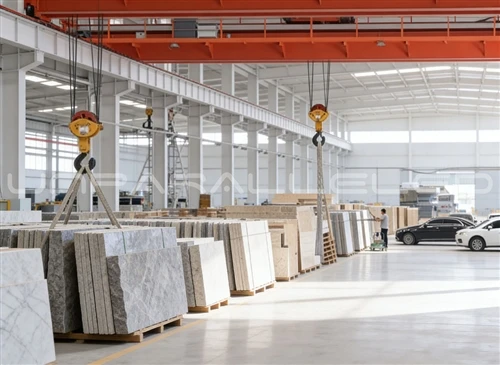
A stable base is mainly a question of scale and process. UNPARALLELED® machines single granite components up to 20,000 mm in length, 4,000 mm in width and 1,000 mm in thickness, with individual parts reaching about 100 tons. That capacity means a base can be produced as one integral piece rather than assembled from smaller blocks, and monolithic construction is where stiffness and thermal stability come from: no joints to soften the structure and no interfaces to move with temperature. Grinding and hand lapping are done by craftsmen with over 30 years of experience, and every part is verified with Mahr, Mitutoyo, WYLER and Renishaw instruments in a temperature-controlled workshop, traceable to DIN, ASME, JIS, GB, BS and GOST.
If your machine must hold a micron or better while it moves fast, the base is part of the specification, not background structure. Send us your drawing, your stage layout and the accuracy you need at speed, and we will tell you how we would build a granite machine base for it.