



As modern ultra‑precision equipment keeps advancing toward micron‑ and even nanometer‑level accuracy, traditional metal castings and alloys are gradually showing performance bottlenecks in thermal stability and damping properties. In the development of components for semiconductor inspection, optical imaging and high‑precision motion platforms, granite is no longer merely a material for inspection surface plates. It is increasingly adopted in manufacturing critical mechanical parts such as bases, hollow substrates, guide‑way substrates and gantry components. Unlike metal materials that improve performance via structural reinforcement, granite relies on the intrinsic physical properties of its minerals to fundamentally address pain points in precision machinery including deformation, vibration and thermal drift, making it a compelling option for high‑end equipment component selection.
Thermal deformation is a major cause of accuracy failure for mechanical precision parts. Subjected to ambient temperature fluctuations and heat generated during equipment operation, metal components expand and contract obviously. Minor temperature changes translate into geometric errors, directly disturbing equipment positioning and inspection results. Featuring dense mineral structure and an extremely low thermal expansion coefficient, granite undergoes minimal overall deformation under working‑condition temperature variations. Even with long‑term continuous operation, the part itself barely suffers thermal drift and consistently maintains the geometric status of datum surfaces. This characteristic is particularly vital for vision‑inspection and semiconductor process equipment running non‑stop. It reduces frequent compensation and adjustment triggered by temperature changes and eases the burden on the complete‑machine control system.
Vibration suppression directly determines the repeat positioning accuracy and imaging quality of motion mechanisms. Vibration from motor rotation, slider movement and external workshop conditions transfers to core parts, resulting in blurred lens images, fluctuating inspection data and deviated motion trajectories. Metal parts feature slow vibration attenuation with long residual‑vibration duration, requiring complex auxiliary vibration‑isolation structures for interference offset. Granite possesses natural high‑damping properties; vibration energy is rapidly absorbed and dissipated inside mineral lattices for fast vibration decay. When fabricated into load‑bearing parts such as bases and guide‑way substrates, granite weakens vibration transmission paths from the source. Without excessive external vibration‑isolation assemblies, it builds stable carriers for air‑bearing guide‑ways and linear‑motor modules, enabling a fast transition to stable working status after high‑speed movement.
Long‑term dimensional stability constitutes an indispensable indicator for precision mechanical parts. Metal castings retain casting residual stress. Even after aging treatment, stress is gradually released during long‑term service and causes slow component deformation, leading to growing accuracy deviation over time. Premium raw granite undergoes sufficient natural aging to fully release internal stress and delivers uniform, dense mineral texture free from creep found in metals. After grinding, granite mechanical parts can sustain long‑term flatness and straightness of datum surfaces, free from aging‑induced deformation common in metal counterparts. It greatly extends the effective service life of precision components and cuts the frequency of later‑stage accuracy repair for equipment.
Granite mechanical parts also combine unique non‑magnetic performance and resistance to medium intrusion. In semiconductor and magnet‑related inspection scenarios, metal parts may generate magnetic interference and impair normal operation of sensors and probe assemblies. Granite is inherently non‑magnetic and creates no magnetic disturbance to surrounding precision electronic components. Meanwhile, its stone surface resists rust and will not corrode when contaminated by small amounts of workshop oil or cutting media. Nevertheless, material advantages cannot guarantee unlimited application. As granite is brittle, stainless‑steel thread‑insert embedding solves its limitation of direct tapping and achieves reliable bolt assembly, expanding its application scope for mechanical parts.
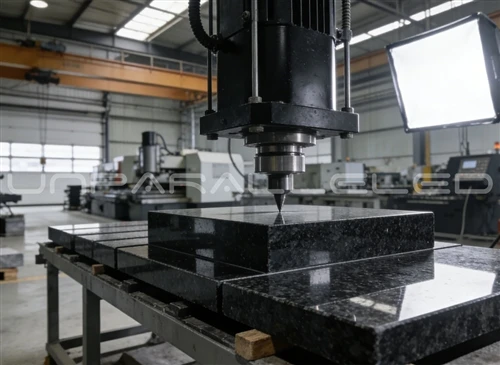
Granite components also have objective application boundaries. They are not suitable for working conditions with heavy impact loads. Component structural design shall fully consider wall thickness and stress points, and strike rigidity balance through rational hollow‑out and stiffener layout. Compared with steel and cast iron, granite cannot be welded or bent. Its part shapes are formed by cutting and grinding, making it more suitable for customized precision substrate‑type parts.
Overall, granite is not intended to fully replace metals. Instead, as a differentiated high‑performance material, it compensates for the weaknesses of ultra‑precision mechanical parts in thermal stability, vibration reduction and long‑term dimensional stability. As high‑end manufacturing continuously raises accuracy requirements for equipment, granite will no longer be confined to inspection platforms. It will find wider applications in customized mechanical structural parts and deliver an alternative solution for high‑precision components in the semiconductor, optical and scientific‑instrument sectors.