



In application scenarios such as precision equipment bases, air-floating guideways and optical reference platforms, the surface treatment process of granite plates directly determines the micro-morphology, wear resistance, air tightness and long-term precision retention of the reference surface. Many equipment integrators tend to simplify surface treatment of mechanized granite plates as merely "flattening the plate surface" and ignore the differences between processes for different working conditions. Mismatched processes often occur: using high-roughness processing for air bearing bases triggers continuous air film jitter; adopting over-polished plates for heavy-duty machine tool bases leads to insufficient surface wear resistance and collision damage. Targeting different equipment working conditions, loads and precision grades, UNPARALLELED Group (Brand: UNPARALLELED®) has built a complete selection logic for surface treatment of mechanized granite plates to help customers match the most suitable surface processing solution.
The surface treatment of mechanized granite plates relies on automatic graded grinding by CNC grinders, different from the randomness of traditional manual lapping. It can flexibly adjust abrasive grain size, grinding feed rate and tool path mode, generating multiple process routes including rough grinding, finish grinding, ultra-precision grinding and mirror lapping. Each process corresponds to a specific roughness range and surface micro-structure. Selection should not simply pursue the smoothest surface, but be comprehensively judged based on equipment precision grade, movement mode, contact form and workshop environment.
The first selection criterion is precision grade and application purpose. For ordinary mechanical tooling, load-bearing base plates and low-precision inspection platforms, plates only need guaranteed macroscopic flatness without nano-level micro-flatness. Mechanized rough grinding is sufficient. Rough grinding removes cutting marks, sand holes and concave-convex defects on the stone surface, featuring high processing efficiency and controllable cost. The surface has certain anti-slip properties and fits static load-bearing working conditions. However, the plate surface after rough grinding contains many micro grooves and cannot be used for air bearing structures. The rough surface will disrupt air film uniformity, so it is not recommended for air pressure guideways or air bearing bases.
For conventional precision measuring platforms, CMM frames and mounting substrates for ordinary linear guideways, mechanized finish grinding is recommended. On the basis of rough grinding, finish grinding adopts finer abrasives to eliminate large scratches on the plate surface and stabilize roughness within a qualified range. Flatness and parallelism are reliably guaranteed. This process balances precision, processing cycle and cost. The plate surface delivers excellent wear resistance and strong anti-collision performance, suitable for direct mounting of mechanical guideways. During finish grinding, UNPARALLELED® adopts constant-temperature mechanized grinding to avoid thermal deformation during processing, ensuring uniform surface quality across the whole large plate without uneven local grinding depth, meeting the benchmark requirements of most precision equipment.
For scenarios such as air-floating guideways, granite air pressure bases and optical reference plates for optical inspection or laser resonant bases, where high air film stability is required, mechanized ultra-precision grinding is the preferred choice. The air bearing system relies on a uniform micron-level air film to realize suspension. Tiny scratches or local protrusions on the plate surface will disturb airflow and cause air film jitter and positioning drift. Ultra-precision grinding uses superfine abrasives. CNC equipment performs low-speed and uniform full-area processing to optimize the micro-texture of the plate surface and reduce the peak-valley difference of micro features, forming a continuous and uniform reference surface. The ultra-precision grinding process of UNPARALLELED® matches plate surfaces for multi-air-chamber granite air pressure bases. The finished plate features highly consistent micro-morphology, which can maintain stable air film for a long time and guarantee nearly frictionless movement of the platform. It is the preferred surface treatment for semiconductor and optical inspection equipment.
Mirror lapping is a higher-grade surface treatment. Many customers mistakenly believe high-end equipment must adopt mirror processes. In fact, mirror lapping has clear application boundaries. Mirror treatment greatly reduces surface roughness and delivers a mirror-like bright surface, suitable for partial optical reflection benchmarks and special interferometric measurement platforms. However, although mirror granite plates have high hardness, their surface micro anti-impact capacity is weak. Tiny hard particles falling in the workshop may leave permanent scratches. Meanwhile, mirror processing takes a long cycle with high cost. It counts as over-selection for ordinary air bearing bases and brings no performance improvement but raises project budget. UNPARALLELED engineers will evaluate working conditions in advance to help customers avoid unnecessary cost increase caused by blind selection of mirror processes.
Besides precision and usage, load conditions and workshop environment form the second selection dimension. Under heavy-load conditions, the plate surface is more vulnerable to extrusion friction by metal debris and hard particles. Finish grinding is preferred to balance flatness and wear resistance. In clean workshops and dust-free optical laboratories, ultra-precision grinding is recommended to reduce dust trapped in surface grooves and lower pollutant accumulation. If the workshop is dusty with frequent workpiece loading and unloading that brings collision risks, mirror processes are not recommended; finish grinding is preferred to improve scratch resistance.
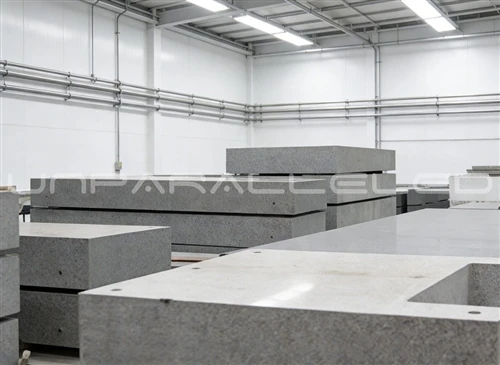
Moreover, the selection of surface treatment processes must match the granite substrate and internal airway processing. The exclusive black granite substrate of UNPARALLELED® has dense crystals and resists crystal peeling and chipping during mechanized graded grinding, enabling stable realization of different grades of surface treatment. If the plate is equipped with built-in air channels and air chambers, the grinding depth should be controlled during surface grinding to prevent damage to airway sealing caused by excessive cutting of the surface layer. This step requires overall planning of airway forming, stress relief by aging and graded surface grinding. At UNPARALLELED, airway forming, stress relief and graded surface grinding are integrated into one CNC processing workflow, preventing subsequent surface treatment from changing the relative position between airways and reference surfaces and ensuring the overall performance of air bearing components.
Factory inspection is also supporting work for surface process selection. Different surface treatment processes correspond to different inspection items and metrology indicators. In the constant-temperature metrology room, UNPARALLELED Group inspects each plate piece by piece with traceable roughness testers and flatness interferometers, issuing corresponding inspection reports and clearly recording indicators such as roughness and flatness, so customers can verify whether the selected surface process meets the design requirements of the whole machine.
The core principle for selecting surface treatment processes of mechanized granite plates is matching according to actual demands rather than blindly pursuing higher surface smoothness. Rough grinding applies to static load tooling; finish grinding suits ordinary precision substrates and mechanical guideway platforms; ultra-precision grinding is the first choice for air-floating guideways and optical benchmarks; mirror lapping only fits a small number of special optical measurement scenarios. Supported by a full set of mechanized processing systems, UNPARALLELED® customizes matched surface treatment solutions according to equipment load, precision requirements and workshop environment, ensuring long-term stable operation of granite benchmark plates while controlling costs.