



For most ultra-precision equipment, black granite is the best all-round choice for a machine base: it combines low thermal drift, strong vibration damping, long-term flatness and a reasonable cost. Cast iron wins when you need complex shapes or built-in features. Technical ceramics win when you need maximum stiffness and light moving parts. The right answer depends on your accuracy target, your load and your budget.
A machine can only be as accurate as the structure it stands on. Guides, motors, encoders and optics can all be world-class, but if the base expands with room temperature, rings after every acceleration or slowly changes shape, the error goes straight into your measurement or your part.
This guide compares the three materials engineers most often consider for bases of CMMs, laser systems, semiconductor tools and optical inspection equipment: granite, cast iron and technical ceramic. It explains what each does well, where each falls short, and how to choose.
What a precision machine base must do
Four properties decide whether a base material suits ultra-precision work:
- Thermal stability. A low coefficient of thermal expansion (CTE) and low thermal conductivity keep the base from changing size or bending when the room warms up or a motor heats one side.
- Vibration damping. A good base absorbs vibration from motors, floors and moving axes instead of ringing. Faster settling means faster, more repeatable measurement.
- Stiffness. High stiffness for a given mass keeps the structure from deflecting under the weight of the axes and the workpiece.
- Long-term dimensional stability. The surface must stay flat for years, without internal stress relaxing, corrosion or wear.
No material is best at all four, so the real question is which trade-offs your equipment can accept.
Granite: the stable default for metrology and precision motion
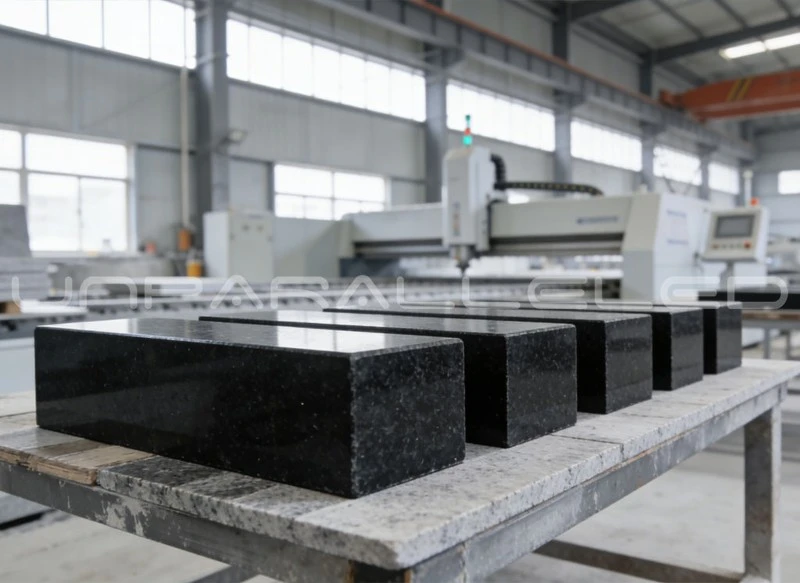
High-density black granite (about 3,000–3,100 kg/m³) is a fine-grained, uniform stone that has been the reference material of metrology for decades. It is the standard base for CMMs, video measuring machines, laser processing systems and many semiconductor and inspection tools.
Strengths
- Low thermal drift. Granite has a moderate CTE and very low thermal conductivity, so it reacts slowly to temperature changes. That gives precision machines time to stabilize.
- Excellent damping. The crystalline structure absorbs vibration far better than steel.
- Stable over decades. Natural stone has no residual casting stress and does not rust.
- Hand-lapped flatness. Skilled lapping reaches flatness in the sub-micron range, and the surface can be re-lapped or re-calibrated later.
- Non-magnetic and burr-free. A chip or scratch leaves a small crater instead of a raised burr that distorts measurement.
- Very large parts. Single pieces several meters long are practical.
Limits
- Heavy, so it needs strong supports and careful handling.
- Brittle: it can chip on impact and cannot be welded or bent.
- Threaded inserts, T-slots and cooling channels must be bonded or drilled in, which adds process steps.
- Lower stiffness-to-weight than ceramics or carbon fiber.
Cast iron and fabricated metal: flexible, but more drift
Grey cast iron (density about 7,100–7,300 kg/m³) is the traditional machine-tool material. Welded steel and aluminum structures follow the same logic: shape freedom in exchange for thermal and stress behavior that need more management.
Strengths
- Complex geometry. Ribs, pockets, bosses and mounting faces can be cast or machined directly, so one part can replace several assemblies.
- High stiffness and strength. Good load capacity, and cast iron damps better than steel.
- Impact tolerance. It is not brittle, and it can be repaired or modified.
- Mature supply chain. Foundries and machining shops are widely available, and it is cost-effective for series production.
Limits
- Thermal response. A higher CTE and much higher thermal conductivity than granite mean it follows room temperature more quickly and needs thermal control for sub-micron work.
- Residual stress. Castings and weldments must be stress-relieved and can still creep or warp over time.
- Corrosion. Unprotected surfaces rust and need coating or oiling.
- Magnetic. Not suitable for some measurement and electron-beam applications.
- Hard to reach very high flatness. Fine scraping and grinding are possible, but flatness stability is usually below that of lapped granite.
Technical ceramic: the stiffest and lightest, at a price
Engineering ceramics such as alumina (Al₂O₃) and silicon carbide (SiC) are used where stiffness, low moving mass and extreme surface quality matter most. Typical uses are wafer stages, air-bearing guides, precision rulers and reference mirrors.
Strengths
- Very high stiffness. Elastic modulus is several times that of granite (alumina roughly 350–400 GPa, SiC about 400 GPa), so beams can be light and still rigid.
- High hardness and wear resistance. Good for air-bearing surfaces and sliding contacts.
- No corrosion, non-magnetic. Suitable for clean, vacuum and chemical environments.
- Very high flatness and surface finish. Ceramic can be ground and lapped to extremely tight tolerances.
- SiC thermal behavior. Low CTE combined with high thermal conductivity spreads heat quickly and evenly.
Limits
- Cost. Material, sintering and finishing are much more expensive than granite or cast iron.
- Size limits. Large parts are difficult to sinter, so very big bases are usually bonded from segments.
- Brittleness. Low fracture toughness requires careful design and handling.
- Lower inherent damping. Vibration control often needs to be designed into the structure.
- Long lead time and limited shape changes once the part is fired.
Side-by-side comparison
Granite leads on stability and cost for large precision bases, cast iron on shape freedom, ceramic on stiffness. Values below are typical ranges for common grades and are approximate; always confirm with the material datasheet.
|
Property |
Black granite |
Grey cast iron |
Alumina / SiC ceramic |
|---|---|---|---|
|
Density (kg/m³) |
~3,000–3,100 |
~7,100–7,300 |
~3,900 (Al₂O₃) / ~3,100 (SiC) |
|
Elastic modulus (GPa) |
~70–100 |
~100–130 |
~350–400 |
|
CTE (10⁻⁶/K) |
~5–8 |
~10–12 |
~7–8 (Al₂O₃) / ~4 (SiC) |
|
Thermal conductivity |
Very low |
Medium |
Medium (Al₂O₃) / High (SiC) |
|
Vibration damping |
Excellent |
Good |
Fair |
|
Corrosion / magnetic |
None / non-magnetic |
Rusts / magnetic |
None / non-magnetic |
|
Long-term stability |
Excellent |
Good after stress relief |
Excellent |
|
Complex features |
Limited (inserts, bonding) |
Very good |
Limited |
|
Practical size |
Very large (meters) |
Very large |
Small to medium, segmented when large |
|
Relative cost |
Moderate |
Low to moderate |
High |
How to choose by application
|
Equipment |
Usual best choice |
Why |
|---|---|---|
|
Coordinate measuring machines (CMM), video and optical measuring |
Granite |
Thermal stability and flatness over long spans matter more than weight. |
|
Femtosecond / picosecond laser systems |
Granite |
High damping protects beam quality during fast axis moves. |
|
Semiconductor inspection, AOI, X-ray and CT |
Granite, with ceramic for moving parts |
A stable base carries lightweight, stiff ceramic beams and stages. |
|
PCB drilling and high-speed machining |
Granite or mineral casting |
Damping lets axes accelerate without ringing. |
|
Air-bearing stages and linear-motor platforms |
Granite or ceramic |
Flat, wear-resistant, non-magnetic surfaces for air bearings. |
|
Heavy general machine tools with many features |
Cast iron or welded steel |
Shape freedom and toughness outweigh thermal drift. |
|
Wafer handling, vacuum and cleanroom tools |
Ceramic |
Clean, stiff, corrosion-free, light. |
In practice, the best designs often combine materials: a granite base for stability, ceramic or carbon-fiber moving beams for low mass, and metal parts where features and toughness are needed.
Quick decision rules
- If sub-micron thermal stability and damping decide your accuracy, start with granite.
- If you need many machined features, and accuracy requirements are moderate, start with cast iron or steel.
- If low moving mass and stiffness are the bottleneck, use ceramic for the moving parts.
- If the part is very large, granite or cast iron is more practical than ceramic.
Not all granite is equal
Choosing granite is only the first step. The grade of stone decides whether a base reaches its accuracy on paper. Precision work needs dense, fine-grained black granite with a density around 3,000–3,100 kg/m³. Marble and lower-density stones can look similar once polished, but they are softer, absorb more moisture and are less stable over time, so they are not suitable for precision components.
Before ordering, ask your supplier for:
- Material identification. The stone type, quarry origin, density and water absorption, ideally backed by a test report.
- Inspection method. Which instruments are used for flatness, parallelism and squareness (for example electronic levels, laser interferometers and indicators) and the measurement environment.
- Traceable calibration. Calibration certificates for the measuring tools, traceable to national metrology institutes.
- Standards. Which grade standards the finished part is certified to, such as DIN 876, ASME B89.3.7, JIS B 7514 or GB/T 20043.
- Process capability. Maximum single-piece size and weight, and whether lapping is done in a temperature-controlled workshop.
- Quality system. ISO 9001 and related certifications, and willingness to let you audit the factory or watch manufacturing and inspection videos.
A reliable supplier will answer all of these openly. If a quote is far below the market, material substitution is the first thing to check.
Frequently asked questions
Why is granite used instead of cast iron in CMMs? Granite changes shape more slowly with temperature, damps vibration well, does not rust and keeps its flatness for decades. These properties matter more in a measuring machine than the shape freedom of cast iron.
Is granite stronger than cast iron? No. Cast iron is tougher and handles impact better. Granite is stiff and very stable, but brittle. For a precision base that mostly carries static and moderate dynamic loads, stability is what counts.
Can granite be used with air bearings? Yes. A lapped granite surface is flat, hard and non-magnetic, which makes it a common counter-surface for air bearings in precision stages.
When is ceramic worth the extra cost? When moving mass and stiffness limit your speed or accuracy, such as in wafer stages, beams and reference mirrors. Many designs use ceramic only for these parts and keep a granite base.
What is mineral casting, and how does it compare? Mineral casting (polymer concrete) is a cast composite of mineral aggregate and resin. It offers good damping and allows embedded features at lower cost, but its long-term stability and achievable flatness are generally below those of natural granite.
How large can a granite base be? That depends on the manufacturer's quarry access, lifting capacity and machines. Ask for the maximum single-piece length, width and weight, rather than relying on assembled segments.
Conclusion
Choose granite when thermal stability, damping and long-term flatness decide your accuracy. Choose cast iron when you need complex features and toughness at moderate accuracy. Choose ceramic where stiffness and low mass are the limit and the budget allows. Many of the best ultra-precision machines combine all three.
UNPARALLELED® manufactures precision granite components, granite assemblies and granite air bearings from high-density black granite, as well as precision ceramic, precision metal and mineral casting parts. We can machine single pieces up to 20 m long and 100 tons, and we are happy to help you compare materials for your design.
Send us your drawing or specification for a free review and quote: info@unparalleled-group.com · www.unparalleled-group.com