



A precision machine base should be made of true granite, not marble, and buyers can confirm this with a density figure, a hardness figure and a material test report. The two stones look similar on a quotation sheet, but they behave very differently once a base is loaded, cleaned and held at sub-micron tolerance for years.
This guide explains why the difference matters for CMMs, laser systems, semiconductor tools and metrology equipment. It then gives five checks you can run before placing an order.
Why the Base Material Decides Machine Accuracy
The base is the reference for every axis, guide rail and sensor mounted on it, so any movement in the base becomes error in the measurement or the cut.
Granite is an igneous rock made mostly of feldspar and quartz. These minerals are hard, dense and chemically stable, which gives granite a stable surface, good vibration damping and a low, uniform thermal expansion. Fine-grained dark granite is the standard choice for CMMs, optical inspection systems and ultra-precision motion stages.
Marble is a metamorphic rock made mostly of calcite. It is softer, reacts with acids and is more porous. It suits decorative work well, but a calcite surface is more easily scratched or etched by cleaning agents and coolants, and it wears faster under repeated contact.
The risk for buyers is that both stones can be cut, ground and lapped to a flat, shiny surface, so a low price can hide the wrong material until the equipment drifts out of calibration.
Granite vs. Marble: Typical Property Comparison
Precision-grade black granite is denser, harder and stiffer than typical marble, as the approximate ranges below show.
|
Property |
Precision black granite |
Typical marble |
|---|---|---|
|
Main mineral |
Feldspar, quartz, pyroxene |
Calcite |
|
Density (kg/m³) |
about 3,000–3,100 |
about 2,600–2,750 |
|
Mohs hardness |
about 6–7 |
about 3–4 |
|
Elastic modulus (GPa) |
about 100–130 |
about 50–80 |
|
Acid resistance |
High |
Low, etched by mild acids |
|
Suitability for precision bases |
Standard choice |
Not recommended |
Values are typical ranges for reference only. Actual figures vary by quarry and grade, so always ask the supplier for a test report on the material you are buying.
5 Ways to Verify Real Granite Before You Order
Ask for a material test report. A reliable supplier can show density, water absorption, compressive strength and hardness for the stone in your order. A density near 3,000 kg/m³ or higher points to dense black granite; a figure near 2,700 kg/m³ points to marble or a lower-grade stone.
Check the density yourself. Weigh an offcut and measure its volume, or ask the supplier to weigh a block of known dimensions. Density is mass divided by volume, so no special equipment is needed.
Run a simple acid test on an offcut. A drop of dilute acid, such as white vinegar, will fizz and dull a calcite surface like marble over time, while granite shows no reaction. Test only an offcut, never a finished working surface.
Look at the grain. Granite shows a speckled, crystalline structure of small mineral grains. Marble more often shows veining and a softer, cloudy look. Colour alone proves nothing, because a black stone can be marble, dyed stone or another dark rock.
Ask for the inspection record. Request flatness reports and calibration certificates for the instruments used. Reports traceable to a national metrology institute show that the supplier can measure the part to the tolerance it promises, and factory inspection videos let you check this before shipment.
Red Flags to Watch for in a Quotation
Several warning signs suggest the material may not match what is promised:
The quote says only "black stone" or "natural stone" and never names the material or its density.
The price is far below other quotes for the same size and flatness grade.
The supplier cannot provide a test report, a sample or photos of the raw blocks.
Flatness is claimed without a calibration certificate for the measuring instruments.
The supplier refuses factory visits, video inspection or third-party testing.
One warning sign alone is not proof. Several together justify asking for independent testing before you commit to an order.
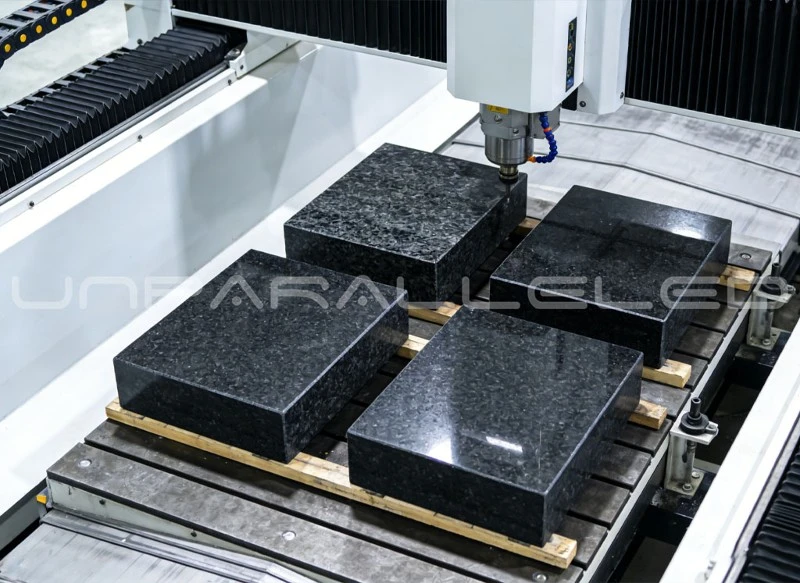
How UNPARALLELED® Selects and Verifies Its Black Granite
UNPARALLELED® uses only black granite for its precision components and does not substitute marble. Our UNPARALLELED® black granite has a density of about 3,100 kg/m³, and the material and every finished part can be checked against the five methods above.
Material: high-density black granite selected for stable physical properties and fine grain.
Standards: components are made to DIN 876, ASME B89.3.7, JIS B 7514 and GB/T 20043, and we can also work to GGG-P-463c on request.
Measurement: parts are inspected with Mahr dial indicators (0.5 µm resolution), WYLER electronic levels and Renishaw laser interferometers.
Traceability: our instruments carry calibration certificates from the Jinan and Shandong metrology institutes, traceable to the national metrology institute.
Quality systems: ISO 9001, ISO 14001, ISO 45001 and CE certified.
Scale: single granite components up to 100 tons, machined in a temperature- and humidity-controlled workshop.
Customers can request test reports, raw-block photos and manufacturing and inspection videos before they place an order.
Frequently Asked Questions
Can marble be used for a precision machine base? It is not recommended. Marble is softer, less stiff and more easily damaged by acids and coolants, so it is a poor reference surface for long-term accuracy.
Is all black stone granite? No. Dark colour can come from granite, marble, dyed stone or other rocks. Confirm the material with a test report rather than by appearance.
What density should precision granite have? Precision black granite is typically around 3,000 kg/m³ or higher. UNPARALLELED® black granite is about 3,100 kg/m³.
Can UNPARALLELED® make custom granite components? Yes. We produce custom granite bases, assemblies and air-bearing components to your drawings for CMM, laser, semiconductor and metrology equipment.
Get a Quote for Your Granite Components
Send your drawing, size, tolerance and quantity to info@unparalleled-group.com and our engineers will reply within 24 hours. You can also visit www.unparalleled-group.com to see our precision granite product range and request test reports and inspection videos.