



Large precision granite components are engineered structures, not simply cut stone. A granite machine base, metrology frame, air-bearing structure, or heavy granite assembly must support defined loads, interfaces, geometric requirements, and transport conditions while becoming a stable reference for the finished machine. This article explains the typical manufacturing logic for large precision granite components-from material selection through final delivery-and shows why early drawing review is essential for machine builders, semiconductor-equipment manufacturers, automation integrators, and metrology-system designers.
Why Precision Granite Is More Than Stone Processing
A large granite component may look simple in a general arrangement drawing: a base, plate, beam, column, bridge support, or machine frame. In practice, it can include dozens or hundreds of functional requirements. These may include precision reference surfaces, mounting holes, threaded inserts, dowel locations, rail seats, cable passages, air-bearing interfaces, assembly datums, lifting features, and protected transport surfaces.
The finished component may be used in a semiconductor inspection system, CMM, laser machine, industrial CT platform, optical inspection machine, precision CNC system, XY table, linear-motor platform, or a specialized automation assembly. In each application, the granite structure becomes part of the mechanical reference chain.
That is why large precision granite components manufacturing must be approached as a controlled engineering process rather than a conventional stone-cutting task. The material must be suitable for the intended application. The part geometry must be manufacturable. Functional surfaces must be accessible for machining and inspection. The component must be safely supported during processing, measurement, packaging, shipment, and installation.
Granite is widely used in precision machinery because it can offer useful rigidity, thermal stability, corrosion resistance, and vibration-damping characteristics when selected and processed appropriately. However, the final behavior of a machine depends on the total system: material, component geometry, support arrangement, motion system, assembly interfaces, environment, and verification method.
UNPARALLELED Group manufactures precision structures under the UNPARALLELED® brand. Our product scope includes Precision Granite, Precision Ceramic, Precision Metal, Precision Glass, Mineral Casting, UHPC Precision, Carbon Fiber Precision Beam/Bridge, and Precision 3D Printing. For each project, material and process selection should remain subject to drawing review and project requirements.
Stage 1: Material Selection and Project Review
The manufacturing process begins before CNC machining. It begins with confirming the drawing, intended application, material requirement, finished dimensions, functional surfaces, and inspection criteria.
For relevant precision-granite projects, UNPARALLELED® uses black granite with an approximate density of 3,100 kg/m³. Density can assist in estimating component weight and handling requirements, but it is only one part of material evaluation. The component's suitability also depends on the required geometry, wall thickness, cut-outs, inserts, loading arrangement, and finished machine function.
UNPARALLELED Group is headquartered in Jinan, China, with convenient access to Qingdao Port. The Group operates two manufacturing factories and a dedicated granite raw-material storage site, with a total land area of approximately 220,000 m². This infrastructure supports the management of raw material, large-part processing, precision finishing, assembly, inspection, and export planning.
During early project review, engineering teams should identify:
The component's application and operating environment
Critical reference surfaces and geometric relationships
Overall dimensions, estimated weight, and required quantity
Static loads, moving loads, support locations, and center of gravity
Inserts, holes, slots, rail interfaces, air-bearing features, and cable-routing needs
Required inspection reports, acceptance criteria, packaging conditions, and delivery destination
This review prevents common problems later in the project. For example, an insert pattern may require a certain wall thickness; a rail seat may need access for finishing and inspection; or a component may exceed practical transport limits after packaging is considered. These items should be resolved before production begins.
Stage 2: Structural Processing and Granite CNC Machining
After material and drawing requirements are reviewed, the component moves into structural processing. The purpose of this stage is to create the main geometry and prepare the component for later precision operations.
Large precision granite machining can involve sizing, squaring, creating pockets, drilling holes, producing channels, preparing mounting surfaces, and machining locations for inserts or assembly features. The available process route depends on the component dimensions, geometry, required tolerances, handling condition, and the relationship between critical features.
UNPARALLELED® can support individual component machining and handling of up to 100 tons, with maximum machining dimensions of up to 20 meters in length, 4,000 mm in width, and 1,000 mm in thickness. These capabilities must be assessed against each drawing. A component may be within the overall size range but still require additional review because of its weight distribution, machining access, lifting points, thin sections, deep pockets, or assembly sequence.
Granite CNC machining should also be planned around the later finishing process. If a surface will become a rail seat, precision datum, air-bearing way, or optical reference interface, the machining allowance, access, support method, and inspection approach should be considered in advance.
Large parts often require a defined handling strategy throughout processing. The location of lifting points, crane access, protective contact points, support blocks, and temporary fixtures can influence both safety and geometric stability. A large granite machine base should not be supported arbitrarily during machining or inspection; its support arrangement should reflect the design and verification plan.
Stage 3: Precision Grinding, Lapping, and Manual Finishing
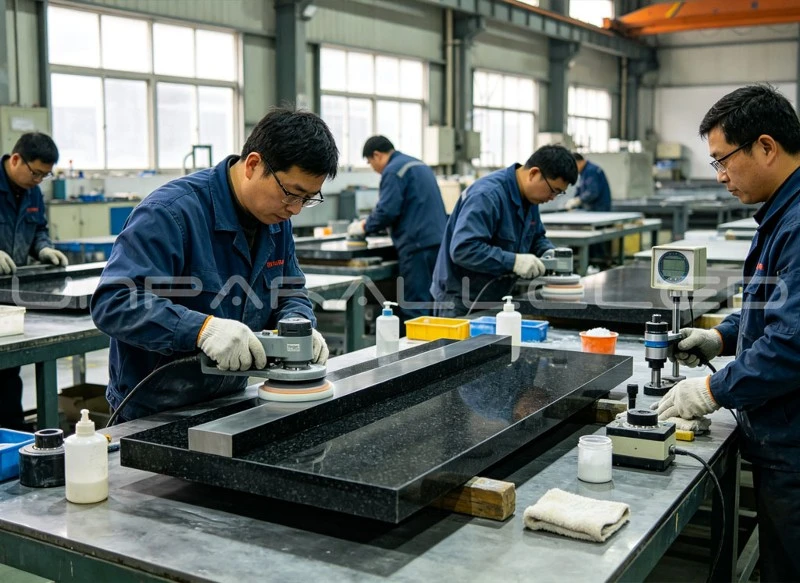
After structural processing, critical surfaces may require precision grinding, lapping, and manual finishing. These operations are not decorative polishing. They are controlled finishing processes used to achieve the required geometry, surface condition, and functional relationship between precision features.
A large granite component may include several types of functional surface:
A reference top surface for metrology or machine assembly
Parallel mounting surfaces for rails, stages, or fixtures
Perpendicular faces for columns, bridges, or side assemblies
Prepared interfaces for air bearings or precision motion components
Locations requiring accurate holes, inserts, dowels, or assembly alignment
The finishing sequence must consider how one surface relates to another. A flat surface alone is not enough if a mating rail seat, insert pattern, or perpendicular side face is not correctly related to the required datum system.
UNPARALLELED Group operates four ultra-large grinding machines that can support the grinding of metal and non-metal precision platforms up to 6,000 mm in length. The appropriate grinding or lapping route depends on the part's actual size, geometry, target requirements, and project-specific inspection plan.
Manual finishing may also be used where appropriate to refine specified surfaces and correct local geometric conditions. The level and sequence of manual work should not be assumed from the part's overall size; it is determined by the drawing, functional requirements, and quality plan.
Stage 4: Controlled Measurement and Component Inspection
Inspection is not only the final step. It should be planned from the beginning because it affects datum selection, handling, workshop conditions, instrument choice, reporting format, and acceptance criteria.
Large components can be sensitive to temperature differences, vibration, support-point placement, cleanliness, and the measurement method. A reliable inspection result requires a defined relationship between the drawing requirement, the measuring instrument, the inspection environment, and the way the component is supported.
UNPARALLELED Group operates a 10,000 m² temperature- and humidity-controlled workshop. The controlled workshop includes stable foundations, vibration-isolation features, quiet crane systems, and dedicated clean assembly areas. These conditions support applicable measurement, finishing, and assembly activities, particularly when the project requires controlled environmental conditions.
Measurement tools may include Mahr, Mitutoyo, WYLER, and Renishaw instruments. The correct method depends on what must be verified. A dimensional feature, a hole location, a flatness requirement, a straightness requirement, a parallel relationship, or an assembled interface may each require a different inspection approach.
A component-specific inspection plan may include:
Overall dimensions and critical cross-sections
Flatness, straightness, parallelism, perpendicularity, or other stated geometric requirements
Threaded insert, through-hole, dowel-hole, and counterbore verification
Rail-seat and assembly-interface inspection
Visual checks, surface-condition checks, and cleaning verification
Measuring-instrument calibration or traceability information where required
Packaging and shipment-release inspection
Results must always be interpreted according to the approved drawing, stated tolerance, component size, measurement method, environmental conditions, and agreed acceptance criteria. No single inspection instrument or isolated measurement should be assumed to represent the complete quality of a large granite assembly.
Stage 5: Assembly, Packaging, and Delivery Planning
For a heavy granite assembly, final delivery planning is an engineering activity. Packaging must protect precision surfaces, inserts, corners, edges, and interfaces during lifting, inland transport, port handling, container loading, ocean freight, unloading, and installation.
The customer and supplier should agree on responsibilities before production is completed. Questions to resolve include:
Will the product be delivered as a granite component, a pre-assembled structure, or a partially assembled system?
Which surfaces require protective covers, rust-prevention treatment for metal inserts, or special cleanliness protection?
Are lifting holes, lifting brackets, or dedicated handling fixtures required?
What are the crate dimensions, gross weight, center of gravity, and lifting instructions?
Can the finished package be safely transported to the customer's site and moved through the final installation route?
Does the destination require specific export documentation, packaging standards, fumigation treatment, container loading procedures, or site-delivery instructions?
The location of UNPARALLELED Group in Jinan, with convenient access to Qingdao Port, supports export logistics planning. However, transport feasibility, packaging method, shipping schedule, and destination-specific requirements must be evaluated separately for every project.
A heavy granite assembly should be protected against impact, vibration, moisture exposure, contamination, and uncontrolled support changes during transport. The final packing plan should also make installation easier by clearly marking lifting points, handling instructions, assembly orientation, and protected functional surfaces.
Information to Prepare Before Requesting a Quote
To support a meaningful engineering review and accurate quotation, customers should provide:
Current 2D drawings and, where available, 3D models with revision numbers
The intended machine application and the function of the granite component
Finished dimensions, estimated weight, quantity, and target delivery location
Required material specification and any required supporting documentation
Critical geometric requirements, including flatness, straightness, parallelism, perpendicularity, and hole locations
Insert types, thread specifications, hole details, rail interfaces, dowel features, channels, and cable-routing requirements
Static loads, dynamic loads, support-point arrangement, center-of-gravity information, and motion-system details
Required inspection method, reporting format, acceptance criteria, and calibration expectations
Cleanliness, assembly, packaging, lifting, shipping, and destination-site limitations
Requested delivery schedule, noting that feasibility and lead time remain subject to drawing review and project requirements
Conclusion
Large precision granite components manufacturing is a coordinated process of material control, structural processing, granite CNC machining, precision grinding, lapping, manual finishing, controlled inspection, assembly planning, and logistics preparation. It cannot be reduced to the simple cutting of a stone block.
The most effective projects begin with early engineering communication. When drawings, loading conditions, interfaces, tolerances, inspection requirements, and delivery constraints are understood before production, both customer and manufacturer can reduce risk and establish a realistic manufacturing route.
UNPARALLELED® follows the quality policy: "The precision business can never be too demanding." Large precision structures require exactly that level of disciplined planning.
Contact UNPARALLELED® with your drawings, dimensions, weight estimates, intended application, and required inspection criteria. Our engineering team can review manufacturability, handling requirements, process considerations, assembly interfaces, inspection planning, and delivery factors before production begins.