



In the semiconductor industry, equipment precision directly determines wafer yield, process stability, and long-term manufacturing reliability. From lithography systems to wafer inspection tools, the structural base of the machine plays a crucial role in ensuring vibration stability, thermal consistency, and structural rigidity.
Two materials dominate the market for high-precision equipment bases: precision granite components and mineral casting structures. Both offer excellent stability compared with traditional metal frames, but their characteristics differ significantly.
For engineers designing next-generation semiconductor platforms, choosing the right semiconductor base requires understanding the physical performance differences between these materials.
Below are five critical comparisons between granite and mineral casting that help semiconductor equipment manufacturers make the right material selection.
1. Vibration Damping Performance
Semiconductor equipment often operates in environments where micro-vibrations can affect nanometer-level positioning accuracy. Therefore, vibration damping is one of the most important parameters for base materials.
| Material | Damping Ratio | Performance |
|---|---|---|
| Precision Granite | ~0.8 – 1.5% | Moderate vibration absorption |
| Mineral Casting | ~5 – 10% | Excellent vibration suppression |
Mineral casting materials are composed of granite aggregates bonded with epoxy resin, creating a composite structure that absorbs vibrations far more effectively than solid stone.
This is why many modern wafer processing tools increasingly adopt mineral casting bases to improve motion control accuracy.
Key Insight:
Higher damping ratios significantly reduce resonance and micro-vibration interference in precision stages.
2. Thermal Stability and Expansion
Temperature fluctuations inside semiconductor fabs can lead to micron-level deformation, which directly impacts measurement accuracy and lithography alignment.
Typical thermal expansion coefficients:
| Material | Thermal Expansion Coefficient |
|---|---|
| Precision Granite | ~5.5 – 7.0 ×10⁻⁶ /K |
| Mineral Casting | ~8 – 12 ×10⁻⁶ /K |
Precision granite components provide excellent thermal stability, making them ideal for metrology equipment and coordinate measuring systems.
However, modern mineral casting systems can be engineered with optimized filler ratios to significantly improve thermal behavior.
Engineering Perspective:
Granite remains a benchmark for thermal stability, but advanced mineral casting formulations are rapidly narrowing the gap.
3. Structural Design Flexibility
One of the biggest mineral casting benefits lies in its ability to support complex structural designs.
Granite components are machined from solid blocks. While extremely stable, their shapes are limited by machining capabilities.
Mineral casting, on the other hand, is cast directly in molds, allowing engineers to integrate features such as:
Internal cooling channels
Embedded steel inserts
Cable routing cavities
Vibration isolation structures
This flexibility makes mineral casting particularly attractive for large semiconductor equipment platforms.
4. Weight and Structural Rigidity
The density of the base material affects both machine stability and transportation logistics.
| Material | Density |
|---|---|
| Precision Granite | ~2.7 g/cm³ |
| Mineral Casting | ~2.3 – 2.5 g/cm³ |
Mineral casting bases are typically 10–15% lighter, which can simplify installation and reduce structural load on fab floors.
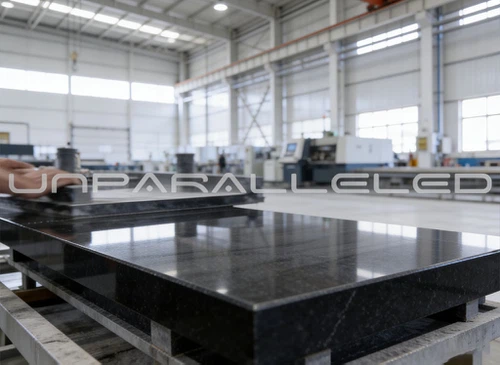
However, granite still offers exceptionally high compressive strength and rigidity, which remains critical for ultra-precision metrology platforms.
5. Manufacturing Efficiency and Customization
For semiconductor equipment manufacturers, time-to-market and customization capability are becoming increasingly important.
Granite bases require:
Quarry extraction
Precision grinding
Lapping processes
These steps can extend lead times.
Mineral casting bases allow near-net-shape manufacturing, reducing machining steps and enabling faster development cycles.
At Unparalleled Group, engineers specialize in custom mineral casting solutions and precision granite components tailored to semiconductor equipment manufacturers. From prototype structures to full-scale production platforms, both material technologies can be optimized for specific performance requirements.
Which Semiconductor Base Is Right for Your Equipment?
The answer depends on the application.
Choose precision granite components when:
Maximum thermal stability is required
Ultra-high geometric precision is critical
The structure is relatively simple
Choose mineral casting when:
High vibration damping is needed
Complex integrated structures are required
Weight reduction and modular design are priorities
In many advanced semiconductor systems, hybrid designs combining granite and mineral casting are becoming the optimal solution.
The Future of Semiconductor Equipment Structures
As semiconductor manufacturing pushes toward sub-nanometer precision, base materials must deliver better vibration control, structural integration, and thermal stability than ever before.
Innovations in mineral casting technology and precision granite engineering are enabling equipment manufacturers to build more stable, scalable, and efficient semiconductor platforms.
With decades of experience in precision engineering materials, Unparalleled Group supports semiconductor equipment developers worldwide with advanced semiconductor base solutions, including both mineral casting systems and precision granite components.
Conclusion
Choosing the right structural material is a critical step in semiconductor equipment design. By carefully evaluating vibration damping, thermal behavior, structural flexibility, weight, and manufacturing efficiency, engineers can select the optimal semiconductor base for their application.
Both granite and mineral casting offer unique advantages. Understanding their differences ensures the highest performance, stability, and yield in semiconductor manufacturing systems.