



The problem with granite measuring tools is not new, and it is not small. On a market where "granite" is a claim rather than a material, some suppliers pass off cheap marble as black granite, because marble is easier to quarry, easier to cut and far cheaper to buy. For the buyer the trap is simple: a marble plate and a granite plate can look almost identical under a coat of polish, and both will sit flat enough to pass a casual look - until the temperature moves or the tool is used as a reference for years. This guide explains how to tell them apart before you buy.
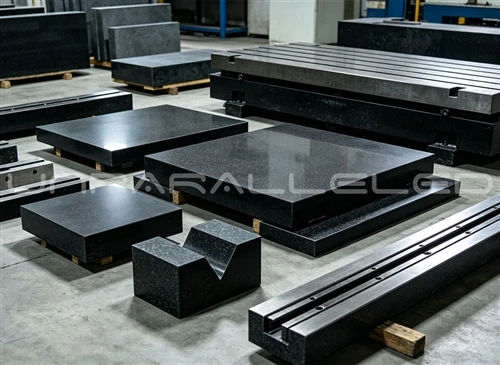
What is actually being sold as granite measuring tools
Honest suppliers use real black granite, a fine- to medium-grained igneous rock dominated by quartz and feldspar. The cheaper substitutes are marble, a metamorphosed limestone made mainly of calcite, and occasionally dark serpentine or dyed stone. Marble can be polished to the same mirror finish and ground just as flat, so a photograph tells you almost nothing. The difference shows up in the properties that matter to metrology, not in appearance.
Marble vs granite: the numbers that separate them
The two materials can be told apart with a short list of measurable properties. The table below sets out the ones that matter most for a measuring tool.
| Property | Black granite | Marble (sold as granite) |
|---|---|---|
| Density | About 2,900-3,100 kg/m³ | About 2,600-2,800 kg/m³ |
| Hardness (Mohs) | About 6-7 (quartz, feldspar) | About 3-4 (calcite) |
| Dilute acid | No reaction | Effervesces (fizzes) |
| Scratch on glass | Scratches the glass | Is scratched by the glass |
| Water absorption | Low (typically under 0.1%) | Higher and more porous |
| Thermal and wear stability | Low expansion, high abrasion resistance | Higher expansion, wears faster |
Why marble fails as a metrology reference
A surface plate or a straight edge is a reference, and a reference has to stay where it was set. Marble is soft: at about Mohs 3-4 it is scratched by ordinary glass, while granite is more than twice as hard at about Mohs 6-7, so a marble tool accumulates nicks and burrs that a granite one shrugs off. Marble is also more porous and absorbs more water and oil, and it reacts with mild acid, so a cleaning agent, a fingerprint or a humid workshop can leave a mark. Marble expands more with temperature, and it does so less uniformly, so a marble plate drifts and warps where a granite one holds its geometry. Over a long production life, a marble "granite" plate wears, stains and drifts out of tolerance far sooner.
Quick checks you can do in a minute
Three simple tests catch most fakes. First, the acid test: a drop of dilute acid - even household vinegar - fizzes on marble because it is calcite, and does nothing on granite; use it on an inconspicuous spot. Second, the hardness test: granite is harder than glass and marble is softer, so a clean corner of real granite will scratch a glass slide while marble will not. Third, the grain test: genuine black granite is a mix of mineral grains, with fine grey, black and white speckles across the face, while dyed or marble stone often shows a single flat colour or faint veining and can release dye on a damp cloth.
The paperwork test: certificates, standards and traceability
Real granite measuring tools ship with documents, and a fake rarely does. Expect a material description, a grade - for example ISO 8512-2 or DIN 876 for a surface plate - and an inspection report giving the measured flatness and, where required, straightness and parallelism, taken under controlled temperature and traceable to a national standard. If a supplier cannot name the rock or the standard, or the "certificate" is a generic sheet with no measured values, treat the claim with suspicion. Ask what the measured flatness is, in which grade, and which instrument proved it.
Price is a signal you should not ignore
Material is the floor under any honest price. Black granite is denser and more expensive than marble, and the grinding, lapping and hand-scraping that turn a block into a reference cost more than the rough stone. A price far below the market for a comparable size and grade usually means one of two things: the material is not what the label says, or the flatness was never verified. The cheapest way to buy a granite measuring tool is rarely the cheapest over the life of the tool.
How UNPARALLELED® controls the material before it is cut
The defence against this problem is control of the stone before it becomes a product. UNPARALLELED® selects black granite for density (about 3100 kg/m³), uniformity and internal soundness, stores and seasons it in a dedicated stone yard, and rejects blocks with hidden defects before any machining begins. Plates and rulers are then ground, lapped and hand-scraped, and inspected under stable temperature. This is slower and more expensive than buying cheap stone, and it is the reason a UNPARALLELED® granite surface plate is what the drawing and the standard say it is.
How to buy granite measuring tools you can trust
Whether you are buying a single granite surface plate for a toolroom or a full set of granite measuring tools for a calibration lab, the checks above will separate real granite from marble in disguise. Ask for the material, the grade, the measured flatness and the traceability, and buy from a supplier who will put those numbers on paper. UNPARALLELED® supplies the granite surface plate and the wider family of granite measuring instruments in verified black granite, each with inspection data to match its grade. Send us the size, the grade and the standard, and we will return a tool whose certificate is worth as much as the stone it is cut from.