



Many precision machining workshops cannot maintain a constant temperature. Equipment heats up continuously during daytime operation and cools rapidly at night after shutdown, accompanied by wide temperature swings across seasons. Temperature fluctuations trigger thermal expansion and contraction of machine structures, directly altering the geometric dimensions of the bed, shifting machining coordinates and resulting in out-of-tolerance workpiece dimensions. Many equipment manufacturers wonder during the selection phase: how does the dimensional stability of mineral casting beds perform under working conditions with obvious temperature fluctuations, and will significant deformation occur? Featuring a unique composite formula and monolithic casting process, UNPARALLELED® mineral casting beds effectively suppress dimensional drift caused by temperature variations.
Mineral casting is made of natural mineral aggregates and cured epoxy resin. Its coefficient of thermal expansion is far lower than traditional metal beds such as cast iron and steel. Metallic materials expand substantially when heated; minor temperature changes stretch or shrink the overall structure and shift reference positions. In contrast, mineral aggregates feature stable crystals. The resin matrix tightly encapsulates countless aggregate particles, forming an integral structure less sensitive to temperature shifts. When workshop temperatures rise or fall, the bed undergoes minimal expansion or contraction, without obvious dimensional changes seen in metal beds under temperature differences.
However, mineral casting should not be regarded as completely immune to temperature impacts. All solid materials expand and contract to a certain extent with temperature changes. Mineral casting merely delivers smaller deformation, not zero deformation. In case of abrupt temperature shocks in the workshop, such as cold air blowing directly onto the bed or concentrated local heat sources, temperature gradients will form across different bed zones and still induce localized thermal deformation. During casting, UNPARALLELED ensures uniform aggregate distribution inside, lowers internal material stress and reduces uneven deformation triggered by partial temperature differences. Its dimensional stability advantages are fully demonstrated under slow, wide-range ambient temperature fluctuations.
In practical production, temperature-induced errors often accumulate over time. For precision grinders, high-speed machining centers and special inspection equipment, repeated day-night and morning-evening temperature differences cause continuous expansion and contraction of metal beds, constantly shifting the mounting reference of guideways. Frequent coordinate compensation is required, increasing debugging workload. Mineral casting beds reduce coordinate drift brought by such cyclic deformation, ease thermal compensation pressure on machine tools, deliver better workpiece dimensional consistency during long-duration machining and cut scrap rates.
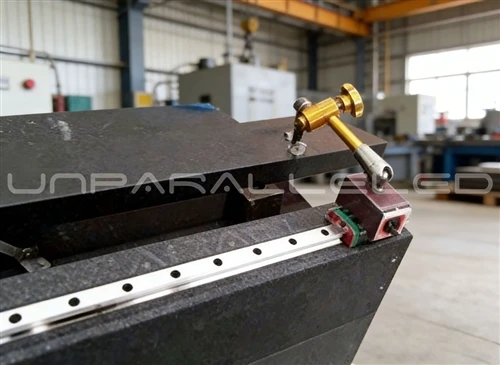
Beyond material selection, the overall machine structural design is equally critical. Even when low-expansion mineral casting beds are adopted, improperly arranged heat sources such as motors and spindles that concentrate heat on local bed areas will still induce deformation via partial temperature differences. The value of mineral casting lies in reducing overall thermal expansion and mitigating dimensional variations caused by ambient temperature swings on the premise of rational overall machine design, rather than fully blocking thermal effects.
For metrology laboratories and enterprises manufacturing precision components, constant-temperature workshops come with high renovation costs. Many factories only implement simple temperature control and inevitably face temperature fluctuations. UNPARALLELED® mineral casting beds are better suited for such non-constant-temperature workshops. They minimize dimensional changes induced by temperature differences, reduce workpiece rejection due to thermal drift and cut man-hours spent on repeated equipment calibration and commissioning. They are a premium choice for precision machine tool beds in workshops with large temperature variations.