



During the assembly of precision inspection platforms, coordinate measuring machines, semiconductor production equipment and laser processing machines, support pads undertake key functions including reference positioning, load‑bearing and leveling for complete equipment. Currently the market mainly offers two options: metal pads and granite support blocks. Many purchasers tend to choose metal pads out of habit for their high mechanical strength and convenient machining, yet they overlook accuracy losses caused by temperature variation, vibration and stress deformation under ultra‑precision conditions. For micron‑ and nanometer‑level applications, the inherent material properties often matter more than simple mechanical strength. Drawing on abundant domestic and overseas project practices, UNPARALLELED Group compares practical performance of the two types of pads and analyzes the core competitive advantages of granite support blocks for high‑end precision manufacturing.
Difference in thermal expansion stands as the most essential dividing line between granite and metal pads. Metals such as steel and aluminum alloy feature high thermal expansion coefficients. Slight temperature fluctuation in workshops will trigger expansion and contraction of metal pads, directly shifting equipment bases and leading to measurement drift. Especially under working conditions with large day‑night temperature differences or continuous heat generation from long‑hour equipment operation, metal pads keep changing dimensions with temperature, which calls for frequent re‑calibration and consumes substantial manpower and working hours. UNPARALLELED® black granite substrate boasts an extremely low thermal expansion coefficient. Dimensional change induced by temperature shift is minimal. It maintains stable reference dimensions even with certain workshop temperature fluctuations, greatly reducing repeated equipment calibration and suiting 24/7 non‑stop semiconductor and optical inspection production lines.
Vibration‑suppression performance directly determines resolution and repeatability of precision equipment. Metal pads have high hardness yet weak damping capacity. Ground‑borne vibration and vibration from surrounding machinery transmit directly to the whole unit, and tiny vibrations get amplified in inspection results. By contrast, dense granite features interwoven internal crystal structures and excellent vibration‑damping properties. It rapidly absorbs and dissipates external vibration energy and mitigates disturbance to equipment references. For highly vibration‑sensitive equipment such as femtosecond‑laser machines, industrial CT and AOI optical inspection systems, granite support blocks create a quieter and more stable reference environment, which ordinary metal pads can hardly achieve.
Remarkable gaps exist in stress aging and long‑term dimensional stability. After CNC cutting, metal pads retain residual machining stress inside. Stress releases gradually over time, causing distortion and warpage. Even if accuracy passes factory inspection, geometric performance degrades months after commissioning. High‑quality granite blanks undergo sufficient static aging in stone yards to eliminate internal stone stress before fine machining in constant‑temperature workshops. Supported by the factory's Class‑10000 constant‑temperature & constant‑humidity workshop and seasoned lapping craftsmen, finished granite support blocks feature stable stress status, resist aging deformation in long‑term service and sustain reference accuracy for a long time. Metal pads also suffer rust risks. They oxidize and rust under workshop coolant and moisture conditions; rust layers alter actual pad thickness and tilt equipment. Granite is rust‑free and non‑magnetic, resistant to cutting fluid and coolant erosion. It requires simple later‑stage maintenance with no anti‑rust coating needed. 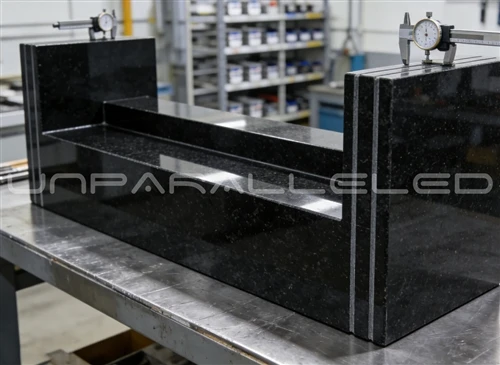
Admittedly, metal pads have their own applicable scenarios. They fit general‑purpose mechanical tooling and heavy‑duty rough‑processing equipment, but are not suitable for ultra‑precision metrology and optical‑semiconductor machinery. Apart from material itself, metrological traceability of products cannot be ignored. Geometric accuracy of granite support blocks shall be inspected with a full suite of imported metrological instruments including laser interferometers, electronic levels and roughness testers. All instruments hold calibration certificates issued by legal metrology institutes and measurement results are traceable to national metrological standards. Granite support blocks manufactured by UNPARALLELED comply with DIN, ASME, JIS, GB and other international standards to meet project requirements for customers from different countries.
Do not judge merely by unit price during selection; evaluate total life‑cycle costs comprehensively. Metal pads may have lower procurement prices, yet frequent calibration, product rejection caused by accuracy drift and downtime for commissioning generate high hidden costs. Many customers initially adopt metal pads and later switch to granite support blocks due to unstable accuracy.
As an original manufacturer of ultra‑precision components holding ISO three‑system certifications and CE certification together with more than 20 international trademarks and patents, UNPARALLELED Group owns a 200,000 ㎡ production plant and large‑scale stone storage yard with processing capacity for heavy‑duty and large‑size granite components. Its products serve Fortune Global 500 enterprises, multiple national metrology institutes and top universities worldwide. Beyond granite products, the enterprise supplies various ultra‑precision components including precision ceramics, mineral castings, UHPC, carbon‑fiber beams and precision 3D‑printed parts. Facing diverse working conditions, the company adheres to its customer commitment of no deception and no concealment, provides objective material‑selection suggestions based on on‑site conditions and helps customers select proper reference load‑bearing components for their equipment, empowering high‑quality development of global ultra‑precision manufacturing.