



I. Three Pre-Inspection Fundamentals: Eliminating "Environment & Support" False Errors
Before an electronic level even touches the surface of a granite plate, up to 80% of measurement errors have already been introduced through environmental factors and physical setup.
1. Thermal Equilibrium (Soaking Time) & Microclimate Control
UNPARALLELED® black granite possesses an ultra-high density of $\approx 3100\text{ kg/m}^3$ and exceptional thermal inertia. Although its resistance to sudden temperature spikes is far superior to standard marble or metals, strict stabilization protocols must still be followed prior to nanometer-level flatness testing:
Complete Thermal Equilibrium: The surface plate and electronic level must be soaked in a constant temperature and humidity, dust-free workshop at $20^\circ\text{C} \pm 0.5^\circ\text{C}$ for a sufficient duration.
Avoiding Micro-Air Currents: The sensors on electronic levels are extremely sensitive. Radiated body heat (such as gripping the sensor head with bare hands) or operator airflow from breathing can cause bubble or electronic reading drift.
Tip: Always wear thermal insulation gloves during operation and install a shielding cup over the level.
2. Classical "Three-Point Support" Mechanical Stress Relief
Granite surface plates undergo microscopic deflection under their own weight.
During inspection, three primary support points must be strictly set according to Airy Points or Bessel Points, with an additional two auxiliary points used to prevent tipping.
Eliminating Stress Constraints: If multiple points are rigidly locked down, internal stresses within the plate cannot be freely released. The electronic level will then measure a surface distorted by external forces rather than the granite's natural flatness.
II. Practical Surveying Techniques: From "Bridge Selection" to "Matrix Mapping"
Measuring flatness with an electronic level essentially involves determining consecutive tilt angles arranged at a specific step length, then using integration to convert these into relative height differences. 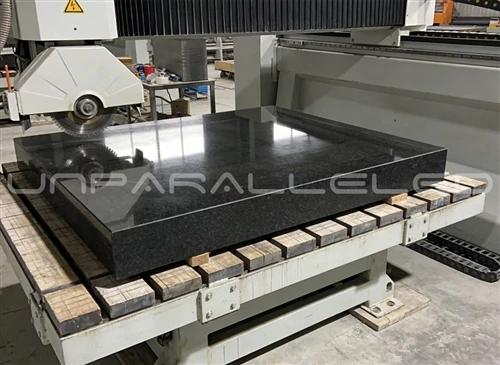
1. Golden Rule for Bridge Base Step Length Selection
The bridge step length directly determines the spatial sampling resolution:
Step length too large: Omits high-frequency microscopic surface waviness.
Step length too small: Increases accumulated calculation errors and drastically reduces inspection efficiency.
UNPARALLELED Recommended Standard: Divide the main diagonal into 8 to 12 equal intervals based on the surface plate size to determine the bridge step length. For plates $1000\text{ mm} \times 1000\text{ mm}$ and larger, a bridge step length between $100\text{ mm}$ and $200\text{ mm}$ is recommended.
2. Combining the Moody Method and Grid Method
When inspecting ultra-high-precision reference plates (such as Grade 00 or Grade 000), relying solely on diagonal Moody lines often misses edge settlement.
Cross-Closure Verification: When using the Grid Method, the start and end points of every line must undergo data calibration at closure nodes. If the closure error exceeds tolerance, it indicates temperature drift or floor vibration interference during measurement.
III. UNPARALLELED® Unique Mastery: Cross-Verification Between Electronic Levels and Master Craftsmen
In UNPARALLELED's $10,000\text{ m}^2$ constant temperature and humidity facility-equipped with a $1,000\text{ mm}$ thick ultra-hard concrete foundation and a $2,000\text{ mm}$ deep anti-vibration trench-instrumentation and human expertise achieve seamless synergy.
"Without understanding the stone, data is merely cold numbers."
UNPARALLELED's master technicians bring over 30 years of hand-lapping experience, earning them the reputation of "living electronic levels." Their muscle memory detects micro-level surface variations-a single lapping stroke tells them precisely how many micrometers were removed.
When lapping and correcting granite plate flatness, the ultimate technique is: "Electronic instruments define the macro-quantity, master hands refine the micro-detail."
Macro Alignment: A WYLER electronic level paired with software generates a 3D topology map to rapidly pinpoint high spots and depressions.
Micro Correction: Lapping masters utilize the gradient maps from the electronic level, relying on tactile feel and specialized lapping tools to make localized micrometer- or even nanometer-scale corrections.
Eliminating "False Flatness": Some marble or lower-density granite may show stable electronic level readings after lapping, yet reveal microscopic burrs when re-checked with high-precision inductive micrometers ($0.1\text{ }\mu\text{m}$) or dial indicators (such as Mahr $0.5\text{ }\mu\text{m}$). UNPARALLELED utilizes dense black granite ($\approx 3100\text{ kg/m}^3$) with a highly uniform structure, ensuring that ultra-high flatness measured by electronic levels is faithfully preserved.
IV. Data Traceability & International Standard Alignment
How data is processed after electronic level surveying directly impacts the authority of evaluation results:
Minimum Zone Evaluation (MZE) vs. Least Squares Method (LSM):
When benchmarking against German DIN 876 or US ASME/GGG-P-463C-78 standards, algorithm switching must be noted. ISO and GB standards specify the Minimum Zone Evaluation (adhering to the minimum condition principle) for assessing flatness error. This method yields values closest to physical reality and prevents "smoothing algorithms" from masking localized out-of-tolerance spots.
Data Traceability:
All UNPARALLELED calibration and inspection equipment (including laser interferometers, electronic levels, and dial indicators) undergoes regular calibration by the Jinan Institute of Metrology and the Shandong Institute of Metrology. Data is fully traceable to the National Institute of Metrology (NIM) and the International Bureau of Weights and Measures (BIPM), ensuring full acceptance and compliance for global client deliveries across Europe, North America, and Southeast Asia.
Conclusion
In precision engineering, no standard is overly demanding.
An electronic level is far more than a sensor reading digits-it serves as the metrology team's window into the microscopic world of granite. From the premium physical properties of UNPARALLELED® black granite to $1000\text{ mm}$ military-grade anti-vibration foundations, down to the temperature of a master craftsman's hand, UNPARALLELED integrates cutting-edge sensor technology with artisan craftsmanship.