



In the rapidly evolving landscape of industrial manufacturing and quality assurance, precision and accuracy have become more critical than ever. As industries push the boundaries of technology, the demand for reliable measurement tools that guarantee the highest levels of accuracy has surged. Among these tools, precision granite surface plates have emerged as indispensable components in metrology laboratories and high-precision manufacturing environments. These plates serve as the foundation for a wide range of measurement tasks, ensuring that machinery, components, and instruments meet exacting standards.
Granite surface plates are meticulously engineered platforms made from natural or synthetic granite, known for their exceptional stability, hardness, and wear resistance. Unlike metallic surfaces, granite exhibits minimal thermal expansion and vibration sensitivity, making it ideal for precision measurements. This inherent stability ensures that readings taken on granite surfaces are consistent and reliable, even in environments subject to temperature fluctuations and mechanical stress. In industries where tolerances are measured in microns, this level of stability is non-negotiable.
The primary role of a precision granite surface plate is to provide a perfectly flat reference plane. Measurement accuracy begins with the assumption that the reference surface itself is flawless. Even the slightest deviation in flatness can result in cumulative errors that compromise the quality of manufactured parts. Modern granite surface plates undergo rigorous grinding and lapping processes to achieve flatness tolerances that conform to international standards, such as the ISO 8031 and ASME B89.3.7. These standards define acceptable deviations based on plate size and intended usage, ensuring uniformity across metrology laboratories worldwide.
In addition to flatness, granite surface plates are valued for their resistance to wear and deformation. Unlike metal plates, which may dent, warp, or corrode over time, granite maintains its structural integrity even under repeated use. This durability translates to long-term cost savings, as granite plates require minimal recalibration and maintenance compared to other materials. Furthermore, granite's non-magnetic properties prevent interference with sensitive measuring instruments, making it suitable for electronics and semiconductor industries where precision is paramount.
Environmental factors play a significant role in measurement accuracy. Temperature changes, humidity, and vibrations can introduce errors if the measuring surface is unstable. Granite surface plates offer a natural solution to these challenges. Their high density and low coefficient of thermal expansion reduce dimensional changes caused by temperature fluctuations, while their rigidity dampens vibrations that could affect delicate measurements. For laboratories working in climate-controlled conditions, granite plates provide a stable foundation that enhances repeatability and traceability of measurements.
The versatility of granite surface plates extends beyond flatness verification. They are widely used in conjunction with precision instruments such as height gauges, dial indicators, and coordinate measuring machines (CMMs). These combinations enable highly accurate inspection of components, from simple machined parts to complex aerospace assemblies. Industries such as automotive, aerospace, electronics, and medical device manufacturing rely heavily on granite surface plates to ensure product quality and compliance with strict regulatory standards.
Quality assurance protocols often dictate regular calibration and certification of surface plates to maintain measurement reliability. Certified granite plates are usually accompanied by calibration reports, indicating compliance with international standards. This certification process involves sophisticated measuring techniques, including electronic levels and laser interferometry, to detect minute deviations from flatness. By maintaining certified reference surfaces, organizations can establish traceable measurement systems, reduce production errors, and enhance overall process efficiency.
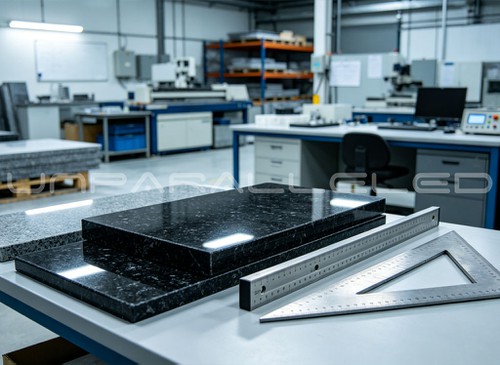
Recent advancements in granite surface plate technology have focused on enhancing performance, durability, and usability. Composite granites and engineered materials have been developed to further improve hardness, reduce thermal expansion, and resist chemical corrosion. Surface treatments and coatings enhance scratch resistance and extend the lifespan of plates in high-use environments. Additionally, modular designs allow for easy transportation, installation, and integration with other metrology equipment, making granite surface plates more adaptable to modern industrial needs.
In today's data-driven manufacturing ecosystem, precision measurement is not limited to standalone inspections. Digital measurement systems and automated inspection setups often rely on granite surfaces as a stable base for sensors, probes, and imaging equipment. By combining traditional granite plates with advanced metrology technologies, manufacturers can achieve high-throughput, high-accuracy inspections that support lean manufacturing and quality control initiatives. The synergy of traditional materials and modern technology exemplifies the ongoing relevance of granite in precision measurement.
Investing in precision granite surface plates is not merely a choice for better measurement-it is a strategic decision that directly impacts product quality, regulatory compliance, and operational efficiency. High-precision industries recognize that accurate measurements underpin the entire production process. Even minor deviations can lead to assembly failures, increased waste, and financial losses. By establishing a reliable measurement foundation with granite surface plates, organizations minimize risk, ensure repeatable results, and maintain competitive advantages in increasingly demanding markets.
In conclusion, precision granite surface plates are fundamental to achieving the highest standards in industrial measurement. Their inherent stability, resistance to wear, and exceptional flatness make them an irreplaceable tool in metrology laboratories and manufacturing facilities. As industries continue to demand tighter tolerances and greater measurement accuracy, the role of granite surface plates will only grow in importance. By combining material science, engineering precision, and calibration rigor, these plates provide the foundation for reliable, traceable, and accurate measurements that are essential to modern industry.
For companies committed to quality, efficiency, and innovation, granite surface plates are not just tools-they are a strategic investment that ensures long-term measurement integrity and operational excellence.