



Many equipment maintenance staff will raise a concern during the selection phase: whether the later maintenance of granite mechanical parts is complicated, and whether much time, special consumables and professional personnel are required for continuous upkeep. Compared with metal bases that demand regular rust removal and protective coating spraying, precision granite components have a lower maintenance threshold with simple overall maintenance procedures. The core goal is to protect the ultra-precision lapped reference working surface, prevent scratches caused by foreign particles and long-term adhesion of contaminants, and preserve the original micron and nanometer-level accuracy.
Granite boasts stable chemical properties. It will not rust, nor produce particles from oxidative peeling as metal parts do. There is no need for regular anti-rust oil application. Nevertheless, it belongs to brittle stone. Although the lapped reference surface has high hardness, it cannot withstand rolling by hard particles or impacts from hard objects. Maintenance focuses not on chemical protection of the stone itself, but on environmental control and surface cleaning to avoid precision damage brought by external impurities.
Daily cleaning should follow the principle from mild to simple. For regular dust removal, use lint-free dust-free cloths and wipe gently in one consistent direction. Avoid repeated back-and-forth rubbing, which may trap fine grit on the cloth and leave scratches on the worktable. For light oil stains and minor cutting fluid residues, use neutral dedicated detergent. Dilute it, moisten the dust-free cloth for gentle wiping, then immediately wipe off residual reagent with a clean damp dust-free cloth, and finally absorb moisture with a dry cloth. Strong acid or alkaline cleaners are forbidden. Repeated long-term contact with such chemicals will slowly corrode the stone grain boundary and damage the micro-morphology of the reference surface. It is also not recommended to spray detergent directly onto the granite tabletop, to prevent liquid from seeping into the bottom of components along assembly gaps.
For stubborn firmly attached contaminants, never forcibly scrape them with blades, hard scrapers or steel wool, as these can easily scratch the precision lapped surface. The softening method by soaking is applicable: place dust-free cotton pads soaked with neutral cleaning liquid on stains and leave for a period. Wipe softly after contaminants soften. After cleaning, confirm the tabletop is fully dry, then cover it with a matched dust-proof cover to reduce continuous dust accumulation.
Besides surface cleaning, there are several routine maintenance points. During regular inspections, check the surrounding area of the worktable, and timely remove metal debris and abrasive particles accumulated inside guide rails, mounting holes and T-slots. Such hard particles are the main culprit scratching reference surfaces. Watch out for condensed water in the workshop and avoid long-term ponding on the tabletop. Although granite has ultra-low water absorption, prolonged standing water may seep into assembly gaps and affect matched metal fasteners. When moving or overhauling surrounding parts, handle tools and tooling gently to prevent falling objects from hitting granite components and chipping edges.
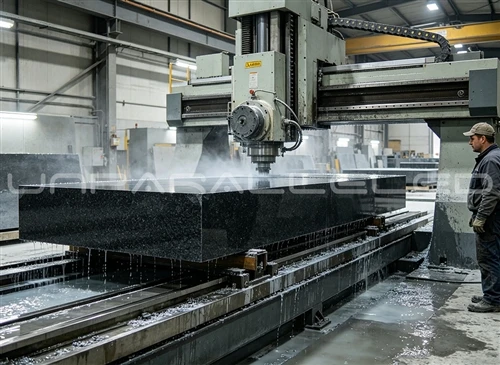
For equipment shut down for long-term storage, maintenance is even simpler. Thoroughly clean the reference surface, cover with a dust-proof protective plate after drying, and keep the workshop ventilated and dehumidified to reduce dust accumulation and condensation. There is no need to apply grease, protective paint or other coatings. Before reactivation, simply clean and recheck flatness, skipping complex procedures such as re-polishing and recoating required for metal parts.
It is worth noting that simplicity does not mean zero maintenance. The difficulty of granite part maintenance lies not in complicated operations, but in sticking to the principle of gentle operation, hard object prevention and environment control. If protection is neglected for a long time, continuous accumulation of hard particles and frequent collisions will still cause permanent damage to the reference surface. As long as basic inspection and cleaning specifications are established, daily maintenance workload will be far less than that of precision metal bases.
Overall, granite mechanical parts feature simple daily maintenance and low maintenance costs, without tedious work such as rust removal and regular protective coating application. The whole set of cleaning and maintenance operations mainly includes dust-free wiping, softened contaminant removal, dust-proof protection and impact avoidance. Proper basic protection can preserve the original accuracy of granite reference surfaces for a long time, reduce equipment downtime for maintenance, and fit the operation and maintenance requirements of semiconductor, precision inspection and laser production lines.