



1. Design Philosophy of T-Slot Granite Plates: Coordination Between Reference Surface and Mounting Slots
Many customers worry that machining T-slots on granite will compromise plate stability. The granite slab undergoes full stress relief before slotting. With rational slot layout and proper cross-section design, the overall flatness will not be impaired.
T-slots are not randomly cut. During design, plate thickness, slot quantity and positions are comprehensively evaluated. Slots are arranged away from the core measuring zone of the plate to keep the effective reference surface intact. Slot walls are finely ground to ensure smooth sliding of T-bolts without jamming. Slot edges are passivated to eliminate stress concentration at sharp corners and reduce chipping risks during operation. The whole plate acts both as a high-precision measurement benchmark and a fixture mounting base, eliminating the need for an extra installation platform.
2. Fast Fixture & Gauge Mounting to Resolve Traditional Clamping Pain Points
Traditional inspection stations have obvious drawbacks. When switching product batches, clamp positions need repeated adjustment, and locking tends to shift workpieces. If multiple gauges are placed simultaneously, maintaining a unified reference becomes difficult. Temporary supports introduce cumulative errors and hurt measurement repeatability.
On T-slot granite plates, T-bolts slide directly into the channels. Fixtures, positioning blocks and gauge bases can be quickly tightened via pressure plates. Loosening the bolts allows free translation and repositioning, with no need for repeated drilling or custom base fabrication. Multiple sets of gauges can be pre-fixed on the plate according to layout plans. For product changeover, users only need to switch probes or adjust limit stops, greatly shortening station changeover time. Meanwhile, clamping force is evenly distributed across the granite body. Compared with single-point clamps, it reduces displacement caused by fixture overturning.
3. Suitable Application Scenarios for T-Slot Granite Plates
Sampling inspection stations for multi-process components: Frequent fixture replacement for low-volume, high-variety testing to boost changeover efficiency.
Gauge comparison and calibration stations: Multiple gauges placed on the same reference plane for mutual comparison to guarantee consistent benchmark.
Auxiliary measurement platform for CMM: Used as an external reference base to hold complex workpieces and special jigs for probe data acquisition.
Assembly and commissioning stations: Precision component assembly and pre-adjustment, enabling positioning and measurement on one shared reference.
For pure metrology room reference transfer, large-area slotting is not recommended. Slots reduce available reference area. Standard unslotted granite surface plates are preferred to maintain the highest flatness grade.
4. Operation & Maintenance Tips to Extend Plate Precision Life
Control bolt tightening torque: Granite is brittle. Over-tightening T-bolts may crack slot openings or trigger stress deformation on the plate and degrade flatness. Torque wrenches are suggested for standardized tightening.
Slot cleaning: Metal chips and grit easily accumulate inside T-slots and scratch slot walls when bolts slide. Clear debris inside slots after each fixture assembly and disassembly to avoid abrasive wear.
Prevent heavy impact: When hoisting fixtures into place, avoid hard bases striking the working surface and slot edges to prevent chipping.
Periodic flatness re-verification: Despite granite's excellent stability, repeated clamping stress over long-term use requires regular metrology inspection to verify reference surface accuracy.
5. Key Selection & Customization Points
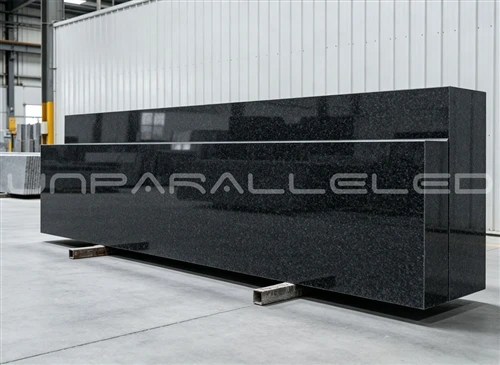
When placing orders, slot quantity alone is insufficient. It is necessary to define working surface accuracy grade, T-slot specifications (width, pitch), slot orientation and whether local sealing treatment is required. UNPARALLELED Group plans T-slot layouts according to customers' fixture base dimensions, balancing reference area and clamping points. Slabs receive secondary stress relief, and re-grinding of the flat surface is carried out after slot machining to ensure finished flatness meets tolerance requirements.
Conclusion
The core advantage of granite surface plates with T-slots lies in integrating precision measurement reference and fixture mounting structures. It retains granite's stable, low-deformation properties and enables fast positioning and locking of fixtures and gauges through T-slot channels. It addresses the drawbacks of tedious clamping and slow product changeover on conventional plates. It does not replace standard metrology plates, but serves as a dedicated benchmark solution for on-site inspection stations. UNPARALLELED Group delivers customized T-slot granite surface plates with balanced accuracy, rigidity and clamping convenience for precision component inspection and gauge commissioning stations.