



A good granite base for semiconductor or laser equipment is defined by seven things: precise geometry, thermal stability, damping and stiffness, well-made inserts, a suitable air-bearing surface, cleanliness, and correct support. Missing any one of them can show up later as drift, noise or a failed alignment.
This guide explains each requirement in plain terms and ends with a drawing checklist you can use when you ask a supplier for a quote.
Why These Tools Are Built on Granite
Semiconductor inspection, wafer handling and laser processing machines all move a tool or a part by micrometres or less, so the base must not move on its own. Granite suits this work because it is dense, stiff, non-magnetic and does not rust, and because it holds its shape after machining with no internal stress to release.
Laser processing adds another demand: the beam path stays aligned only if the base resists vibration and temperature change. Semiconductor tools add a cleanliness demand, since particles and magnetic fields can damage the process.
The seven requirements below turn those needs into points you can put on a drawing.
Requirements 1 to 4: Geometry, Heat, Vibration and Fixings
1. Precise geometry of the mounting surfaces
Rails, linear motors, air bearings and optical modules all reference the granite, so the flatness, parallelism, perpendicularity and straightness of each mounting surface go straight into machine accuracy. Specify tolerances per surface and name the datum surface, rather than quoting one general tolerance for the whole part.
2. Thermal stability
Granite has a low and uniform coefficient of thermal expansion, roughly 5 to 8 × 10⁻⁶ per kelvin, and it conducts heat slowly. That means it reacts slowly to room temperature changes, but it also needs time to settle. Keep heat sources such as motors and amplifiers away from the base, and keep the design symmetrical so that small temperature differences do not bend it.
3. Damping and stiffness
A stiff, massive base keeps the structure's natural frequency high and absorbs vibration from motors and the floor. Weight is an advantage here, but it must be balanced against handling limits and the load the isolation system can carry. Cut-outs, pockets and thin walls reduce stiffness, so keep them away from highly loaded areas.
4. Inserts, threaded holes and through holes
Granite cannot be tapped like metal, so threaded holes use bonded inserts, usually stainless steel. Specify the thread size, position tolerance, depth and pull-out load for each insert. Keep inserts a safe distance from edges and from each other, and state the maximum tightening torque so that assembly does not crack the stone.
Requirements 5 to 7: Air Bearings, Cleanliness and Support
5. A suitable air-bearing surface
An air bearing floats on a film of air only a few micrometres thick, so the granite surface must be very flat, smooth and free of pores or chips that disturb the air film. Ask the supplier to state the flatness, surface roughness (Ra) and the inspection method for every bearing surface, and to describe how pores and edges are controlled.
6. Cleanliness and non-magnetic behaviour
Semiconductor tools are sensitive to particles and magnetic fields. Granite is non-magnetic and does not rust, but its surface and inserts still need a cleaning and sealing plan. Ask how the part is cleaned after machining, how it is packed, and whether final assembly is done in a controlled-environment room.
7. Correct support, handling and transport
A large granite base bends under its own weight, so the support points define its final shape. Specify where the base will sit, how many support points it will have, and where lifting points go. Transport and installation can crack or shift a precision part, so the packing method, lifting equipment and shock protection should be part of the order.
Drawing Checklist: What to Specify
Give your supplier the items in the right-hand column and the quotation will be faster and more accurate.
|
Requirement |
What to put on the drawing or order |
|---|---|
|
Geometry |
Datum surfaces, flatness, parallelism, perpendicularity and straightness per surface, in µm |
|
Thermal stability |
Operating temperature range, nearby heat sources, symmetry requirements |
|
Damping and stiffness |
Moving mass, load on each area, vibration isolation system, any cut-outs |
|
Inserts and holes |
Thread size, position tolerance, depth, pull-out load, maximum torque, insert material |
|
Air-bearing surfaces |
Flatness, roughness Ra, pore and edge condition, inspection method |
|
Cleanliness |
Cleaning method, packaging, cleanroom assembly, non-magnetic inserts |
|
Support and handling |
Support points, lifting points, weight limit, packing and shipping method |
|
Inspection and certificates |
Standards, instruments, calibration traceability, report format |
If you are unsure about a value, say so and ask the supplier's engineers to propose one. A good supplier will review the drawing and point out features that are costly or risky before production starts.
Example: Specifying a Base for an Optical Inspection Stage
The example below is illustrative only and shows how the checklist turns into a clear specification. Real values depend on your machine.
|
Item |
Example specification |
|---|---|
|
Part |
Granite base with a bridge, for an XY inspection stage |
|
Datum |
Top surface A, with the rail-seat surfaces referenced to A |
|
Flatness of rail seats |
2 µm over the full length |
|
Parallelism of the two rail seats |
3 µm |
|
Air-bearing surface |
Flatness 1 µm, Ra 0.2 µm |
|
Inserts |
Stainless steel, M6 and M8, position tolerance ± 0.05 mm, pull-out load stated |
|
Support |
Three points under the base, with positions marked on the drawing |
|
Environment |
20 °C ± 1 °C, assembled in a clean workshop |
|
Inspection |
Flatness by electronic level and laser interferometer, report with serial number |
Writing the specification this way lets the supplier check feasibility at once and avoids rework after the first sample.
How UNPARALLELED® Builds Granite Bases for Semiconductor and Laser Equipment
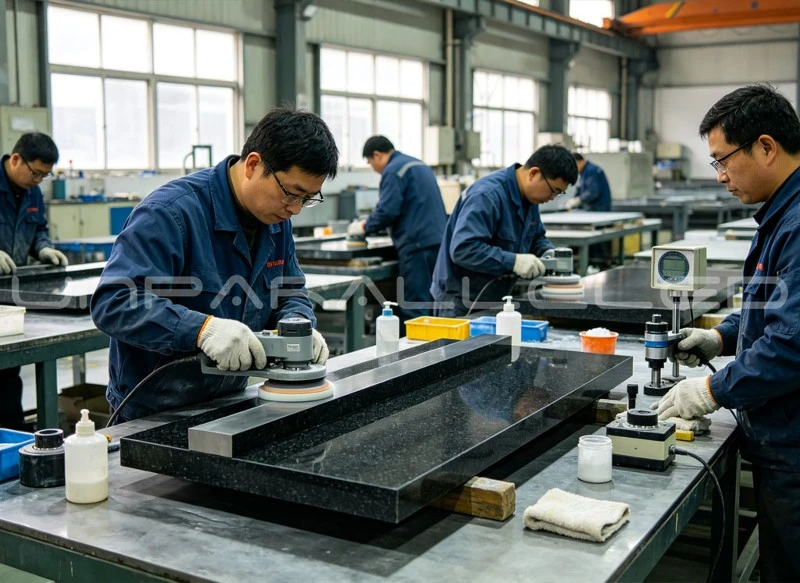
UNPARALLELED® makes granite machine bases, assemblies and air-bearing components from high-density black granite (about 3,100 kg/m³) for semiconductor, laser, CMM and optical inspection equipment.
Machining: single granite parts up to 100 tons, with large grinders that can lap metal and non-metal platforms up to 6,000 mm long.
Environment: a 10,000 m² temperature- and humidity-controlled workshop with a thick concrete floor and surrounding vibration-isolation trenches, plus a dedicated clean, dust-free assembly room modelled on a semiconductor equipment workshop.
Measurement: Mahr dial indicators (0.5 µm resolution), WYLER electronic levels and Renishaw laser interferometers, with calibration certificates traceable to national metrology standards.
Quality systems: ISO 9001, ISO 14001, ISO 45001 and CE certified.
Service: inquiries answered within 24 hours, OEM and ODM available, and manufacturing and inspection videos on request.
Frequently Asked Questions
Why is granite used for semiconductor equipment bases? It is dense, stiff, non-magnetic and stress-free, and it keeps its shape with changes in temperature and vibration much better than most alternatives.
How are threaded holes made in granite? Bonded inserts, usually stainless steel, are set into drilled holes. The drawing should give thread size, position tolerance, depth and pull-out load.
Can granite be used as an air-bearing surface? Yes. The surface must be very flat and smooth, and free of pores and chips that would disturb the air film.
What should I send to get a quotation? Send your drawing, tolerances, operating temperature, quantity and any special requirements for inserts, cleanliness or packing.
Get a Quote for Your Granite Machine Base
Send your drawing and requirements to info@unparalleled-group.com and our engineers will reply within 24 hours. You can also visit www.unparalleled-group.com to see our precision granite components and assemblies.