



As global industries push toward ever-higher accuracy and reliability, one material has quietly become indispensable in advanced inspection and manufacturing systems: precision granite. Whether used in a granite assembly for semiconductor manufacturing process device or as a granite base for Computed Tomography, engineered black granite has proven to be one of the most stable structural materials for high-precision equipment.
This rising trend begs the question: why granite, and why now? Understanding its role in cutting-edge technologies such as Computed Tomography (CT), semiconductor wafer processing, and advanced metrology reveals why so many equipment manufacturers are turning toward granite apparatus components as their foundation for long-term performance.
The semiconductor industry is driven by nanometer-level tolerances, and any instability in the equipment's structure can compromise pattern uniformity, device yield, and measurement reliability. Engineered granite has become a preferred solution for creating a granite assembly for semiconductor manufacturing process device because of its naturally high density, non-magnetic properties, dimensional stability, and near-zero internal stress. Unlike metal structures, granite does not deform under long-term load or thermal variation, allowing precision instruments to operate with exceptional repeatability.
In the CT imaging field, structural stability directly influences the clarity and reliability of every scan. A granite machine base for Computed Tomography minimizes vibration and thermal drift, providing a rigid reference frame for X-ray sources, detectors, and rotational stages. Medical and industrial CT systems rely on extremely stable mechanical architectures to deliver accurate imaging results, especially when dealing with micro-CT and high-resolution non-destructive testing. The use of a granite assembly for Computed Tomography improves scanning accuracy and mechanical alignment over the entire lifecycle of the machine.
One of the most important advantages of granite is its resistance to long-term wear. A precision granite apparatus component maintains its geometry over years of operation, even in high-duty environments. This makes it valuable not only for metrology laboratories, but also for semiconductor lithography, inspection modules, wafer packaging machines, and advanced CT inspection systems. Granite absorbs vibration more effectively than cast iron or aluminum, enabling smoother motion control and better imaging resolution.
A well-designed granite apparatus also supports the integration of linear motors, air bearing stages, and multi-axis systems. Through precision machining and custom inserts, granite structures can form complex mechanical frameworks with precise geometry that remains stable for decades. This is especially important for semiconductor equipment manufacturers that require highly customized granite assemblies to fit their motion platforms, optical modules, and environmental control designs.
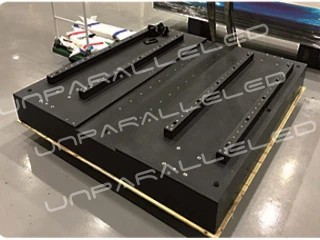
For Computed Tomography, mechanical stability determines whether dynamic rotation, detector positioning, and X-ray alignment remain constant throughout the scanning cycle. A granite base for Computed Tomography provides the necessary rigidity and damping to support high-speed rotary tables and sensitive imaging components, ensuring that micro-movement does not compromise resolution. This stability also reduces recalibration frequency, extending equipment uptime and lowering long-term operational costs.
Beyond performance, granite offers strong advantages in sustainability and lifecycle value. It does not corrode, warp, or fatigue, and requires minimal maintenance over years of use. Precision manufacturers appreciate the fact that granite components can be restored and re-lapped if needed, extending the service life of the equipment significantly longer than metal alternatives. In high-value industries where system accuracy determines productivity, granite's durability becomes a strategic advantage.
As global demand for high-precision imaging, metrology, and semiconductor production continues to surge, the role of precision granite will only expand. From granite assemblies for semiconductor manufacturing process devices to custom-designed granite bases for Computed Tomography, leading manufacturers are embracing granite as a fundamental structural material capable of meeting today's demands-and future challenges.
For companies invested in the next generation of ultra-precision technologies, understanding the value and applications of granite apparatus is no longer optional. It is becoming a core requirement for achieving the stability, accuracy, and long-term reliability expected in modern industrial and scientific equipment.