



Sourcing precision granite components from China has become routine for procurement teams in the metrology, semiconductor, and machine tool industries. The price advantage is real, the engineering capability of the top factories is genuine, and lead times are competitive. But the gap between the best Chinese granite manufacturers and the rest of the market is also real, and a buyer who cannot tell the difference during the evaluation stage will discover it later, on the shop floor, at a much higher cost. You do not need to be a granite expert to separate them. You need a structured checklist and a few well-designed verification steps. Here are seven things to check before you order from any precision granite manufacturer China has to offer.
1. Material Reports: Verify the Stone Before You Verify the Factory
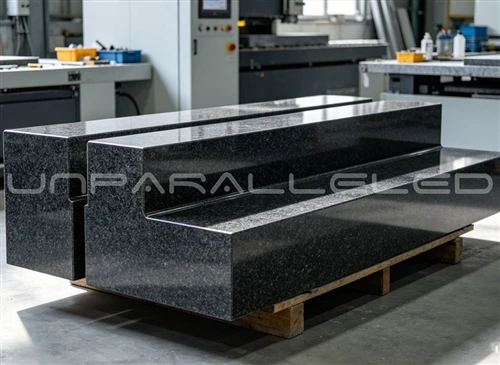
Almost all precision granite components from China are made from black granite quality stone, typically fine-grained gabbro or diabase. The stone itself is the foundation of every tolerance on the drawing, so your first document request should be a material test report from an independent laboratory. Do not accept a one-line statement that the material is "Jinan black" or "Taishan black"; ask for the actual measured values.
A credible material report for black granite should list these properties and you should compare them against the accepted range:
| Property | Typical accepted range for precision black granite |
| Density | 2.95 to 3.05 g per cubic cm |
| Water absorption | Below 0.08 percent, ideally below 0.05 percent |
| Shore hardness | Around 70 HS or higher |
| Compressive strength | 200 to 250 MPa or higher |
| Thermal expansion coefficient | Roughly 5 to 8 x 10⁻⁶ per degree C |
Each number matters in a specific way. High density and low water absorption mean the stone will not take in coolant or humidity and slowly deform. The thermal expansion coefficient is the reason granite outperforms steel in inspection rooms: it moves far less than cast iron when the temperature drifts. If a supplier cannot produce a recent, third-party material report, treat it as a significant signal and move the sample request described in item six to the front of your process.
One more practical tip: ask which quarry and seam the stone comes from. Granite quality varies between seams in the same mountain, and a manufacturer that has processed the same seam for over a decade can promise repeatable material properties across repeat orders, which matters more than a single impressive report.
2. Inspection Equipment and Calibration Certificates: The Truth Told by Traceability
A granite surface plate or machine base is only as flat as the instrument that verified it. Ask the supplier for a complete list of their metrology equipment, and then ask the question that actually filters: are the calibration certificates traceable to national or international standards?
The equipment list for a serious factory should include electronic levels, autocollimators, laser interferometers, and coordinate measuring machines. The brand and origin of these instruments tell you a lot. European and Swiss metrology brands such as Mahr, British alignment systems such as Renishaw, and high-precision inclinometers such as those from WYLER are the standard tools of top-tier granite workshops. When a factory keeps every instrument on a documented calibration schedule with traceable certificates, its published flatness figures can be trusted. When it cannot show any calibration records, the numbers on the quotation sheet are aspirations, not measurements.
Ask for one specific document: the calibration certificate for the machine or plate class you intend to buy, issued within the last calibration cycle, showing the measurement instrument used and its traceability chain. A reliable precision granite manufacturer China buyers can audit remotely will send this within hours, because it is part of routine shipping documentation, not a special favor.
3. Machining Capability: Match the Factory to Your Drawing, Not the Other Way Around
Granite machining looks simple, but capability limits show up quickly on large or complex parts. Before committing, map your requirements against four concrete parameters:
First, maximum workpiece size. Can the factory handle a single piece of 100 tons or a monolithic structure 20 meters long, 4 meters wide, and 1 meter thick? If your program includes machine tool beds or large CMM bases, only a handful of Chinese factories can physically lift, saw, and lap parts at this scale. Ask for photos of the actual parts produced, not catalog renders.
Second, grinding capacity. Precision lapping is done on large grinding machines, and their quality determines both the achievable flatness and the production rate. Ask how many large grinding machines the workshop runs, where the machines come from, and what each one cost. Top factories run multiple heavy-duty grinding machines sourced from Taiwan, each valued at more than half a million US dollars. A factory operating four machines of this class can deliver a 5000 mm machine bed and thousands of smaller components per month without stretching its quality control.
Third, hole and insert work. Most precision granite components need threaded steel inserts, air bearing grooves, or T-slots. Ask to see examples of insert work and how insert pull-out strength is verified.
Fourth, assembly and integration. If your project involves granite combined with metal parts, sensors, or air bearing surfaces, ask whether the factory performs complete mechanical assembly and debug in-house. A supplier that only delivers lapped stone pushes integration risk back onto you.
4. Temperature-Controlled Production: Where Tolerances Are Actually Made
A flatness value of 3 micrometers over two meters cannot be produced or verified in an ordinary workshop. Thermal drift alone will exceed the tolerance before the measurement is finished.
Ask the supplier directly: is lapping and inspection performed in a temperature and humidity controlled workshop, and what are the controlled values? The reference environment for precision dimensional work is 20 degrees C, and a serious factory maintains its metrology and finishing areas at 20 degrees C with controlled humidity, usually around 40 to 60 percent relative humidity, around the clock. Staff gowning, air filtration, and morning warm-up procedures for instruments are all visible markers of a mature operation.
If a factory answers that lapping happens on the general shop floor and only final inspection is climate controlled, understand what that means: the stone was finished at one temperature and measured at another, and residual stress from that mismatch can surface later. The strongest answer is that both finishing and inspection happen inside the same controlled environment. Many established manufacturers now run live video walk-throughs of their climate controlled areas, which lets your engineers see the environment without flying to China.
5. Certifications and Compliance: The Combination That Counts
Certificates are easy to display and sometimes easy to fake, so check the combination and the issuing bodies rather than the logos on the website. For a precision granite supplier exporting to Europe, the United States, Japan, and Korea, a practical minimum is ISO 9001 for quality management, ISO 14001 for environmental management, and ISO 45001 for occupational health and safety. Few factories in this niche hold all three together alongside CE compliance; the combination is a meaningful filter because each certificate requires sustained third-party auditing, and a factory that maintains all of them shows an institutional discipline that appears in production consistency.
Two more checks take five minutes each. First, ask whether the company holds international patents and trademarks registered through bodies such as the CCPIT. More than twenty internationally registered patents and trademarks indicates a manufacturer that invests in its own engineering identity rather than reselling generic output. Second, ask for export references in your own industry. When a supplier can name controlled deliveries for programs associated with global companies such as GE, Samsung, or Apple component supply chains, it has already passed audits stricter than the one you are about to run.
6. Samples and Video Factory Tours: Verify Before You Wire
Documents filter out careless suppliers; samples filter out the rest. For components below a few hundred kilograms, order a paid sample with full inspection data before committing to production quantities. When it arrives, do not just admire the surface finish. Check flatness with your own instruments, verify the reported values against the certificate, examine insert quality, and weigh the part against the material density from item one. Density times volume is hard to fake, so the weight test is a surprisingly effective integrity check.
For large components where samples are impossible, insist on a live video factory tour, and make it count with three requests. Ask the host to walk you through the temperature controlled area and show the live readings on the wall display. Ask them to power up a calibration instrument and show its certificate sticker. Ask to watch a lapping cycle on a machine of the size class you need. An established manufacturer will agree without hesitation; many now offer structured remote tours and VR walk-throughs as a standard part of their sales process.
7. Communication, Documentation, and the People Behind the Order
The final check is the least tangible and the most predictive. Evaluate how the supplier communicates during the quotation stage, because that is when they are trying the hardest. Do technical questions reach engineers or only sales staff? Are drawing markups answered with measurements or with marketing phrases? Does the quotation itemize material grade, tolerance class, insert specifications, and inspection scope, or does it list a single price? Request the name of the quality inspector who will sign the final report, and agree in writing on the acceptance standard, for example the flatness tolerance grade and the measurement method, before production starts. A manufacturer that welcomes this level of detail has done it hundreds of times.
Putting the Checklist to Work
| Check | What to request | Red flag to avoid |
| Material report | Third-party test of density, water absorption, hardness, compressive strength, CTE | No report, or values outside accepted ranges |
| Metrology | Equipment list plus traceable calibration certificates | No calibration records shown |
| Capability | Photos of similar-size parts, grinding machine inventory | Catalog renders only |
| Environment | Live readings from the climate controlled workshop | Finishing outside controlled areas |
| Certification | ISO 9001, 14001, 45001, CE, patent records | One expired certificate as the whole answer |
| Verification | Paid sample or structured video tour | Refusal of both |
| Process | Named inspector, written acceptance standard | Price-only quotation |
A factory that clears all seven checks will almost certainly deliver what it promises, and a factory that fails early checks has saved you the cost of discovering it after the container arrives. If you are building a shortlist, start with manufacturers whose quality systems and equipment investments are already documented in public channels. Choosing a precision granite supplier is not about the lowest quote; it is about finding the workshop where the numbers on the certificate are the same numbers your instruments will read. This checklist is how you find it in a week instead of a year.