



Coordinate Measuring Machines (CMM) serve as core equipment for precision geometric inspection, and measurement stability fundamentally depends on the base. Many customers wonder that metal casting technology is mature, so why high-end CMMs widely adopt granite instead of cast iron, cast aluminum or steel. Based on years of experience in ultra-precision components, UNPARALLELED explains that granite satisfies critical CMM requirements including low internal stress, low thermal deformation and high damping, making it an ideal substrate to guarantee micron-level measurement accuracy.
While a CMM inspects workpieces, the probe moves along three-axis guideways. Tiny deformation directly translates into measurement error. Cast iron bases feature decent rigidity, yet retain massive residual stress after casting. Slow stress release causes gradual micro-deformation over time and requires lengthy aging treatment. Granite blanks adopted by UNPARALLELED have undergone natural geological aging for tens of years with nearly fully released internal stress. Machined granite bases maintain stable geometry without creep over time, keeping the three-axis orthogonal benchmark of CMM consistent year after year.
Ambient temperature fluctuation in workshops creates major interference for precision measurement. Metals own high thermal expansion coefficients. Slight temperature rise or fall triggers obvious dimensional variation and CMM measurement drift. The UNPARALLELED granite base achieves thermal expansion coefficient ≤3e-6/℃. Its thermal deformation is far lower than cast iron and aluminum alloy. Under minor temperature changes inside temperature-controlled metrology rooms, dimensional variation of granite base stays minimal, reducing measurement drift and improving repeatability.
During CMM inspection, motor drive and guideway movement continuously generate vibration. Vibration transmits to the worktable and triggers probe signal jitter, degrading point collection accuracy. Dense mineral composition endows granite with better damping performance than metals. It absorbs and attenuates vibration rapidly and suppresses resonance. The UNPARALLELED granite base quickly dampens micro-vibration from moving guideways, stabilizes the probe while touching workpieces, reduces measurement noise caused by vibration and enhances repeatability of test data.
Many users only focus on rigidity while ignoring long-term maintenance cost of metrology bases. Cast iron bases tend to rust. Humidity variation inside metrology rooms and splashing cutting fluid corrode surfaces and ruin guide mounting benchmarks, requiring regular anti-rust coating. UNPARALLELED granite boasts stable chemical properties, rust resistance and tolerance to minor oil splashes without anti-rust treatment. Nano-level lapped reference surfaces wear slowly when bearing workpieces and mounting guide rails, lowering maintenance and re-calibration frequency of CMM.
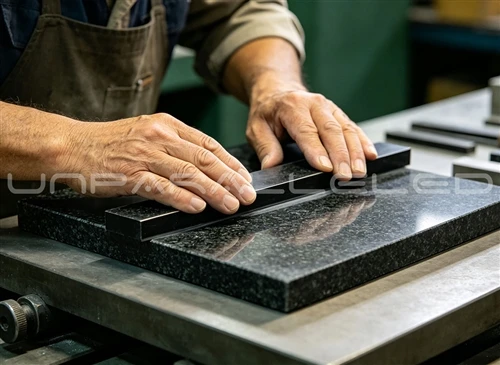
Granite bases also have inherent material limitations. UNPARALLELED reminds users that granite is brittle. Strong impact and local heavy load should be avoided during hoisting and workpiece placement to prevent chipping. Besides, granite is hard to machine. Professional CNC lapping is required to achieve nano flatness for guide mounting faces and worktables, which forms the technical threshold of ultra-precision granite components.
High-precision bridge CMM and gantry CMM adopt granite bases together with granite beams. UNPARALLELED supplies complete granite structural assemblies including bases, beams and columns. Uniform material performance of the whole set further improves thermal stability and vibration damping. These parts support metrology equipment brands worldwide and are deployed in precision inspection of automotive, semiconductor and aerospace components.
CMMs adopt granite bases mainly to address three core challenges in precision measurement: structural deformation, thermal drift and vibration. UNPARALLELED granite bases feature low internal stress, minimal thermal deformation, excellent vibration damping, rust-free property and wear-resistant reference surfaces. They sustain stable equipment geometry to meet micron or sub-micron measurement demands of CMM. With proper operation to avoid impact damage, granite bases act as long-term reliable benchmark carriers and ensure stable precision inspection.