



Semiconductor equipment often has a service life of more than a decade. When selecting components, equipment manufacturers and production line operation and maintenance teams focus not only on static precision at delivery, but also on the capability of the base to retain accuracy under years of continuous production. Many metal structural parts suffer stress release, creep and corrosion after several years of service, resulting in slow benchmark shift and frequent shutdown for calibration. In contrast, the long-term stability of granite platforms stems from the mineral properties of the material itself, aging treatment, precision lapping and factory metrology verification. Combined, they form a benchmark system adapted to the ultra-long service cycle of semiconductor fabs.
The inherent material characteristics lay the foundation for long-term stability. High-grade precision granite is formed by interwoven dense crystalline minerals with tightly bonded crystals and nearly no creep effect. It will not undergo slow plastic deformation under continuous load unlike metallic materials. UNPARALLELED® black granite reaches a density of 3100kg/m³ with minimal pores and inert chemical properties. Within the constant-temperature and constant-humidity environment of semiconductor cleanrooms, it will not expand by absorbing moisture, oxidize or corrode over time, nor be easily attacked by a small amount of solvents or clean gases in workshops. With sufficient natural aging completed before delivery, residual stress inside the stone can be fully released, so no deformation drift caused by gradual stress release will occur under sustained loads later.
Some assume granite is completely deformation-free. In fact, it can still be affected by temperature gradients, yet its deformation is highly predictable. Unlike metals that expand and contract rapidly with temperature changes, granite features an ultra-low thermal expansion coefficient. Deformation induced by temperature variation is slight and reversible. That is to say, when temperature returns to the original range, the geometric shape of the platform is mostly restored without permanent deformation left behind. In the stable constant-temperature environment of semiconductor workshops, such minor reversible thermal deformation can be incorporated into compensation algorithms in the early-stage equipment simulation. It will not accumulate into irreversible benchmark deviation and guarantees consistency of repeated positioning and measurement over many years.
In terms of mechanical stability, the platform must withstand the dead weight of equipment and alternating loads from reciprocating motion modules. Linear motors and air-bearing stages inside semiconductor equipment keep moving back and forth, continuously transmitting alternating stress to the base. Ordinary stone with poorly bonded crystals may experience microcrack propagation under long-term alternating loads and gradual precision degradation. High-density granite features tightly interlocked crystals and excellent fatigue resistance. No microstructural damage occurs under long-duration alternating loads. With proper structural design and installation scheme, flatness and straightness indicators of the platform can be maintained for a long time without continuous degradation caused by daily high-frequency motion.
Surface stability under cleanroom conditions is also an indispensable part of long-term performance. The working surface of the platform undergoes ultra-fine lapping treatment, featuring dense texture with no open pores. It hardly absorbs contaminants and avoids particle shedding from the surface. Under long-term laminar airflow scouring and regular cleaning and wiping in workshops, the working surface will not erode slowly or generate loose particles. This is especially critical for optical and laser semiconductor equipment. Once particles continuously separate from the base surface, they will not only contaminate wafers but also alter local surface morphology and indirectly impair benchmark precision.
Nevertheless, the long-term stability of granite platforms is not absolute. It can be affected by installation foundation, on-site operating environment and subsequent maintenance methods. Uneven settlement of the factory foundation or workshop temperature and humidity persistently exceeding the design range will lead to benchmark shift of the whole machine even if granite itself has excellent performance. Therefore, a complete stability solution includes preliminary site survey, base structural simulation, multi-environment metrology verification before delivery, and installation guidance after shipment. Before delivery, the platform is inspected in a constant-temperature, humidity-controlled and dust-free lab simulating actual semiconductor workshop conditions. A full set of international metrology instruments and multiple national metrology standards are adopted to verify all indicators, ensuring long-term performance after delivery meets expectations.
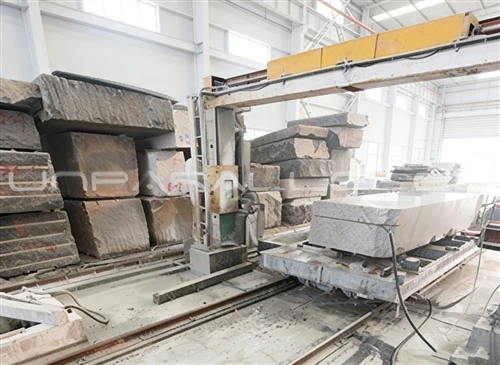
Compared with other base materials, granite's biggest advantage is no accumulated permanent deformation. Much of the deformation of metals and composite materials is irreversible. Once formed, it cannot recover automatically and the components have to be reworked or replaced. For qualified granite platforms, as long as the operating environment stays within the design range, geometric precision only undergoes tiny reversible fluctuations, without continuous accumulated permanent precision loss. It greatly reduces annual equipment calibration frequency, cuts production line downtime and stabilizes chip manufacturing yield.
Conclusion
The long-term stability of granite platforms is jointly determined by mineral characteristics of the material, aging treatment, precision machining, environmental adaptability and on-site installation. Within the ten-year or longer service life of semiconductor equipment, high-quality precision granite barely suffers creep, corrosion or stress drift. Its deformation is slight and reversible, and the working surface resists degradation. Provided on-site environment and foundation meet design requirements, granite platforms can continuously deliver nanometer-level benchmarks, lower equipment maintenance costs and support long-term stable mass production of semiconductor lines.