



In the semiconductor industry, where a single particle can ruin a wafer and nanometer-scale accuracy determines device performance, the foundation of precision equipment is everything. Lithography machines, wafer inspection systems, and metrology platforms all share one critical requirement: an ultra-stable, vibration-dampening, dimensionally perfect granite structure that serves as their precision foundation.
The days of off-the-shelf granite components are rapidly fading in the semiconductor equipment sector. As lithography nodes shrink below 3nm and inspection requirements push into the sub-angstrom regime, equipment manufacturers are turning to custom precision granite components engineered to their exact specifications. This shift from standard to custom is not just a trend-it is becoming a requirement for next-generation semiconductor manufacturing equipment.
Why Custom Granite Components Are Non-Negotiable in Semiconductor Equipment
Semiconductor equipment manufacturers face unique challenges that generic granite components cannot address. The thermal stability requirements alone are staggering: lithography systems operate within a ±0.001°C thermal environment, and any dimensional drift in the granite foundation directly translates to overlay errors on the wafer.
But thermal stability is only one piece of the puzzle. Consider the environmental contamination concerns: semiconductor fabs require Class 1 or better cleanroom environments. The granite components must not only meet precision specifications but also must be manufactured, cleaned, and packaged in ways that prevent any particle generation or contamination that could compromise the cleanroom environment.
Furthermore, the integration challenges are substantial. Semiconductor equipment often requires complex patterns of threaded holes, air bearing channels, vacuum ports, and embedded mounting features that must align with micron-level accuracy across the entire granite component. Standard granite plates with pre-drilled hole patterns simply cannot accommodate these requirements without compromising the structural integrity or precision of the granite itself.
Critical Design Considerations for Semiconductor Granite Components
Hole Positioning and Pattern Accuracy
In semiconductor equipment, the location of mounting holes and reference features is as critical as the flatness of the granite surface itself. When designing custom granite components, hole position accuracy must be specified to within ±0.005mm or better for most applications-and for the most demanding lithography and inspection equipment, tolerances can reach ±0.002mm.
Design Best Practice: Specify hole positions relative to the granite's datum surfaces rather than edge-to-edge dimensions. This allows for more precise control during the manufacturing process and ensures that the critical features are located accurately relative to the reference plane. Additionally, consider the thermal expansion effects when designing multi-hole patterns across large granite components-the hole spacing must account for the granite's coefficient of thermal expansion relative to other materials in the assembly.
Tolerance Stacking and Statistical Process Control
When semiconductor equipment incorporates multiple granite components, tolerance stacking becomes a critical consideration. A common oversight is specifying individual component tolerances without considering how they accumulate in the final assembly.
Practical Approach: Implement statistical process control (SPC) during the manufacturing phase. This involves measuring critical features on each component and analyzing the data to ensure that the population of parts will assemble correctly. For critical semiconductor applications, consider specifying Cp and Cpk requirements for dimensional tolerances rather than simple maximum/minimum limits. This approach ensures not just that each part meets the specification, but that the manufacturing process is capable of consistently producing parts that will work in assembly.
Insert Design and Integration Techniques
Embedded inserts-threaded steel inserts, dowel pins, and other metallic features-are frequently required in semiconductor equipment granite components for mounting and alignment purposes. However, these inserts present significant challenges: the differential thermal expansion between granite and metal can cause stress-induced distortions, and the interface between insert and granite can become a source of contamination or dimensional instability.
Advanced Solutions: Modern precision granite manufacturing employs several sophisticated insert integration techniques. Press-fit inserts with epoxy bonding provide both mechanical retention and environmental sealing. For the most demanding applications, thermal expansion compensation designs use stepped inserts or graded interfaces that minimize stress transfer. The epoxy selection is equally critical-it must be vacuum-compatible, low-outgassing, and maintain mechanical properties across the operating temperature range.
Critical Note: Insert placement must be carefully considered relative to the granite's internal stress distribution. Placing inserts in high-stress areas can cause cracking or distortion over time, especially when the granite is subjected to thermal cycling during operation. Experienced granite manufacturers can provide guidance on optimal insert placement based on finite element analysis and empirical data from similar applications.
Surface Finish and Cleanroom Compatibility
The granite surface finish is often specified based on mechanical considerations-wear resistance, friction properties, or compatibility with air bearing systems. However, for semiconductor applications, the surface finish also has significant implications for cleanroom compatibility.
A surface that is too rough can trap particles and contaminants, becoming a source of contamination during equipment operation. Conversely, an overly polished surface may not provide the necessary mechanical properties for precision movement or air bearing operation. The optimal surface finish for semiconductor granite components typically falls in the range of Ra 0.4-0.8µm, providing both cleanroom compatibility and functional performance.
Additional Consideration: The cleaning and packaging of granite components for semiconductor equipment is as critical as their manufacturing. Components must undergo rigorous cleaning processes to remove all machining debris, oils, and surface contaminants, followed by packaging in cleanroom-compatible materials that prevent recontamination during shipping and installation.
Application Case Studies
Lithography System Granite Stages
EUV lithography systems represent the pinnacle of precision engineering, with positioning requirements that push into the picometer range. The granite stages in these systems must provide nanometer-level positioning accuracy while maintaining flatness over travel ranges exceeding 300mm.
One recent project involved designing a custom granite stage for a next-generation lithography scanner. The design required 274 precisely positioned threaded inserts for actuator and sensor mounting, with hole position tolerances of ±0.003mm. Additionally, the granite had to accommodate integrated air bearing channels and vacuum grooves for wafer chucking.
The manufacturing challenge was compounded by the requirement that the granite maintain Grade 0 flatness across the entire travel range, even when subjected to thermal loads from the scanner's high-power illumination system. The solution involved careful material selection, precision thermal stress relief processing, and a multi-stage manufacturing sequence that included intermediate stress-relief cycles between major machining operations.
Outcome: The completed granite component exceeded all specifications, with actual flatness better than 0.002mm/m and hole position accuracy within ±0.002mm across the entire pattern. The stage was successfully integrated into the lithography system and has demonstrated stable performance over more than 18 months of continuous operation.
Wafer Inspection Metrology Platforms
Automated wafer inspection systems rely on ultra-stable metrology platforms to ensure detection of defects as small as 20nm. One recent project involved developing a custom granite metrology platform for a high-throughput inspection system designed for 450mm wafers.
The granite platform required an 850mm × 850mm work surface with integrated Z-axis column support structures. The design specified over 400 threaded inserts for mounting various optical components, motion stages, and vacuum fixtures. Critical design requirements included maintaining flatness within 0.003mm/m across the entire work surface and ensuring that all mounting points for precision motion systems were coplanar within 0.005mm.
A particular challenge was designing the granite to accommodate the system's integrated air bearing vacuum system, which required precision-machined vacuum channels and sealing surfaces embedded directly in the granite structure. Any vacuum leakage would compromise system performance, so the interface between the granite and the vacuum system had to be perfect.
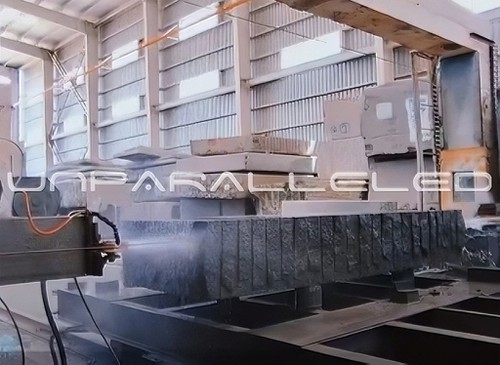
Manufacturing Solution: The granite component was manufactured using a multi-axis CNC grinding system with in-process metrology feedback. Critical features were measured during manufacturing to ensure that the final component met all specifications. The vacuum channels were precision-ground to surface finishes better than Ra 0.2µm and subjected to helium leak testing to verify hermetic sealing.
Result: The completed metrology platform enabled the inspection system to achieve defect detection capability down to 18nm, exceeding the customer's design target by more than 10%. The granite foundation has maintained dimensional stability for over two years of operation, with no measurable drift in flatness or positioning accuracy.
Particle Metrology Systems
Particle metrology systems used for wafer surface contamination analysis present unique challenges for granite component design. These systems often require integrated vacuum chucks, electrostatic discharge (ESD) protection features, and extremely clean surface finishes to prevent false particle detection.
A recent project involved developing a custom granite base for a particle counting metrology system. The design required integrated vacuum chucking capability with multiple independent vacuum zones, ESD-safe grounding features embedded in the granite, and a surface finish that would not trap or generate particles.
Innovative Solution: The granite component was manufactured with precision-ground vacuum channels that connected to a manifold system, allowing independent control of vacuum zones. ESD-safe inserts were installed using conductive epoxy, providing reliable grounding while maintaining the vacuum integrity of the system. The surface finish was carefully controlled to Ra 0.4µm, providing both cleanroom compatibility and the required mechanical properties for wafer handling.
Performance: The completed system achieved particle detection sensitivity down to 50nm particles, with no false particle generation attributable to the granite foundation. The ESD protection features successfully prevented electrostatic discharge events that could have damaged sensitive wafers during measurement.
UNPARALLELED's Custom Granite Manufacturing Capabilities
Semiconductor equipment manufacturers require more than just precision manufacturing-they require a partner who understands the unique challenges of their industry and can provide comprehensive solutions from design through delivery. At UNPARALLELED, we bring 30 years of experience in ultra-high precision granite manufacturing to the semiconductor equipment sector.
Our capabilities include:
Advanced CNC Manufacturing: Multi-axis CNC grinding and milling systems with in-process metrology ensure that every dimension meets your specifications. Our equipment can achieve positional accuracy of ±0.002mm and surface finishes better than Ra 0.2µm when required.
Complex Feature Integration: We can integrate threaded inserts, dowel pins, air bearing channels, vacuum ports, and other features with the precision and reliability that semiconductor equipment demands. Our experience with over 500 custom granite projects gives us the expertise to handle the most challenging integration requirements.
Cleanroom Manufacturing: Our manufacturing facilities include cleanroom-compatible processing areas for semiconductor-grade granite components. From material handling through final cleaning and packaging, we maintain environments that meet your contamination control requirements.
Thermal Stress Relief: We employ advanced thermal stress relief processes to ensure dimensional stability of granite components, even when subjected to extreme thermal cycling during operation. This capability is particularly critical for lithography and inspection equipment that experiences significant thermal loads.
Comprehensive Quality Documentation: We provide complete traceability for all materials and processes, including CMM inspection reports, material certifications, and cleanroom compatibility documentation. Our quality system is designed to meet the stringent requirements of the semiconductor industry, including support for ISO 9001 and other quality management system certifications.
The Request for Quotation Process: From Concept to Delivery
When you're ready to move forward with a custom granite component project, the RFQ process should be structured to ensure that all critical requirements are captured and understood. A well-prepared RFQ not only accelerates the quotation process but also ensures that the final product meets your expectations.
Essential RFQ Elements:
Complete engineering drawings with all dimensions, tolerances, and surface finish specifications
Material specifications, including granite type and grade requirements
Insert specifications, including size, material, thread type, and placement requirements
Cleanroom requirements, including particle size limits and cleaning protocols
Quantity and delivery schedule requirements
Quality documentation and certification requirements
At UNPARALLELED, we review every RFQ carefully and provide detailed quotations that include not just pricing, but also technical recommendations based on our experience. We welcome design discussions and can provide guidance on optimizing your design for manufacturability, cost, and performance.
Conclusion: Precision Foundation for Semiconductor Excellence
As semiconductor equipment manufacturers push the boundaries of what's possible in lithography, inspection, and metrology, the importance of precision granite foundations continues to grow. Custom granite components are no longer optional-they are becoming essential for next-generation equipment that must deliver nanometer and sub-angstrom performance.
The difference between success and failure often comes down to the partnership you choose for your precision granite components. At UNPARALLELED, we combine advanced manufacturing capabilities, deep semiconductor industry experience, and a commitment to quality that makes us the preferred choice for the world's leading semiconductor equipment manufacturers.
Your semiconductor equipment deserves the best foundation. Let's discuss how UNPARALLELED's custom precision granite components can help you achieve the performance and reliability your customers demand.
Ready to elevate your semiconductor equipment precision? Contact UNPARALLELED today to discuss your custom granite component requirements. Our team of engineers and metrologists is ready to help you transform your concepts into precision reality.
About UNPARALLELED
Founded in 1998, UNPARALLELED has established itself as a global leader in ultra-high precision manufacturing, specializing in granite components, ceramic components, and precision measuring instruments. With 30 years of experience and two manufacturing facilities spanning 39 acres, we serve the world's most demanding precision industries, from semiconductor manufacturing to aerospace metrology. Our commitment to quality has made UNPARALLELED synonymous with the highest standards of precision manufacturing excellence.