



Optical path drift in optical systems often originates not from optical components such as light sources and lenses, but from persistent micro-vibration transmitted through the floor. Air compressors, air conditioning units and rotating equipment inside buildings, as well as faint disturbances caused by pedestrian movement, can propagate through the ground to the stage surface, resulting in spot jitter and poor measurement repeatability. For long-duration continuous inspection, laser interferometry and on-site semiconductor metrology, minor short-term vibrations accumulate over time and eventually compromise the measurement accuracy of the entire system. Thanks to its inherent material damping paired with well-engineered structural design, the granite optical stage base suppresses vibration transmission and delivers a stable reference carrier for optical paths. This is why UNPARALLELED Group prioritizes granite as the stage substrate for a wide range of ultra-precision optical projects.
1. Intrinsic Damping of Granite: Dissipate Vibration Energy at the Source
Many engineers equate vibration isolation solely with external leveling feet, overlooking the vibration absorption capacity of the base material itself. Metals feature high stiffness yet low damping. Vibration energy bounces repeatedly inside metal components and decays slowly. Once disturbed, the tabletop keeps oscillating slightly and takes a long time to settle.
Granite is a dense natural mineral aggregate. Natural interfaces between countless mineral grains dissipate vibration energy through friction when vibration enters the base, rapidly attenuating oscillation and preventing resonance amplification. UNPARALLELED® adopts high-density granite blanks with minimal internal pores and uniform mineral distribution. The material comes with excellent inherent damping and can quickly dissipate high-frequency micro-vibration without complicated built-in vibration suppression structures, reducing spot jitter on the tabletop. This material-native vibration suppression is an innate advantage that metal bases cannot easily match.
2. Mass Counterweight Effect: Heavy Granite Base Restrains External Disturbances
The impact of vibration on the tabletop is closely related to the base mass. Under identical external disturbance, heavier objects achieve smaller acceleration and weaker tabletop displacement fluctuation. With high density, granite delivers greater self-weight for the same volume and forms an inertial stabilizer by its own mass to resist tabletop shaking induced by minor external impacts.
During optical stage design, UNPARALLELED optimizes base thickness and outline according to the weight and center of gravity of the full optical module, reasonably distributing self-weight to avoid resonance triggered by thin-walled local structures. The heavy granite base together with vibration isolation supports forms a three-level vibration control system: material damping + inertial counterweight + isolation supports. External isolation feet block low-frequency ground vibration while the granite substrate dissipates residual vibration energy. The dual effect greatly cuts vibration amplitude transmitted to optical components and stabilizes optical paths.
3. Vibration Reduction Is Not the Only Metric: Long-term Dimensional Stability Matters
Focusing merely on vibration performance while ignoring dimensional stability still fails to sustain long-term optical path stability. Some vibration-absorbing materials offer good damping yet are prone to creep or deformation under temperature and humidity changes. Over time, table flatness shifts and the optical reference drifts accordingly.
Granite boasts outstanding chemical inertness and strong resistance to moisture and mild acid/alkaline gas in workshops. Its low thermal expansion minimizes deformation under gradual temperature changes. UNPARALLELED carries out aging treatment after machining to release residual internal stress of stone and reduce the risk of slow long-term deformation. Even if the equipment runs nonstop for months, the benchmark geometry of the tabletop remains stable without gradual reference drift caused by continuous vibration and environmental variation. This characteristic is especially critical for on-line optical inspection equipment operating 24/7.
4. Engineering Implementation: Structural and Installation Details to Maximize Granite Damping
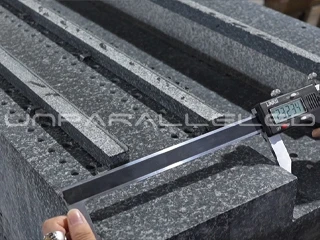
The inherent vibration suppression potential of granite can only be fully realized through rational structural design and installation schemes. A base with poorly designed structures such as long cantilevers or abrupt thickness transitions may still suffer local resonance. Before machining, UNPARALLELED conducts modal analysis to avoid common resonant frequency bands. Mounting slots and reference surfaces for air bearings are reserved to match the layout of customer optical modules and prevent structural defects from weakening vibration damping performance.
Installation also plays a vital role. Rigidly locking the granite base directly to the ground transfers ground vibration to the base without attenuation. Vibration isolation supports matching working conditions are required, adopting three-point main support layout to release stress. Contact surfaces between supports and base must stay clean to avoid local stress points formed by hard particles. Graduated fine-tuning is followed during leveling to reduce assembly stress inside the base. Only when substrate damping, modal structural design and external vibration isolation supports work in synergy can various vibration interferences be suppressed to the maximum extent.
5. Suitable Application Scenarios
The composite vibration suppression advantages of granite optical stage bases fit scenarios with stringent optical path stability requirements: laser interferometry, semiconductor optical inspection, high-precision 3D vision measurement, Raman spectroscopy and research optical platforms. They are particularly suitable for equipment requiring long continuous data acquisition with strict standards for spot stability and measurement repeatability.