



An air bearing is a specialist component, and the engineers who search for it usually already know what they need. A granite air bearing is the meeting point of three disciplines: precision granite machining, pressurized-air film bearings and high-accuracy motion. This article explains what an air bearing is, why granite is the material of choice for it, how it compares with conventional mechanical guideways, where it is used, and why the granite surface itself has to be machined to a level most shops cannot reach. The product itself has also matured into an integrated package: granite structure, air bearing and linear-motor motion stage combined into one semiconductor- and metrology-grade platform, which is exactly the kind of search that brings serious buyers to a supplier like UNPARALLELED.
What Is an Air Bearing?
An air bearing supports motion using a thin film of pressurized air between two surfaces. Instead of balls, rollers or sliding contact, the moving part floats on that film, so there is no solid-to-solid contact in the load path. The pressure that keeps the film alive is supplied by a clean, filtered compressed-air source, and the film is only a few micrometres thick, which is why the surfaces it rides on must themselves be extraordinarily flat. The practical consequence is virtually frictionless motion: with almost no friction to overcome and almost no stick-slip, the stage can start, stop and settle predictably, and it can hold a commanded position without the microscopic judder that mechanical guides introduce. A granite air bearing is simply an air-bearing system whose reference and guide surfaces are cut into a monolithic granite body, so the air film rides on granite rather than on a metal way.
Why Is Granite Used for Air-Bearing Systems?
Several properties of granite make it the natural host for an air-bearing surface. Surface flatness comes from grinding and hand lapping, and because granite is dimensionally stable it holds that flatness without drift. Its low thermal expansion means the bearing gap does not change much as the shop warms through the day, which matters because the air film is only a few micrometres thick. Its high vibration damping keeps the floating surface quiet, and its precision machining lets one body carry the guide, the mounting seats and the measuring reference in a single stable part. Granite is also wear resistant and, unlike steel, needs no coating in a cleanroom, so the bearing surface stays true for years rather than slowly degrading.
Granite Air Bearing vs. Conventional Mechanical Guideways
The differences are most visible where accuracy is demanded. The table below compares the two approaches on the properties that decide whether a stage can hold its specification over time.
| Property | Granite Air Bearing | Conventional Mechanical Guideway |
|---|---|---|
| Friction | Virtually zero | Present (contact) |
| Wear | None in service | Progressive |
| Contamination | Clean air only, no lubricant | Particles and lubrication |
| Maintenance | Low | Periodic |
| Motion smoothness | High | Good |
| Precision / repeatability | High | Application dependent |
Applications of Granite Air Bearings
The combination of frictionless motion, nanometre-class smoothness and a stable, non-magnetic, non-rusting reference makes granite air bearings the default choice in a clear set of high-value machines:
Semiconductor equipment, precision stages, linear motor stages, optical inspection, metrology, laser equipment, wafer inspection and research equipment. These machines increasingly appear as one integrated package, where the granite structure, the air bearing and the linear-motor motion stage are designed together because each part depends on the stability the others provide. In each of these, the bearing is not a support part but part of the measuring chain, so its stability sets the floor on what the machine can resolve. Wherever a process must move a payload with nanometre repeatability while staying free of particles, the answer is usually a granite air-bearing stage.
Why Air-Bearing Surfaces Require Extremely Precise Granite Machining
Because the air film is only a few micrometres thick, any waviness, flatness error or surface defect in the granite is transferred straight to the floating stage. The granite therefore has to be machined well beyond ordinary workshop tolerance. Grinding sets the geometry; hand lapping brings the bearing surface to a mirror-like flatness and straightness; and parallelism between opposing bearing faces has to be held so the film stays even across the stroke. Surface finish matters because roughness disturbs the air flow, and every face is measured rather than assumed. This is the step where most suppliers stop and UNPARALLELED keeps going: a granite air bearing is only as good as the lapped face it floats on, so the machining, not just the material, is the product.
How UNPARALLELED® Manufactures Granite Air-Bearing Components
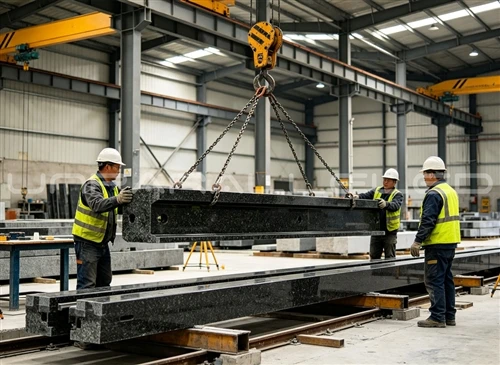
UNPARALLELED® machines single granite components up to 20,000 mm in length, 4,000 mm in width and 1,000 mm in thickness, with individual parts reaching about 100 tons, so an air-bearing body can be produced as one integral piece rather than assembled from blocks. Monolithic construction is where the stability comes from: no joints to soften the structure and no interfaces to move with temperature. Grinding and hand lapping are done by craftsmen with over 30 years of experience, and every bearing face is verified with Mahr, Mitutoyo, WYLER and Renishaw instruments in a temperature-controlled workshop, traceable to DIN, ASME, JIS, GB, BS and GOST.
Have an air-bearing stage project? Send us your drawings and technical requirements, and we will tell you how we would build the granite machine base and bearing surfaces your stage needs.