



Many metrology practitioners believe high-density granite surface plates are inherently moisture-resistant and require no environmental control during storage, until white hazy crystals or local yellow discoloration emerge on the surface. This phenomenon is efflorescence. Water vapor acts as a carrier, transporting soluble salts through stone capillary pores to the plate surface. After water evaporates, salts precipitate to form white frost. Meanwhile, light accelerates the aging of mineral components and leads to color difference and gloss loss. UNPARALLELED® granite surface plates undergo densification treatment and ultra-precision lapping. Though low in water absorption, natural stone still has microscopic capillary channels. Moisture-proof and light-shielded storage is the most economical preventive measure to block efflorescence and surface discoloration.
1. Understand the formation of efflorescence and discoloration: water vapor and light as two major triggers
Efflorescence is not surface stain, but salt precipitation crystallization. Water vapor or condensed moisture in the environment seeps into stone micropores and dissolves trace soluble salts inside. As moisture migrates outward and evaporates, salts remain on the lapped surface and form white foggy patches. Continuous expansion of crystals widens capillary pores, damages the nanoscale micro-topography and causes flatness deterioration. Long-term illumination, especially direct sunlight and continuous ultraviolet radiation, alters the oxidation state of surface granite minerals, resulting in uneven color spots and gradual gloss decay.
Once efflorescence and discoloration develop, simple wiping cannot remove them. Crystals continuously absorb dust and oil contaminants, which tend to trigger systematic measurement errors in subsequent inspection. In severe cases, the plate has to be returned to the factory for re-lapping.
2. Build moisture-resistant storage environment and cut off water migration channels of efflorescence
Ambient humidity is the core for efflorescence control. It is recommended to keep relative humidity stable between 40% and 60%. Avoid rainy seasons, humid basements and areas near water supply and drainage pipelines. Warehouses with large day-night temperature differences easily generate condensation. Dew forms between the plate base and support pads, and penetrating moisture induces efflorescence upward from the bottom of the stone.
Elevate the plate during storage instead of placing it directly on concrete floors. Concrete substrates contain alkaline salts, and ground moisture transmits into the stone through support points. Moisture-proof pads are used to isolate ground vapor, and dehumidifiers are equipped in warehouses. Prevent cold air from air conditioners blowing directly on the plate; abrupt temperature change leads to water droplet condensation on the surface. Check the inside of the dust cover regularly during routine inspection. If condensation is found inside the cover, take it out for drying and re-seal after full drying.
3. Light-shielded storage to avoid surface color difference and surface aging caused by illumination
Many warehouse areas have windows. Long-term scattered natural light or direct sunlight gradually changes the mineral state of granite surface layer and causes local fading and yellowing, ruining color uniformity. The black minerals of precision granite surface plates are sensitive to ultraviolet rays. Prolonged lighting reduces gloss and creates light and dark patches. Although it does not directly affect flatness, it interferes with imaging observation of vision inspection equipment.
The storage area should preferably be an indoor zone without direct light and far from windows and long-time close irradiation from fluorescent lamps. Use opaque dust covers during sealing to achieve both dustproof and light-shielding effects. Separate working areas and storage areas. Low-ultraviolet industrial light sources are adopted for illumination during measurement. After measurement, cover the plate with light-proof dust covers promptly to shorten surface light exposure duration.
4. Support and isolation design to block invasion of external alkaline pollutants
Supporting protection during storage is more than temperature and humidity control; external alkali and salt must also be isolated. Ordinary cement pads and alkaline rubber pads continuously precipitate salts. When contacting the plate bottom, salts penetrate into the stone under the action of water vapor and trigger efflorescence. Special non-metallic pads with low alkalinity and stable performance are selected as storage supports, and the contact surfaces of pads must be kept clean and dry.
Do not place plates on newly finished cement floors. Fresh cement continuously releases alkaline substances and moisture. Keep cutting fluid, rust removers, alkaline cleaners and other chemicals away from plates. Aerosol volatilized from such substances condenses on the plate surface and brings in salts to accelerate efflorescence and corrode the lapped surface.
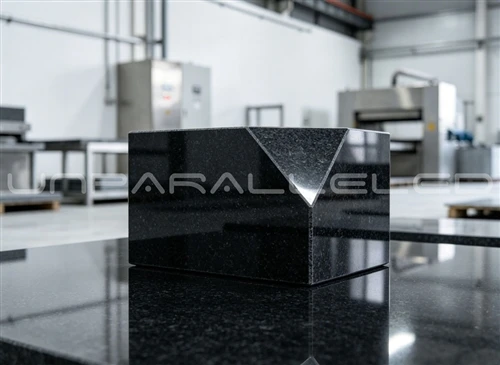
5. Pre-drying treatment before warehousing: eliminate residual surface moisture before sealing
Before warehousing and sealing, thoroughly clean and fully dry the working surface, ensuring no water stains, oil stains or salt residues remain. If sealed with residual moisture, vapor trapped in the enclosed cover cannot dissipate, circulates continuously inside micropores and gradually precipitates salt crystals.
Only use neutral dedicated metrology plate cleaners for cleaning. Leave the plate to dry sufficiently after wiping before light-shielded sealing. If ambient humidity is high, extend standing and drying time appropriately to stabilize the stone moisture content before covering with the opaque dust cover. Avoid full wrapping with plastic film. Fully sealed plastic easily accumulates condensation and increases risks of moisture and efflorescence.
6. Periodic inspection to detect early signs of salt precipitation and color spots
Long-term storage cannot be left unattended. Check plate status regularly. Focus on the working surface, edges and bottom supporting positions to observe white foggy crystals, yellow spots and gloss loss. Once slight efflorescence is spotted, transfer the plate to a dry and light-shielded area immediately, stop usage and contact the manufacturer for professional desalination treatment. Do not try self-cleaning with strong acid or alkali.
Record warehouse temperature and humidity during inspection. Increase inspection frequency in rainy and humid seasons and adjust dehumidification schemes in a timely manner to stop continuous salt precipitation at source and protect lapping benchmark and surface color.
Conclusion
Efflorescence and discoloration of precision granite surface plates originate from salt migration driven by water vapor and mineral aging induced by light. UNPARALLELED high-density granite substrates feature low porosity but cannot completely block water vapor and ultraviolet rays. During storage, environmental humidity control, elevation for moisture isolation, light-shield sealing, low-alkali supports, pre-storage drying and regular inspection form a complete protection strategy to cut off salt precipitation channels and slow surface mineral aging. It maintains stable lapping benchmark accuracy and uniform surface color, avoiding asset loss and downtime rework caused by efflorescence and discoloration.