



Although the factory precision of granite inspection bases is guaranteed by a full set of rigorous processes, many projects encounter an issue: the base passes re-inspection upon arrival, yet the benchmark surface tilts and flatness drifts after equipment commissioning. Most faults stem not from the stone substrate, but from hidden factors neglected during on-site installation and levelling. Many technicians simply equate levelling to zero reading on the level gauge, ignoring details such as self-weight deformation, foundation condition, support force distribution and timing of environment adaptation. Drawing on abundant supporting project experience for precision equipment worldwide, UNPARALLELED Group sorts out the easily overlooked key points during base installation and levelling.
一,Before base placement, foundation settlement and stiffness verification cannot be omitted On-site construction usually only checks ground flatness visually, with rare evaluation of long-term settlement characteristics and local bearing capacity of the foundation. Even if the workshop floor looks solid, the foundation stiffness varies across different areas. Slow settlement caused by past heavy stacking or underground pipelines will induce micro-deformation after the heavy granite base bears load for a long time. If the base is hoisted before the foundation completes initial settlement, even if levelling meets the standard at present, subsequent ground subsidence will directly alter the horizontal state of the plate surface. UNPARALLELED Group recommends customers complete foundation load verification and static curing in advance, and arrange base hoisting only after foundation settlement stabilizes. For ultra-high-precision scenarios such as AOI, semiconductor and CMM, vibration sources in surrounding areas should also be checked to assess vibration transmission from air compressors and conveying equipment, preventing vibration carried by the foundation which leads to temporary false levelling data.
二,After hoisting and positioning, reserve static temperature stabilization time for stone; immediate levelling is forbidden Granite features high thermal inertia. After long-distance transportation, temperature difference exists between the stone body and on-site environment, forming a temperature gradient inside the plate. Many sites start levelling right after positioning, and the obtained level readings are false values. When the stone gradually reaches thermal balance with workshop environment, micro-deformation occurs on the base and horizontal deviation appears again. Besides, hoisting is often treated as handling ordinary large workpieces. Binding with rigid steel cables and impact landing will produce invisible internal microcracks inside the stone, which gradually release stress under vibration and temperature cycles later. UNPARALLELED Group recommends flexible slings, slow positioning at preset lifting points, and static placement for temperature stabilization before levelling.
三,Optimize layout of support pads and balance force on fulcrums to eliminate false supports A common mistake on site is simple four-point support with randomly selected ordinary steel pads and repeated twisting of bolts at single points for forced levelling. Though granite slabs are rigid, unreasonable fulcrum layout will bend the base. Even if the level gauge reads zero, bending stress has accumulated inside the plate. Meanwhile, false supports are hard to identify visually. The fulcrums seem to make contact but bear no actual load. When the equipment runs and vibrates, fulcrums intermittently separate, resulting in repeated jumping of benchmark surface. UNPARALLELED Group calculates the optimal fulcrum layout via simulation according to base dimension and self-weight, and supplies special damping levelling pads. During levelling, multi-point alternate fine adjustment is adopted to avoid excessive jacking at single points, ensuring continuous bearing of each fulcrum and removing hidden risks of false supports.
四,During levelling operation, avoid instantaneous vibration and local temperature difference disturbance Technicians generally close doors and windows, but tend to ignore instantaneous ground vibration caused by personnel walking, forklift passage and start-stop of surrounding equipment. Electronic levels are highly sensitive; tiny remote vibration interferes with readings and distorts levelling results. Direct blowing from air conditioning outlets or partial sunlight on the base creates temperature difference on the plate surface, and local thermal expansion of stone brings micron-scale bending. UNPARALLELED Group suggests carrying out levelling work for ultra-high-precision bases during low-load periods of workshop equipment, avoiding strong airflow directly hitting the base and frequent personnel movement nearby. Readings shall be sampled multiple times at intervals instead of judging levelling results based on a single instantaneous reading.
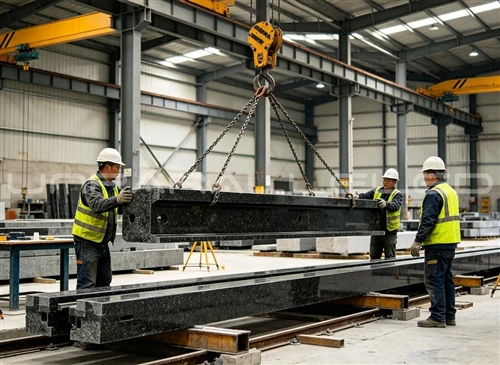
五,Follow step-by-step re-measurement logic for levelling and locking; do not deliver immediately after one-time locking In many projects, adjusting bolts are locked right after horizontal readings reach the standard, and delivery and equipment assembly follow immediately. The bolt locking action itself changes the force state of fulcrums and directly damages the adjusted horizontal benchmark. The standardized operation process: after rough and fine levelling, keep fulcrum bearing and stand still for a period before rechecking horizontal level. After stable readings are confirmed, lock the locking structure in a diagonal progressive way and recheck horizontal level after locking. After locking, large granite bases produce stress redistribution due to self-weight. One-time levelling acceptance is insufficient. Horizontal status needs continuous monitoring at intervals before upper equipment assembly.
六,Reserve conditions for long-term benchmark monitoring after levelling After acceptance of levelling in most projects, no monitoring points are reserved. After equipment assembly on the base, superimposed self-weight, seasonal temperature and humidity variation of workshop and slow foundation deformation will continuously affect the benchmark. At the scheme stage, UNPARALLELED Group advises customers to reserve monitoring points for regular recheck of plate levelness and flatness with electronic levels later. Once tiny deviation is captured, fine adjustment on fulcrums can be made timely to prevent continuous accumulation of benchmark deviation and maintain the long-term stable metrology benchmark performance of the base.