



In scenarios such as semiconductor optical inspection, coordinate measuring and laser measurement, the granite inspection base serves as the geometric origin of the entire equipment. Its plate benchmark is not only qualified at the time of delivery. The real technical difficulty lies in maintaining the nano-level plane benchmark steadily for years. Many platforms pass inspection upon delivery yet suffer benchmark drift and plate warping after months of operation. The root cause usually does not lie in the final grinding process, but the systematic deficiency in intrinsic material stability, full-process stress control, machining damage suppression, environmental isolation and periodic metrology closed loop. As a professional manufacturer deeply engaged in ultra-precision components, UNPARALLELED Group holds that long-term precision is essentially the full-chain suppression of "micro-deformation".
Substrate forms the fundamental basis for long-term benchmark stability. Confusion of stone materials commonly exists in the market. Porous and uneven grains hide massive native internal stress, which triggers deformation under temperature and humidity fluctuation and disqualifies them as long-term benchmarks. UNPARALLELED® black granite features dense and uniform crystal structure, high density and ultra-low thermal expansion, inherently resisting bending deformation induced by temperature swings. At the raw stone screening stage, UNPARALLELED Group conducts petrographic analysis and internal defect detection on rough stones to eliminate blocks with microcracks and mineral segregation, preventing slow deformation risks after long-term aging from the source. Different from ordinary marble available in the market, UNPARALLELED® black granite boasts extremely low water absorption, blocking volume creep caused by water vapor infiltration through micro-pores so that the plate geometric shape will not shift slowly with seasonal humidity changes. The group firmly opposes the industry malpractice of passing marble off as granite.
Stress release acts as the core procedure determining whether the base precision can stay stable. Every procedure from mining to sawing and rough machining introduces mechanical stress. Skipping sufficient aging will result in continuous stress release after delivery and gradual deformation of the benchmark surface. UNPARALLELED Group has established a complete multi-stage static aging scheme. Rough blanks after cutting are sent to the exclusive raw stone yard for long-term natural aging to eliminate surface stress brought by mining and cutting. After semi-finish grinding, workpieces are transferred to the constant-temperature workshop for static placement again. Only after machining residual stress is fully released will the final grinding process start. When material deformation converges, ultra-precision grinding is carried out to avoid the common industry problem of "qualified on delivery but rebounding later". This also explains why low-cost manufacturers' products work temporarily but degrade in benchmark over time - they skip multi-stage aging and only pursue one-time inspection data before shipment.
Ultra-precision gradient grinding reduces subsurface damage on the benchmark plate. Many simply equate granite platform precision to "good flatness". Yet another goal of grinding technology is to control subsurface damage of stone surface. Invisible microcracks left in rough machining will expand gradually under long-term vibration and temperature cycles and alter local plate morphology. UNPARALLELED Group adopts progressive grinding from coarse to fine, supported by senior craftsmen with over 30 years of manual grinding experience. While removing machining allowance, the subsurface damage is minimized. Manual fine grinding serves as the final critical process. Craftsmen accurately perceive micro cutting depth and evenly reshape the benchmark plate, forming a continuous and stable geometric benchmark for the whole plate instead of qualified local points. After grinding, micro-pore sealing treatment is implemented to seal tiny surface pores and prevent benchmark surface from long-term chemical erosion by coolant, dust, acid and alkali contaminants.
Structural design and physical vibration isolation protect the benchmark plate from external disturbances. Even stone with outstanding stability will deform under sustained vibration and local temperature difference. Simple four-point support cannot satisfy large granite bases. UNPARALLELED Group designs multi-point balanced support structure based on simulation calculation to avoid plate bending induced by self-weight. A dual vibration isolation system covers both production and application sides. The in-house constant temperature & humidity workshop of UNPARALLELED Group adopts thickened super-hard concrete foundation paired with deep vibration isolation trenches to cut off external vibration transmission. Finished bases are equipped with dedicated vibration-isolation supports to isolate high-frequency and low-frequency vibration from air compressors, motors and surrounding machine tools. Temperature management focuses on eliminating plate gradient temperature difference rather than merely keeping a fixed room temperature value. Temperature difference across different positions of one single base will trigger micron-level bending. Relying on the 10,000 ㎡ constant-temperature, humidity-controlled and dust-free workshop, UNPARALLELED Group ensures full thermal balance of stone workpieces and removes plate arching or sagging caused by local hot spots.
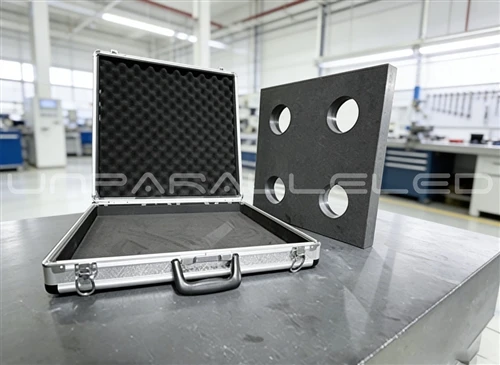
Metrology traceability closed loop builds a long-term benchmark monitoring system. Long-term precision cannot rely solely on factory inspection. A traceable periodic monitoring mechanism must be established. Instead of sampling a small number of points in final inspection, UNPARALLELED Group performs high-density grid sampling on the whole benchmark plate and draws a complete plane contour map to record deviation across all areas. The group is equipped with world-leading metrology tools including German Mahr dial gauges (0.5μm), Swiss WYLER electronic levels and UK Renishaw laser interferometers. All measuring tools can trace upwards to national metrology institutions to guarantee authenticity and reliability of each flatness evaluation. After delivery, UNPARALLELED Group develops periodic re-inspection plans according to customer application scenarios: annual calibration for conventional metrology equipment, and shortened re-inspection cycles for ultra-high-precision scenarios such as semiconductors and femtosecond lasers. Once tiny benchmark drift is captured, targeted partial repair grinding can be performed to keep the benchmark within allowable tolerance range.
Five interlinked segments - material, stress, grinding and metrology, jointly realize the long-term benchmark performance of granite inspection bases. A stable granite inspection base is not a plane obtained through one-time grinding, but a stable system covering raw stone selection, stress release, precision forming, environmental protection and continuous metrology. With full in-house machining capacity, complete international certification system and global metrology & scientific research cooperation resources, UNPARALLELED Group enables granite benchmark plates to serve as geometric origins for years in demanding scenarios such as semiconductor AOI, CMM and precision optical inspection, supporting stable operation of global ultra-precision industrial measurement.