



Many engineers in the precision equipment industry hold a misunderstanding: vibration reduction simply means installing shock-absorbing feet, isolation pads or external dampers. Such solutions can only passively weaken vibration after it occurs, failing to stop vibration from transmitting and superimposing inside the equipment structure. When equipment operates, excitation vibration generated by motor start-stop, reciprocating motion of linear axes and high-speed spindle rotation will still transfer upward, ultimately affecting the dynamic accuracy of the worktable. To truly suppress vibration, the core is not adding external buffer components, but optimizing the bottom load-bearing foundation of the equipment - the machine base.
So can granite machine bases cut down operational vibration generated during equipment operation at the source? The answer is yes, yet it depends on the stone material and machining process adopted for the base.
Vibration is essentially energy transfer. When moving parts of equipment produce excitation force, the material damping, rigidity and internal uniformity of the base determine whether vibration energy dissipates rapidly or keeps reflecting back and forth inside the structure. Ordinary cast iron bases feature acceptable rigidity yet low damping. Vibration decays slowly once generated, and persistent residual vibration tends to form. Welded metal bases contain welding stress; repeated vibration will trigger stress variation and greatly compromise long-term stability.
UNPARALLELED granite machine bases leverage the material's inherent high-damping property to rapidly absorb vibration energy. Dense and homogeneous natural granite crystal structure has no defects such as welding seams or casting pores. When excitation force transmits to the base, vibration energy is quickly consumed by the crystal structure, restraining resonance and preventing vibration from propagating upward to the worktable, optical and inspection assemblies. Unlike passive buffering from external vibration reduction accessories, the granite base acts directly as the bottom load-bearing skeleton of equipment, attenuating vibration at the starting point of the vibration transmission path to realize source vibration control.
Material performance alone is not sufficient; the residual stress inside the base also matters greatly. If components retain machining residual stress, cyclic continuous vibration will trigger gradual stress release, resulting in flatness deformation of the base and loss of benchmark accuracy. All UNPARALLELED granite bases undergo complete aging treatment to fully release internal stress. Combined with ultra-precision grinding technology, the flatness and parallelism of the base's mounting reference surface are guaranteed. After equipment assembly, force distribution remains uniform, and extra vibration induced by uneven local stress is avoided. The whole base forms a stable rigid damping system, maintaining unchanged reference geometry under continuous equipment start-stop and high-speed reciprocating working conditions.
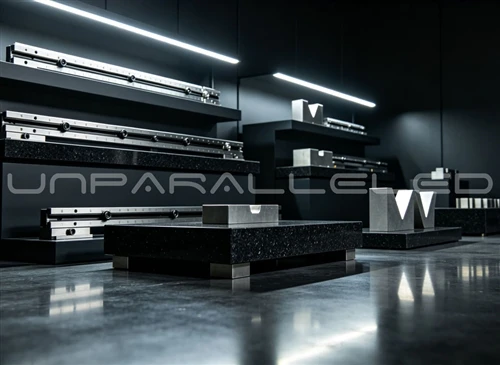
Many purchasers tend to confuse ordinary stone with precision granite bases. Many low-cost stone bases available on the market use stone with insufficient density and disordered crystal distribution and high internal porosity. Although polished surfaces look smooth, their damping performance is unstable, vibration attenuation effect is poor, and deformation may easily occur after long-term use. UNPARALLELED insists on adopting high-density black granite raw materials and firmly rejects shoddy substitutes, ensuring every base delivers stable damping performance and geometric stability.
In practical application scenarios, granite bases are widely applied to optical inspection equipment, XY linear motor stages, precision laser devices and semiconductor inspection machines. When equipped with granite bases, residual vibration during equipment movement is significantly suppressed, dynamic response becomes cleaner, and data dispersion of single and repeated measurements drops, reducing misjudgment and machining deviation caused by vibration. The equipment does not require frequent shutdowns for recalibration, improving overall operational stability.
In summary, external vibration damping components can only serve as auxiliary measures. To reduce equipment operational vibration at the source, a load-bearing base with both high rigidity and high damping is required. Relying on the innate material advantages and precision manufacturing processes, UNPARALLELED granite machine bases consume vibration energy at the vibration source and block upward vibration transmission, building a stable and reliable bottom reference for various ultra-precision equipment.