



A precision machine is only as accurate as the structure beneath it. In semiconductor equipment, coordinate measuring machines and laser systems, that structure is increasingly a granite base, a set of granite components, or a complete granite assembly that has been ground, lapped and inspected long before it is bolted to a frame. Where an axis has to move with almost no friction or wear, it runs on a granite air bearing. This article explains what each element does, where these structures are used in semiconductor and CMM equipment, and what to check when specifying them.
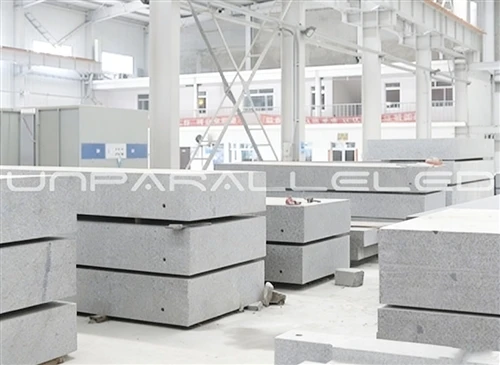
What a granite base does in a precision machine
A granite base is the load-bearing reference of a machine. It carries the guideways, the gantry, the workpiece table and, in some designs, the metrology frame, and it defines the geometry that every axis is measured against. Because it is the datum, its flatness, straightness and stability set the practical limit for the whole system. Black granite is the usual choice: it is dense, does not rust, is non-magnetic, has low thermal expansion and high internal damping, so it also absorbs vibration that would otherwise reach the measurement point. A finished base is ground and lapped to a flatness specification, and its mounting planes are then precision-machined or hand-scraped so that rails, motors and scales sit in the correct relationship.
Granite components and granite assemblies
Most machines are not a single block. They are built from granite components such as guideway beams, columns, gantry cross members, risers, tables, Z-axis slides and instrument frames. A granite assembly combines several of these parts, either on the machine builder's own line or as a pre-aligned sub-assembly delivered ready to integrate. Assemblies can include threaded inserts, vacuum grooves, air channels, cooling passages and mounting pads, all positioned before the final grinding pass so that the finished geometry stays consistent. Keeping those interfaces in one supplier's hands reduces the accumulated error that appears when parts are machined separately and then matched.
Granite air bearing systems: motion without contact
A granite air bearing replaces rolling or sliding contact with a thin film of compressed air between the moving carriage and the granite guide surface. Because there is no metal-to-metal contact, the axis does not wear, does not develop stick-slip at low speed, and can hold sub-micron motion without lubrication. The granite surface itself acts as the bearing race, so its flatness and surface finish directly affect film stiffness, load capacity and straightness of travel. Air bearings are used on precision stages, wafer and panel inspection platforms and metrology slides, where constant velocity and minimal vibration matter more than high load capacity.
Where granite bases, components and air bearings are used
These structures appear wherever mechanical stability sets the measurement or process limit. The table below maps common equipment types to the granite element usually specified.
| Equipment | Typical granite structure |
|---|---|
| Semiconductor equipment (lithography, wafer inspection, bonding) | Granite base and granite assembly with embedded inserts and air-bearing guideways |
| Coordinate measuring machines (CMM) | Granite base with granite bridge and column set, often on an air-bearing guideway |
| Laser processing and laser measurement | Granite base with high-damping mass and precision guideway surfaces |
| Automated optical inspection (AOI) | Granite base or granite stage for stable imaging at high magnification |
| Industrial CT and X-ray systems | Granite base and granite assembly carrying source, detector and rotary stage |
| Linear motor platforms | Granite base and granite linear motion stage providing the reaction and guide surface |
These are not marketing categories. They are the places where a structural error becomes a measurement error. A semiconductor tool that patterns features in the tens of nanometres, a CMM that reports to a few micrometres over a metre, and an industrial CT system that must keep source and detector aligned through a long scan all depend on the same property: the structure does not move when it is not asked to.
Material, damping and thermal behaviour
Granite earns its place because of measurable material properties rather than appearance. A dense, fine-grained black granite has high stiffness with good damping, so it resists deflection under load and ringing after a disturbance. Its coefficient of thermal expansion is low, so a change in room temperature moves the geometry less than it would move a steel or aluminium structure of the same size. It is also non-magnetic and non-corroding, which matters near motors, sensors and coolant. Cast iron and polymer concrete remain valid options for some machines, but granite is often preferred when thermal stability and vibration damping are the dominant requirements.
Flatness, standards and acceptance testing
The numbers that matter are specified, measured and traceable. Flatness and straightness of a granite surface are usually expressed as a tolerance over a defined length, defined at a reference temperature of 20 °C, with the exact values taken from the applicable standard for the surface plate, straight edge or square. For the machine as a whole, geometric accuracy is checked against machine tool or CMM acceptance standards, and an air-bearing stage is characterised by film stiffness, load capacity and straightness of travel. A supplier should be able to state which standard was applied, which instrument performed the measurement, and how that instrument is traceable. A certificate that lists a grade without a measurement method is not a substitute for a calibrated report.
Specifying a granite base or air bearing system
When you define a granite base, a granite component or a complete granite assembly, a short list of questions removes most of the risk. What flatness and straightness tolerance does the application actually need, and which standard defines it? What inserts, mounting threads and air channels must be embedded, and to what position tolerance? How will the finished part be lifted, transported and installed without distorting it? For an air-bearing axis, what film stiffness and load capacity are required, and what surface finish will the guide surface hold? Finally, does the supplier control grinding, lapping and inspection in-house, or subcontract the steps that decide the final accuracy?
Choosing a partner for granite structures
UNPARALLELED® manufactures granite bases, granite components, granite assemblies and granite air bearing systems for semiconductor equipment, CMM, laser, AOI, industrial CT and linear motor platforms. Our granite base page lists the standard base formats, and our granite air bearing page covers the guideway surfaces, inserts and air channels we build in. If your next project depends on a structure that holds its geometry year after year, send us the drawing and the accuracy target, and we will tell you which grade and which process it needs.