



For precision machine tools working under heavy loads, the bases endure massive dead weight, continuous cutting impact and interfacial friction from reciprocating guide rail sliding over long periods. Many machines meet precision requirements at the initial production stage. However, after months of heavy-load operation, micro-wear, local indentation and micro-slip on joint surfaces appear on reference surfaces, leading to gradual deterioration of geometric accuracy. This issue does not merely arise from wearing consumable rail parts; it occurs when base substrate and finish machining processes fail to match heavy-duty wear resistance requirements. The core goal of finish machining for heavy-duty bases is not only to produce surfaces with qualified flatness, but to form stable reference surfaces capable of resisting crushing, abrasive wear and alternating impact loads over long service life. Drawing on manufacturing experience for large-tonnage components, UNPARALLELED Group analyzes the process logic of finish machining for heavy-duty wear-resistant bases.
Three main types of wear exist under heavy-duty conditions: substrate indentation caused by static load, abrasive wear from reciprocating sliding of motion pairs, and fretting wear on interfaces triggered by cutting impact. Even with surface quenching, traditional cast iron bases have limited matrix hardness. Under sustained heavy load, the surface layer undergoes plastic flow. Fine metal debris trapped between guide rails and base joint surfaces creates continuous lapping effects and gradually erodes reference surfaces. Ordinary marble features weak bonding between internal mineral grains. Grains tend to peel off under heavy load, forming pitting pits, so its wear resistance cannot satisfy long-term mass production. UNPARALLELED® black granite has a density of 3100kg/m³, dense mineral crystals and high hardness, offering strong resistance against grain peeling and inherent excellent wear resistance. Meanwhile, mineral castings, UHPC and precision ceramics can also be selected according to different heavy-load types to match varied bearing and friction conditions.
The first step in finish machining of heavy-duty bases is blank pretreatment and self-weight stress relief, a prerequisite for long-term stability of wear-resistant surfaces. Large-size heavy-duty bases carry huge dead weight and easily produce elastic deformation due to improper support during rough machining. If finishing is performed directly, the base rebounds and deforms after fixture supports are removed. Distortion of reference surfaces causes uneven stress on guide rail mounting faces. Local stress concentration then emerges, leading to rapid local wear under heavy-duty operation. After rough machining, UNPARALLELED conducts long static aging inside constant-temperature and vibration-isolated workshops, adopting multi-point flexible support schemes to simulate actual load states on customer sites and release residual stress inside blanks. This prevents rebound deformation of reference surfaces after finish machining. For large monomer bases up to one hundred tons, multi-point conformable supports are applied throughout machining to avoid concentrated pressure at single points. It ensures evenly distributed stress on finished reference surfaces under real heavy loads and prevents local overload wear.
Second, progressive grinding processes build micro-surface morphology with low wear resistance. Heavy-duty wear resistance does not simply rely on mirror polishing; it requires controlling micro peaks and valleys on surfaces to reduce the risk of seizure of motion pairs while maintaining flatness. The process adopts progressive grinding wheels with sequentially reduced grit sizes without skipping grades, gradually eliminating grinding scratches and micro tool marks left in previous working steps. After mechanical fine grinding, craftsmen with more than 30 years of hand lapping experience conduct final fitting and grinding to optimize micro textures, reducing micro peaks on contact points of motion pairs. Micro protrusions on surfaces concentrate pressure at those spots under heavy load. Contact pressure rises sharply, and protrusions wear first, gradually expanding into large-area reference damage. Optimized finish textures disperse contact pressure, reduce adhesion and embedding of abrasive particles and slow down wear development. This lapping process is completed inside constant-temperature workshops with vibration isolation trenches and thick foundations to isolate external vibration interference and guarantee uniform lapping quality across all working surfaces.
Third, integrated finish machining of functional holes and embedded structures for heavy-duty applications prevents wear induced by local load concentration. Heavy-duty bases are pre-embedded with threaded inserts and locating sleeves for locking large guide rails and linear motor modules. Many manufacturers only process reference planes while leaving insufficient precision on mating surfaces of embedded components. After assembly and tightening, bolt tension causes local stress concentration on the base. Under long alternating loads, microcracks emerge around embedded holes, leading to local collapse of reference surfaces and triggering wear. UNPARALLELED performs synchronous finish machining of reference planes, mounting holes and positioning edges, controlling assembly gaps between embedded sleeves and stone substrates to distribute clamping force evenly over the substrate and avoid stress concentration points. All hole positions and form accuracy are inspected using Germany Mahr micrometers, Switzerland WYLER electronic levels and UK Renishaw laser interferometers. All measuring instruments are traceable to national metrology institutes to verify contact status under heavy-duty conditions.
Fourth, heavy-load simulation verification after finish machining tests wear stability in advance. Theoretical material wear resistance parameters cannot represent long-term machine performance on site. After finish machining, static loading and cyclic load tests are carried out to simulate long-term heavy load and alternating impact working conditions. We monitor flatness variation and local indentation of reference surfaces and check whether grain peeling or plastic deformation appears on micro surfaces. If the test reveals positions prone to wear, we trace back and adjust lapping processes, support layout or substrate selection to eliminate failure risks before delivery. "If you cannot measure it, you cannot manufacture it." Wear resistance of heavy-duty bases must be verified through physical testing instead of relying merely on material sample parameters.
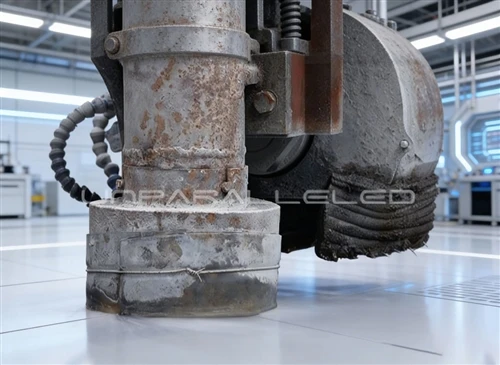
A common misunderstanding among customers: wear resistance of heavy-duty bases depends only on material hardness, and finish machining merely needs to guarantee flatness. In reality, heavy-duty wear results from combined effects of load distribution, micro surface morphology, substrate mechanical properties and residual stress. Even substrates with superior wear resistance will suffer rapid precision degradation after heavy-duty operation if stress relief, support layout and micro surface morphology are not properly handled in finish machining. The essence of finish machining is to unlock the inherent wear resistance potential of base materials, distribute load evenly across the whole reference surface and reduce risks of local overload-induced rapid wear.
In summary, finish machining for heavy-duty wear-resistant machine tool bases forms a complete process chain: blank stress relief, multi-point supported machining, progressive grinding forming, collaborative machining of embedded components and heavy-load loading verification. It eliminates stress rebound from the source, disperses contact pressure and optimizes micro surfaces to reduce abrasive and fretting wear risks. With full-spectrum ultra-precision component manufacturing capacity, UNPARALLELED Group supplies finish-machined heavy-duty base solutions made of granite, mineral casting, UHPC and precision ceramics. Our products help heavy precision machine tools retain benchmark accuracy, slow down precision degradation and extend service life under continuous heavy-load operating conditions.