



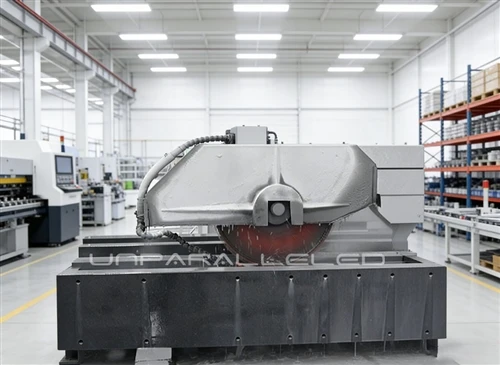
Choosing the base material is one of the most consequential decisions in the design of a precision machine. The base carries every axis, guide, spindle and scale, and its behavior under load, vibration and temperature change defines the accuracy ceiling of the equipment. The short answer to the granite versus cast iron question is this: granite is the better choice when your priority is high accuracy, low vibration and long term dimensional stability, while cast iron remains the better choice when you need heavy damping for shock loads, complex geometries, or when tooling cost and volume favor a casting based design. This article compares the two materials the way a design engineer evaluates them: by properties, by behavior in real equipment, and by total cost and lead time.
Why the Base Material Matters More Than You Think
In a precision CNC machine or a coordinate measuring machine (CMM), the mechanical structure typically contributes more to final positioning error than the control system does. Thermal expansion of the base directly moves the datum surfaces; a base that grows and shrinks with shop temperature shifts every measurement and every cut. Vibration through the base appears as chatter on machined parts and as noise in measurement data. And stress relaxation in the material changes geometry over months and years, which is why some machines need frequent recalibration while others hold alignment for a decade. Granite and cast iron handle these problems differently, and that difference is the core of a sound selection decision.
Granite Machine Base: Strengths and Characteristics
A granite machine base is usually machined from a single block of fine grained black granite, most commonly Jinan black (G654 type material). After sawing, milling and grinding, the granite is lapped to flatness levels that are difficult to reach on metal surfaces of the same size.
The practical advantages of granite fall into four groups. First, dimensional stability: granite does not rust and barely reacts to humidity, so once a base is stabilized after machining its geometry stays put, which is why granite dominates in metrology. Second, low thermal expansion: fine grained black granite expands at roughly 5 to 8 micrometers per meter per degree Celsius, less than half the value of gray cast iron, so in a shop with normal temperature swings this difference alone accounts for a meaningful share of total machine error. Third, vibration behavior: granite has high internal damping compared with steel and dissipates vibration quickly rather than ringing, which shows up as better surface finish and cleaner measurement data. Fourth, large surface accuracy: lapped granite reaches flatness below one micrometer over areas of one square meter or more, with a matte, non reflective surface that suits optical and laser systems.
The limits of granite are equally real. It is strong in compression but weak in tension, so it needs generous section thickness and cannot be welded or easily repaired if cracked. Tapped holes and inserts must be planned in advance and machined in, and because granite is cut from blocks rather than cast, highly complex geometries with deep pockets and internal channels are expensive or impossible.
Cast Iron Base: Strengths and Characteristics
Gray cast iron has been the default machine tool material for more than a century for good reasons. It can be cast into almost any shape, with ribs, walls, pockets, coolant channels, motor mounts and cable channels all formed in the pattern, and its graphite phase gives it excellent intrinsic damping against high frequency vibration. Its strength in tension and compression also allows thinner walls than granite design rules permit, which is why cast iron still dominates in conventional machining centers, press machines and gear cutting equipment.
The drawbacks appear in precision service. Cast iron expands at roughly 10 to 12 micrometers per meter per degree Celsius, about twice the rate of black granite, and it rusts when humidity is high unless painted or oiled. Castings also carry internal stresses; even after stress relieving and aging, residual stress redistribution can move geometry over time, which is why large cast beds are often naturally aged for months before final machining. Finally, a new casting requires a pattern, and the pattern cost is only justified when production volume is high enough to amortize it.
Side by Side Comparison
The table below summarizes the practical differences as they matter for equipment design. Values are typical engineering figures for fine grained black granite and for gray cast iron in the classes normally used for machine bases; specific grades vary, so always confirm against the supplier datasheet.
| Property | Granite Machine Base | Cast Iron Base |
|---|---|---|
| Density | About 2,900 to 3,070 kg/m3 | About 7,100 to 7,300 kg/m3 |
| Thermal expansion | 5 to 8 um/m per degree C | 10 to 12 um/m per degree C |
| Thermal stability in service | Very good, geometry moves little with shop temperature | Fair, responds faster to temperature changes |
| Vibration damping | High, vibration decays quickly, no ringing | Good, especially at high frequency, better than steel |
| Flatness retention | Sub micrometer flatness by lapping, stable for years | Achievable by scraping, but drifts more over time |
| Corrosion and maintenance | No rust, low maintenance, easy to clean | Rusts without paint or oil, needs surface care |
| Geometry freedom | Low to medium, best for block forms and planar features | High, ribs, walls and complex cast shapes possible |
| Typical machining lead time | 3 to 8 weeks depending on size and accuracy | Weeks to months, pattern making adds time for new designs |
| Cost profile | Predictable for prismatic bases, rises steeply with complex features | Low per unit at volume, high for prototypes due to pattern cost |
| Repairability | Difficult, inserts must be planned upfront | Can be welded and remachined in many cases |
Which Material for Which Equipment
The right answer depends on what the machine does. The breakdown below reflects the choices we see working in practice.
CNC machining centers and milling machines. For general purpose CNC tools, cast iron remains dominant because complex ribbed structures, integrated saddle ways and impact toughness matter more than ultimate thermal stability. For ultra precision CNC applications such as jig grinding, diamond turning and high end milling of optical molds, a granite machine base delivers measurably better thermal behavior and surface finish consistency, and many builders combine a granite bed with cast or steel support frames where toughness is needed.
Coordinate measuring machines. Granite is the near universal choice, because the base and working surface are often the same lapped body, the environment is temperature controlled, and there are no impact loads. Every leading CMM builder uses granite, and the material has proven itself over decades of service.
Laser cutting and engraving equipment. Laser machines combine fast moving gantries with beam paths sensitive to vibration and thermal drift. Granite bases hold beam alignment more stable than cast iron in shops with temperature variation, and tolerate spatter and coolant better than bare cast iron.
Optical inspection and metrology equipment. Vision systems, confocal microscopes and profilometers benefit from granite because the measurement signal lives at sub micrometer level, where the thermal drift and rust risk of cast iron are constant threats, and granite provides a clean, matte, non reflective surface that optical setups appreciate.
Semiconductor equipment. Wafer inspection, lithography support stages and metrology tools are almost universally built on granite, driven by dimensional stability at nanometer scales, cleanroom compatible low particle surfaces and electrical insulation. This is where granite has the clearest advantage and cast iron is rarely considered.
Press machines, heavy gear machines and rugged production equipment. Cast iron is generally the right answer here: shock loads, heavy workpieces and complex structural requirements favor cast metal, and accuracy demands are normally within what cast iron delivers comfortably.
Practical Selection Checklist
When you are at the material selection stage, work through these questions in order.
One, what accuracy do you actually need? If the machine must hold features below 5 micrometers or measure below 1 micrometer, granite's stability advantage becomes decisive; above 20 micrometers, cast iron usually does the job at lower cost.
Two, what does your temperature environment look like? A shop at 20 plus or minus 1 degree C is friendly to either material, but one that swings 5 degrees between day and night exposes the thermal expansion difference quickly.
Three, how complex is the geometry? Deep pockets, internal ribs and off axis features favor a casting, while a prismatic block with planar datum surfaces and a pattern of holes is simpler and faster in granite.
Four, what is the production volume? One off and low volume precision machines favor granite because there is no pattern investment, while high volume conventional machines favor cast iron because the pattern cost disappears across the fleet.
Five, what loads and impacts will it see, and where will it live? Interrupted heavy cuts and press style impacts push toward cast iron, while static precision loads favor granite, and in humid, corrosive or cleanroom environments granite's freedom from corrosion and particle generation is a real benefit.
Hybrid Designs Are Often the Best Answer
Many of the best precision machines no longer force an either or choice. A common architecture puts a granite bed where the reference surfaces live and surrounds it with a steel or mineral casting frame that carries motors, covers and utilities. Another embeds granite rails or reference strips into a cast iron body, gaining metal friendly mounting features while keeping granite where accuracy is set. Mineral casting, which combines granite aggregate with an epoxy binder, offers casting level geometry freedom with damping and thermal behavior closer to natural stone. The principle is to allocate material to function: reference surfaces go to granite, structural toughness and complex geometry go to metal or mineral casting.
How We Support Both Decisions
As a manufacturer of granite machine bases, granite metrology structures, mineral casting components and precision ceramics, we help customers evaluate the material question with real engineering input rather than catalog claims. Our team reviews drawings and load data, proposes section thicknesses and mounting schemes, supplies material certificates and dimensional inspection reports, and supports pilot and volume production. For granite bases we machine, grind and lapse every critical surface in house and integrate threaded inserts, air bearing pockets, cooling channels and motor mount pads. For builders who need a precision CNC base or a granite metrology structure, we provide full dimensional reports and flatness calibration certificates with every delivery.
Request a Design Review and Quotation
If you are weighing granite against cast iron for a new machine platform, send us your outline drawing, expected load map, accuracy targets and operating environment description. Our engineering team will return a material recommendation, a feasibility assessment of holes and inserts, an indicative flatness and accuracy plan, and a quotation with lead time, normally within a few working days. There is no cost for this drawing evaluation stage, and it is the fastest way to find out whether granite is the right investment for your equipment.