



Walk through the layout of a femtosecond laser micromachining cell and you'll notice something: the beam delivery optics get most of the engineering attention, and the gantry underneath gets treated almost as an afterthought. That's a mistake worth correcting early, because at the tolerances these systems run at, the structure carrying the optics matters just as much as the optics themselves.
Sub-micron positioning accuracy doesn't survive contact with a structure that rings like a tuning fork every time a stage accelerates. This is where the choice between welded steel, cast iron, and granite stops being a cost-sheet decision and starts being a performance one.
What "Damping" Actually Means on a Laser Platform
Vibration in a laser gantry comes from two directions - external floor-borne disturbance, and internal excitation from the motion system itself. Every time an XY stage accelerates or decelerates, it injects energy into the structure it's mounted on. Steel transmits that energy efficiently and dissipates it slowly, which means the structure keeps oscillating for a noticeable settling time after each move. In a high-throughput picosecond drilling or scribing process, that settling time adds up across thousands of cycles a day.
Granite behaves differently at the material level. Its polycrystalline structure - a dense matrix of interlocking mineral grains rather than a homogeneous metal lattice - converts vibrational energy into heat far more efficiently than steel does. The industry shorthand for this is a higher internal damping coefficient, and in practical terms it means a granite gantry stops moving sooner after a disturbance than an equivalent steel one. For laser processes where beam positioning has to settle before the next pulse fires, that shorter settling window translates directly into cycle time.
Thermal Behavior Compounds the Case
Damping isn't the only reason granite shows up in laser platform design, and it's worth being honest about that - steel and mineral casting both have their place, and granite isn't a universal answer. But laser processing cells often run in environments with localized heat sources: the laser head itself, cooling loops, sometimes nearby process chambers. A gantry with a thermal expansion coefficient an order of magnitude below steel's holds its geometry through those localized temperature gradients far better, which matters when the optical path has to stay aligned across a multi-hour production run.
Granite is also non-magnetic and dimensionally stable over years, not just hours - a detail that matters less on day one and more on the recalibration schedule three years into a machine's service life.
Where Gantry Geometry Becomes the Real Engineering Problem
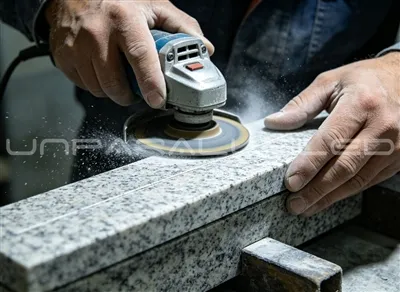
A flat granite plate is straightforward to produce. A gantry - two vertical columns, a horizontal crossbeam, precisely bored mounting patterns for linear guides and motor mounts - is a different challenge entirely, and this is where fabrication experience separates suppliers more than material spec sheets do.
The columns and beam have to hold consistent squareness relative to each other across the full assembly, not just at each individual joint. Mounting hole patterns for linear rails need positional accuracy that stays consistent across a beam that might run two meters or more. And because granite doesn't weld, every interface between components depends on precision-ground contact surfaces and mechanical fastening - dowel pins, threaded inserts, sometimes epoxy-bonded joints - engineered to behave predictably under load, not just look flush on the bench.
We've built gantry-style granite frames for laser and precision measurement platforms where the working requirement was hole-pattern accuracy across a multi-meter beam span, combined with a mass-relief bore through the base to reduce thermal lag without giving up beam stiffness. It's a reminder that the interesting engineering work on a granite gantry isn't cutting the stone flat - it's holding geometric relationships across an assembled structure that started life as separate blocks.
What to Ask Before Specifying a Granite Gantry
For engineers scoping a laser platform base, a few questions tend to separate a solid supplier conversation from a guesswork one: What squareness tolerance can be held across the full gantry span, not just a single face? How is hole position verified across the assembled frame rather than on individual components before assembly? What material density and damping data exists to back the granite grade being quoted, since - as with any natural stone product - quality varies significantly between suppliers?
Granite won't fix a poorly designed motion system, and it isn't the right call for every laser platform - some lighter-duty or cost-sensitive applications are better served by mineral casting or welded steel with isolation mounts. But for high-repetition, tight-tolerance laser processing where settling time and long-term geometric stability drive throughput and yield, it remains one of the more dependable structural choices available, and one worth specifying with the same rigor applied to the optics riding on top of it.