



Granite doesn't take a tap. That single fact drives almost every design decision around mounting fixtures, sensors, or tooling onto a granite surface plate or inspection platform, and it trips up more first-time buyers than any other part of the specification process. Steel and cast iron bases let you cut internal threads directly into the parent material. Granite, being a natural crystalline stone, will chip or crack under that kind of stress. So the industry solved the problem a different way - with thread inserts.
If you've ever specified a granite inspection platform and wondered why the drawing calls out "M8 insert, 20mm depth" instead of just "M8 tapped hole," this is why. It's worth understanding the mechanics of it, because a poorly installed insert is one of the more common - and more preventable - failure points on an otherwise well-machined granite base.
What a Thread Insert Actually Is
A thread insert is a separate metal component, usually brass or stainless steel, bonded into a precision-bored hole in the granite. The insert itself carries the internal thread, so the fastener never contacts the stone directly. Two broad categories dominate the market:
Bonded (epoxy-set) inserts are the standard choice for granite. A hole is drilled to a specified diameter and depth, cleaned of dust, then filled with a structural epoxy before the insert is pressed or screwed into place. Once cured, the epoxy layer transfers load from the insert to the surrounding stone across the full bonded surface, rather than concentrating stress at a single point.
Mechanical expansion inserts, which rely on a wedge or knurl action to grip the hole wall, are used far less often on granite. They depend on radial pressure against the hole wall to hold position, and granite's brittleness makes that approach a real risk - over-torque an expansion insert in stone and you can crack the surrounding material instead of securing the fastener.
Getting the Hole Right Before the Insert Ever Goes In
Most insert failures trace back to the boring step, not the bonding step. A few things matter more than people expect:
Depth-to-diameter ratio. A hole that's too shallow relative to its diameter won't give the epoxy enough bonded surface area to resist pull-out under load, especially on fixtures that see repeated clamping and unclamping. As a rough guide, insert depth should run at least 1.5 to 2 times the nominal thread diameter for general fixturing loads - more for high-load or dynamic applications.
Hole wall roughness. A hole that's too smooth reduces the mechanical keying the epoxy relies on; a rough-bored hole with proper cleaning generally bonds better than a mirror-finished one. This runs counter to what people assume about precision machining, where smoother is usually better - here, it isn't.
Dust and residue removal. Granite dust left in the hole is probably the single most common cause of weak bonds we see traced back after the fact. The hole needs to be blown out and, ideally, solvent-wiped before epoxy goes in - a step that's easy to skip on a rushed production run and hard to detect until the insert fails months later.
Cure time under actual shop temperature, not the datasheet's ideal condition. Epoxy cure rates slow meaningfully below about 15°C, and inserts loaded before full cure are a recurring cause of early pull-out complaints.
Positioning Accuracy Matters as Much as the Bond
On an inspection platform with dozens of insert locations - for fixture plates, sensor mounts, or guideway rails - the hole pattern's positional tolerance often matters more to the end customer than any single insert's pull-out strength. A pattern that drifts even a few hundredths of a millimeter across a one-meter plate can force a fixture designer into slotted holes or shims, which defeats part of the reason for choosing a precision granite base in the first place.
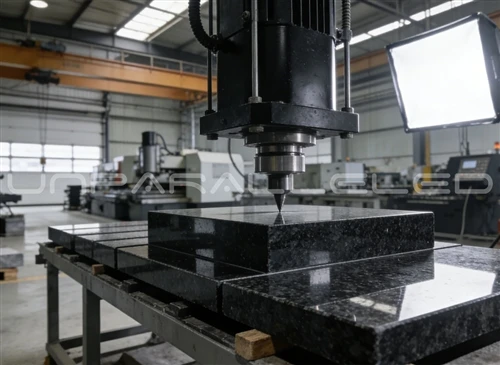
This is one of the areas where in-house drilling equipment and QC discipline actually shows up in the finished part. We bore and set inserts on granite bases as a standard part of our assembly process, and the recurring lesson from doing it at volume is that insert reliability is decided well before the epoxy is mixed - in how consistently the holes are bored, cleaned, and inspected before anything gets bonded in.
A Few Questions Worth Asking a Supplier
Before ordering a granite platform with a pre-installed insert pattern, it's reasonable to ask what insert material and bonding epoxy are being used, what pull-out or load rating the supplier can document, and how hole position is verified across the finished assembly rather than on a sample coupon. None of this makes for exciting reading on a spec sheet, but it's exactly the kind of detail that determines whether a fixture stays put for ten years or works loose after ten months.