



The service life of granite structural components starts with the quality of stone blanks. Many equipment manufacturers encounter rapid benchmark degradation and propagation of hidden cracks in later operation. In most cases, the root cause lies in low-grade stone raw materials with inherent natural defects. As the base substrate of components, raw materials directly determine performance in subsequent machining, aging treatment and long-term working conditions. UNPARALLELED® adheres to strict raw material screening standards and controls quality from the quarry source to extend the service life of granite structural components.
Common stone mining only focuses on appearance and mining cost, while granite raw materials for precision engineering follow an entirely different screening logic. During material selection, technicians conduct multi-dimensional inspections on raw stone blocks, focusing on natural internal cracks, mineral inclusions, loose interlayers and color defects. Even tiny invisible microcracks may gradually expand under long-term temperature cycling, continuous load and vibration, eventually damaging the overall structural integrity of components. Raw blocks with loose mineral particles or impurity-rich zones are rejected directly, preventing inherent defects from becoming potential failure risks later.
High-density black granite is the preferred raw material for precision structural parts. Its mineral crystals interlock tightly to form a compact and stable structure, with density reaching 3100kg/m³ and thermal expansion coefficient ≤3e-6/℃. This crystal structure brings multiple durability benefits. Low porosity greatly reduces penetration of oil and coolant into stone and avoids surface powdering. Ultra-low thermal expansion weakens crystal stress induced by ambient temperature fluctuation. The material is chemically inert and free of oxidation and rust. These inherent material properties allow components to remain stable under complex workshop conditions and slow down performance degradation.
Raw material screening is not a one-time check before warehousing. It runs through the whole blank processing workflow. After raw blocks are selected and cut into blanks, re-inspection will be carried out to observe cross-section textures and confirm no hidden internal defects. Only qualified blanks can proceed to rough machining and long-term stress-relief aging. If raw materials have loose crystal structures, even complete aging, grinding and sealing processes cannot compensate for inherent material weaknesses, and the service life of components will still be greatly shortened.
Differences in raw material quality will be amplified over long-term working conditions. Even if low-grade stone meets precision standards at delivery, its micropores tend to absorb contaminants under alternating dust, coolant and temperature, which gradually causes surface peeling. Internal microcracks keep expanding under cyclic load and finally lead to edge chipping and deformation. In contrast, granite components made from carefully selected premium raw materials have stable crystal structures and stronger resistance to environmental erosion. Combined with staged stress-relief aging and micro-pore sealing post-treatment, material aging can be significantly delayed and service life prolonged.
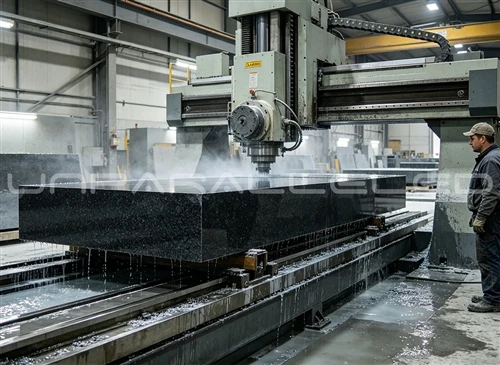
For large workpieces such as heavy machine bases, gantry bridge components and long machine beams, raw material selection criteria become even stricter. Large-size raw blocks have more complex internal stress distribution. Local looseness or hidden cracks bring much higher risks than those for small measuring tools. Relying on a large raw-stone storage yard, UNPARALLELED stores premium selected raw blocks, meeting raw material requirements for large granite components weighing dozens of tons and ensuring uniform material without locally weak zones for large structural parts.
For precision equipment manufacturers, purchasing granite components should not merely compare delivery precision and price. Raw material quality is the fundamental factor determining service life. Structural components produced from premium granite raw materials, supported by full-process quality control, can serve steadily for many years in semiconductor inspection, ultrafast laser processing, CMM measurement and other scenarios. They reduce replacement costs and downtime losses caused by aging benchmark parts.