



The semiconductor industry has entered the era of nanometer manufacturing processes. Core equipment such as lithography, wafer inspection, precision packaging and optical inspection keeps raising the bar for precision requirements. As chip processes evolve from micrometers to 3nm, 2nm and even more advanced nodes, the stability, precision consistency and environmental adaptability of equipment load-bearing bases directly determine chip yield and production stability. Among various base materials including metal alloys, ordinary stone and composite materials, precision granite platforms have become the standard core carrier for high-end semiconductor equipment. This is not a habitual industry choice, but the optimal solution of material properties, processing accuracy and long-term reliability under ultra-precision manufacturing scenarios, and an essential requirement for ultra-high-precision semiconductor production.
Many confuse granite with ordinary marble, yet there is a world of difference between them in precision industry. This is the core reason why semiconductor equipment rejects inferior stone and selects high-grade precision granite. Marble adopted by most low-end equipment on the market features loose texture, uneven density and abundant internal pores. It is prone to micro-deformation caused by temperature, vibration and external force, and only meets low-precision demands of general mechanical processing. In contrast, UNPARALLELED® exclusive black precision granite achieves all-round breakthrough in material performance with an ultra-high bulk density of nearly 3100kg/m³. Its physical stability surpasses that of similar granite from Europe and America. It eliminates hidden dangers of loose deformation and precision drift at the raw material stage, perfectly fitting the 24/7, heavy-load and ultra-high-precision operation scenarios of semiconductor equipment.
1. Ultimate Thermal Stability: Solving Thermal Drift Challenges in Semiconductor Manufacturing
During operation of semiconductor precision equipment, linear motors, transmission modules and laser components continuously generate minor heat sources. Meanwhile, subtle temperature fluctuations exist in cleanroom environments. Even a temperature change of one degree Celsius may trigger micrometer-scale deformation of ordinary metal bases, leading to wafer alignment deviation, overlay error, distorted inspection data and massive chip scrap.
Precision granite boasts core characteristics including ultra-low coefficient of thermal expansion, zero creep and excellent thermal equalization. Its thermal deformation rate is far lower than metal materials such as steel and aluminum. It will not expand or contract with equipment heat generation or ambient temperature variation. Even under long-term constant-temperature conditions in semiconductor workshops and complex scenarios with continuous equipment heat emission, granite platforms maintain nanometer dimensional stability and firmly lock the benchmark precision of equipment. It fundamentally resolves process errors caused by thermal drift and provides a constant precision benchmark for lithography alignment, wafer inspection, precision coating and other core processes - a core advantage metal bases cannot deliver.
2. Natural Vibration Damping: Establishing a Stable Foundation for Nanometer Precision Operation
Ultra-precision semiconductor processing and inspection are extremely sensitive to vibration. Micro-vibrations from workshop floors, self-induced vibration of running equipment and airflow disturbance can directly affect the operational precision of femtosecond laser processing, coordinate measuring machines, AOI optical inspection, perovskite coaters and other equipment. Slight vibration can create nanometer precision deviation and cause chip defects.
Precision granite features natural micro-pore structures inside and delivers outstanding vibration damping performance. It can absorb and attenuate various micro-vibration energy autonomously, preventing vibration transmission and resonance to realize passive vibration isolation and stable positioning. Compared with metal materials prone to resonance and vibration conduction, granite platforms sustain stable benchmark for equipment operation. Combined with the dedicated anti-vibration structural design of UNPARALLELED constant-temperature & humidity clean workshop, including 1000mm ultra-hard concrete floor, 2000mm deep anti-vibration trenches and silent crane system, external vibration interference is thoroughly eliminated. The equipment operates in a vibration-free and highly stable environment to satisfy stringent requirements of nanometer-level precision semiconductor operations.
3. High Precision Machinability: Meeting the Ultimate Benchmark Demands of Semiconductors
The load-bearing base of semiconductor equipment acts as the "origin of reference" for all precision motion, inspection and processing tasks. Its flatness, levelness and precision uniformity directly define the upper limit of the whole machine's accuracy. Unlike rough processing techniques for ordinary stone, high-end precision granite platforms adopt ultra-fine hand lapping together with world-class equipment to achieve nanometer flatness and micrometer dimensional precision.
Supported by decades of senior lapping craftsmen capable of nanometer-level hand grinding, large-scale precision grinding machines from Taiwan Nantou, and a full set of world-leading inspection tools including German Mahr, Japanese Mitutoyo and British Renishaw, we strictly follow multiple national metrology standards from Germany, the US, Japan, China, UK, Russia and more. This enables industry-leading flatness, squareness and parallelism of granite platforms. Besides, granite is wear-resistant, corrosion-resistant, non-magnetic and scratch-resistant. It will not suffer precision degradation, surface abrasion or rust during long-term service. It perfectly adapts to clean, high-precision and long-cycle production environments in semiconductor cleanrooms, reduces frequent calibration and maintenance, and greatly improves equipment operational stability and service life.
4. Mass Production & Customization Capacity: Covering Full-Scenario Semiconductor Applications
Semiconductor equipment covers a wide range of categories, from wafer drilling, precision inspection and laser processing to new-energy lithium battery inspection, optical imaging and linear motor motion platforms. Different equipment puts forward differentiated requirements on base dimension, load capacity, precision and structure. Most ordinary stone manufacturers cannot meet such demands, so the scalable, customizable and standardized production capacity of high-end precision granite producers becomes a key consideration for semiconductor enterprises during supplier selection.
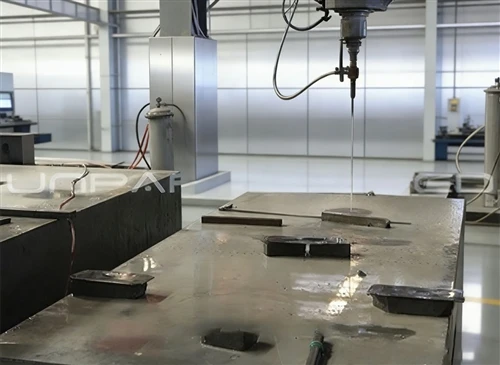
As an industry benchmark manufacturer of precision granite, UNPARALLELED operates a 200,000 ㎡ standardized manufacturing base and four dedicated granite bed production lines. We realize stable mass production of oversized, heavy-load and ultra-precision granite components. We can fabricate ultra-large precision bases with a single piece maximum length of 20m, width of 4000mm, thickness of 1000mm and weight up to 100 tons, fully satisfying customized demands for large semiconductor equipment and integrated machine beds. Meanwhile, with comprehensive international trademark and patent registration, ISO integrated management system certifications and CE certification, product precision is traceable to national metrology institutes. Our products meet strict access requirements of the global semiconductor industry, and we serve as a core partner for Fortune 500 enterprises such as Samsung, Apple and Bosch, as well as national metrology institutes and top universities worldwide.
5. Long-Term Reliability: Fulfilling Continuous Production Needs of Semiconductor Industry
Semiconductor fabs run 24/7 continuous mass production, imposing strict requirements on long-term stability, weather resistance and consistency of equipment bases. Ordinary metal bases tend to generate stress deformation and fatigue deformation after long-time operation, while inferior stone materials suffer aging, warpage and precision decay. Frequent precision calibration and equipment maintenance will severely reduce production capacity and chip yield.
Precision granite features stable structure, free of internal stress, anti-aging and temperature-resistant. It maintains high precision for decades after forming without obvious precision attenuation and minimal calibration needs. In addition, the material is dust-free and unlikely to generate contaminants, fully complying with cleanroom standards of semiconductor workshops. It will not contaminate wafers, optical components and other precision parts. From stability, cleanliness and durability perspectives, it fully meets the long-term, high-efficiency and high-precision production requirements of semiconductor industry.
Conclusion
The competition for ultimate precision in semiconductor industry is essentially a competition of industrial base materials and precision manufacturing technology. Granite platforms are the first choice for semiconductor equipment load-bearing bases mainly due to their comprehensive material advantages: thermal stability, vibration resistance, high precision, wear resistance, cleanliness and long service life. It perfectly solves core pain points in nanometer manufacturing such as precision drift, vibration interference, benchmark loss and insufficient service life.
With continuous advancement of ultra-precision industry, UNPARALLELED high-end precision granite as core base material keeps consolidating the precision foundation of high-end semiconductor manufacturing. With stringent standards for precision manufacturing and continuous innovation in processing technology, we help the global semiconductor industry achieve higher precision, better yield and more stable performance.