



In semiconductor manufacturing, yield loss often stems from invisible micro-vibrations. Wafer exposure, laser micro-machining, optical inspection and precision motion platform operations all rely on nanometer-level benchmarks. When troubleshooting chip defects, many production line engineers first check lasers, lenses and motion controllers, yet frequently overlook that the base is the first gateway in the vibration transmission chain. Vibration sources are complex: air compressors in the factory, air-conditioning fans, reciprocating motion of adjacent equipment, and even faint disturbances caused by pedestrian traffic on the floor can transfer along the ground to the equipment body. Far more than a simple load-bearing table, a granite base acts as a passive vibration suppression system. It attenuates disturbances through multi-layer mechanisms including vibration absorption, modal regulation and benchmark locking, safeguarding the yield of chip production.
Vibration issues fall into two categories: external ground-borne micro-vibrations and self-excited vibration generated by the equipment's own motors and linear modules. Metal bases feature high rigidity but low damping; vibration energy reflects repeatedly inside metal structures, easily triggering resonance. Tiny vibrations get amplified and transmitted directly to the working surface for processing. Ordinary stone and composite materials suffer uneven material properties, leading to unstable vibration attenuation. Although qualified after short-term commissioning, their vibration damping performance gradually declines as internal stress releases over long service time.
Precision granite has a unique dense crystalline mineral structure with inherent high damping properties. When vibration energy reaches the granite platform, crystal interfaces convert kinetic energy into minimal heat, dissipating energy instead of transmitting or amplifying vibration like steel. This material-native vibration absorption capability differs from external air-bearing vibration isolators. Isolators mainly handle low-frequency large-amplitude vibration, while granite bases suppress medium-and-high-frequency micro-vibrations - the frequency band most sensitive to semiconductor optics and laser machining. The two form double-layer protection. For processes extremely sensitive to nanoscale displacement such as femtosecond laser machining, AOI optical inspection and X-ray inspection, medium-and-high-frequency micro-vibrations are the primary culprits causing pattern shift, edge burrs and false inspection judgments, which granite targets to resolve.
Beyond the material's inherent damping, the overall structural rigidity and stress-free property of granite platforms are critical to preventing secondary vibration amplification. Metal components retain residual machining stress after CNC processing. Stress slowly releases over time, causing minor structural deformation, shifting the equipment's natural vibration frequency and triggering resonance drift in later stages. High-grade precision granite undergoes prolonged natural aging and contains almost no internal stress after forming. The natural frequency of the whole platform stays stable and controllable. During the early-stage equipment simulation phase, engineers can conduct vibration simulation based on granite's stable modal parameters to avoid resonance points within the equipment operating range. This circumvents resonance risks from the design stage and reduces uncertainties in later production line commissioning.
Under operating conditions inside semiconductor cleanrooms, vibration control also demands long-term consistency. Semiconductor fabs run 24/7 nonstop. The base surface bears continuous loads from reciprocating linear motor platforms and the weight of optical assemblies. Inferior stone features abundant internal pores. Its structure slowly degrades under repeated loading, vibration damping performance gradually decays, the benchmark precision of equipment drops after several months, and yield fluctuates accordingly. UNPARALLELED® black granite boasts high density and tightly bonded crystals. Its structural performance remains stable under long-term loading without damping decay over time. Supported by rigorous lapping processes, the flatness of the platform working surface stays consistent, and the vibration transmission path will not change due to base deformation, maintaining stable vibration suppression throughout the equipment's entire service life.
Material advantages alone cannot achieve extreme vibration control. Machining and inspection determine whether the vibration reduction solution can be realized. Errors in flatness, parallelism and squareness of the granite platform alter stress distribution, and local defects become vibration amplifiers. Therefore, the lapping and inspection of granite platforms are completed with multiple international metrology instruments and verified in accordance with multiple national precision metrology standards. Senior lapping craftsmen control surface micro-morphology to guarantee uniform stress distribution on the platform and avoid vibration distortion induced by localized stress concentration. Every component undergoes vibration characteristic testing before delivery to ensure damping and modal parameters meet the design requirements of semiconductor equipment, rather than merely checking geometric dimensions.
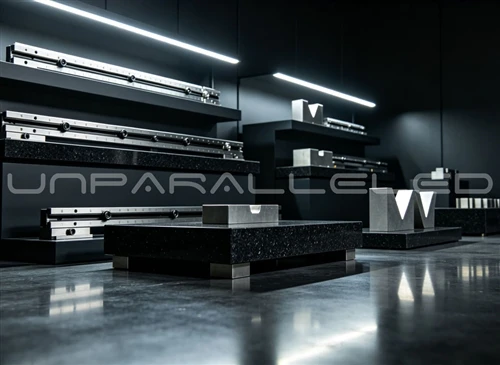
At the level of complete machine integration, granite bases also function as partitions for vibration isolation. Inside semiconductor equipment, motion modules, laser sources and optical lenses are all mounted on the granite platform. The platform decouples the core precision units of the equipment from the outer frame. External vibration gets absorbed upon reaching granite and hardly transfers upward to the wafer processing area. This property is especially vital for XY linear motor stages, perovskite coating equipment and coordinate measuring machines. Even with unavoidable background micro-vibration in the workshop, granite bases can maintain a stable benchmark on the working surface, ensuring repeat accuracy for every exposure, inspection and coating operation and cutting down wafer scrap caused by random errors.
Many customers confuse vibration reduction schemes: air-bearing vibration isolation systems isolate low-frequency large-amplitude vibration, while granite bases absorb medium-and-high-frequency micro-vibrations. The two are complementary rather than mutually exclusive. A mature vibration suppression solution for semiconductor equipment combines air-bearing vibration isolators with precision granite bases. Without granite bases, even with top-tier air isolators, self-excited vibration generated by motors inside the equipment will propagate within the metal frame and directly affect the stability of optical components.
Conclusion
The battle for semiconductor yield is not only about optimizing light sources, algorithms and process parameters, but also systematic management of micro-vibration transmission paths. The value of granite platforms lies not merely in supporting equipment weight. Relying on dense crystals with natural high damping, stable modal performance and zero internal stress, they cut off transmission paths of medium-and-high-frequency micro-vibrations and reduce processing deviations brought by random disturbances. Stable benchmarks, consistent vibration suppression performance and long-lasting geometric precision jointly minimize wafer defects and stabilize yield in semiconductor production lines. As nanometer processes keep advancing, these precision granite bases hidden at the bottom of equipment have become an indispensable underlying guarantee for ultra-precision semiconductor manufacturing.