



In the controlled, high-stakes environment of a professional metrology laboratory, accuracy is not just a goal-it is the absolute standard of operation. Every measurement taken, from the calibration of a gauge block to the inspection of a complex turbine blade, relies entirely on the integrity of the reference platform it rests upon. As industries continue to push the boundaries of manufacturing tolerances into the sub-micron and nanometer ranges, the foundational instruments of the lab must evolve to meet these rigorous demands. Today, advanced granite and ceramic measuring instruments stand at the forefront of this evolution, providing the unwavering stability and precision that modern science and engineering require.
The Enduring Legacy of Precision Granite
For decades, high-quality granite has served as the backbone of professional metrology labs around the world. Quarried from deep underground deposits of fine-grained igneous rock, precision granite surface plates and measuring instruments offer a unique combination of physical properties that are exceptionally difficult to replicate with metals or synthetic materials. The secret to granite's success lies in its geological history. Having been subjected to immense natural pressure and aging over millions of years, the internal stresses within the stone have long since dissipated. This means that once a granite surface is precision-ground and lapped to a mirror finish, it remains dimensionally stable for a lifetime.
In a professional lab setting, granite surface plates serve as the ultimate "zero point" or datum. Their exceptional flatness provides a reliable baseline against which all other parts are measured. One of granite's most celebrated attributes is its thermal stability. With a relatively low coefficient of thermal expansion, granite is highly resistant to the minor temperature fluctuations that are inevitable in any lab environment. This ensures that measurements taken in the morning remain consistent with those taken in the afternoon, safeguarding the integrity of long-term inspection projects.
Furthermore, granite is chemically inert and non-magnetic. Unlike cast iron, it is completely immune to rust and corrosion, eliminating the need for protective oils that can attract dust and compromise cleanliness. Its non-magnetic nature is particularly crucial in labs that utilize sensitive electronic measuring probes, as it ensures there is no electromagnetic interference during data collection. While incredibly hard and wear-resistant, granite also possesses a unique safety mechanism: if accidentally struck, it tends to chip or form a small depression rather than raising a burr. A raised burr on a metal plate can ruin the flatness of the entire surface, whereas a small pit in granite leaves the surrounding area perfectly intact.
The Rise of Advanced Technical Ceramics
While granite remains a staple in metrology labs, the last two decades have seen the meteoric rise of advanced technical ceramics-specifically high-purity alumina and zirconia-as a premier material for high-end measuring instruments. As manufacturing sectors like semiconductor fabrication, optics, and medical device engineering demand faster and even more precise inspections, ceramics have stepped in to fill a critical niche.
The primary advantage of advanced ceramics over granite is their extreme hardness and stiffness. Technical ceramics are significantly harder than granite, making them virtually impervious to scratches and wear, even under heavy, repetitive use. More importantly, ceramics have a much higher modulus of elasticity (stiffness). This allows engineers to design ceramic measuring instruments-such as CMM (Coordinate Measuring Machine) bridges, air-bearing guideways, and precision squares-that are thinner and lighter than their granite counterparts without sacrificing rigidity.
In professional labs equipped with high-speed automated CMMs, the reduced weight of ceramic components is a game-changer. It allows for much higher acceleration and deceleration rates without inducing structural vibration or "chatter." This means that inspections can be completed faster without compromising accuracy, significantly boosting lab throughput. Additionally, advanced ceramics can be sintered and machined into incredibly complex, net-shape geometries that would be impossible or prohibitively expensive to carve out of solid granite. This allows for the integration of air-bearing surfaces, cooling channels, and mounting points directly into the structure of the instrument.
Granite vs. Ceramics: A Strategic Choice for Labs
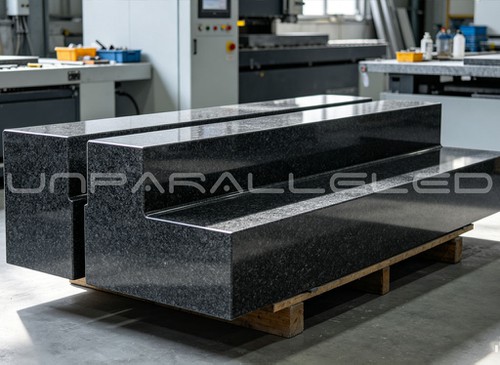
For laboratory managers and procurement specialists, the choice between granite and ceramic instruments is rarely about which material is "better" in a vacuum, but rather which is better suited for a specific application. Granite remains the undisputed champion for large-scale surface plates and heavy-duty structural bases. Its natural vibration-damping properties are superior, making it ideal for isolating sensitive measurements from environmental noise. It is also generally more cost-effective for large volumes, making it accessible for general-purpose inspection areas.
On the other hand, ceramics are the material of choice for moving components and ultra-high-speed applications. If a lab is investing in a next-generation, high-speed scanning CMM, the moving bridges and z-axis rams will almost certainly be made of ceramic to maximize dynamic performance. Ceramics are also preferred in environments where chemical resistance to strong acids or alkalis is required, as their non-porous nature offers total protection against corrosive substances.
Ultimately, many state-of-the-art professional labs utilize a hybrid approach. They rely on massive, stable granite surface plates as the foundation of their inspection rooms, while utilizing advanced ceramic probes, squares, and CMM structures to perform the actual high-speed data collection.
Maintenance and Calibration: Preserving Accuracy
Regardless of whether a lab invests in premium granite or advanced ceramic instruments, the longevity and accuracy of these tools depend heavily on proper maintenance and regular calibration. Even the most stable materials are subject to the laws of physics and environmental wear.
For granite surface plates, routine cleaning is essential to remove dust, oil, and microscopic debris that can interfere with measurements. Labs must establish a strict calibration schedule, typically annually or bi-annually, where the flatness of the plate is verified using electronic levels or laser interferometers. If a granite plate shows signs of wear or slight deviation, it can often be resurfaced or re-lapped on-site by skilled technicians, extending its lifespan indefinitely.
Ceramic instruments, while incredibly durable, require careful handling due to their brittleness. Dropping a ceramic square can result in catastrophic failure, unlike metal which might just dent. However, ceramics rarely need resurfacing due to their extreme wear resistance. Calibration for ceramic components focuses on verifying geometric tolerances-such as squareness, parallelism, and straightness-to ensure they still meet the stringent ISO or ASME standards required by the lab.
Conclusion
As we move further into an era defined by miniaturization and extreme precision, the role of the professional metrology lab becomes increasingly vital. These labs are the gatekeepers of quality, ensuring that the parts driving our cars, planes, and electronics fit together perfectly and function safely. Advanced granite and ceramic measuring instruments are the silent partners in this endeavor. By combining the geological stability of natural granite with the high-tech performance of engineered ceramics, professional labs are equipped to tackle the measurement challenges of today and tomorrow. Investing in these high-quality foundational tools is not merely an operational expense; it is a strategic commitment to truth, accuracy, and excellence in manufacturing.