



In the intricate ecosystem of global manufacturing, where precision is the ultimate currency, the foundational components of machinery often go unnoticed despite being the linchpins of quality. Among these unsung heroes, export-quality precision granite parts have emerged as a cornerstone for industries ranging from automotive and aerospace to semiconductor fabrication and advanced metrology. As the demand for ultra-high tolerance and long-term stability grows across international markets, the role of high-grade granite components has evolved from simple support structures to sophisticated engineering solutions that define the capability of modern machinery.
The Geological and Engineering Foundation of Precision
The journey of an export-quality granite part begins deep within the earth. Unlike synthetic materials, the integrity of a precision granite component is dictated by its geological history. Top-tier manufacturers source fine-grained, dense igneous rocks-often black or green granite-that have undergone millions of years of natural aging. This natural process is crucial because it ensures the complete dissipation of internal stresses. Before the stone is ever cut, it has already achieved a state of equilibrium that synthetic materials struggle to replicate.
For global buyers, understanding the physical properties of this material is essential. High-quality precision granite boasts a high density (typically around 3050 kg/m³) and a Mohs hardness of 6 to 7. These characteristics translate into exceptional structural rigidity and wear resistance. However, the most defining feature for export-grade components is the material's low coefficient of thermal expansion. In a global market where machinery is shipped from temperature-controlled factories in Asia to diverse climates in North America or Europe, this thermal stability is non-negotiable. It ensures that a coordinate measuring machine (CMM) or a lithography scanner maintains its geometric accuracy regardless of minor ambient temperature fluctuations, safeguarding the investment of the end-user.
Meeting the Diverse Needs of Global Markets
The export market for precision granite is not a monolith; it is a diverse landscape with varying requirements. In North America and Europe, where advanced manufacturing and aerospace industries are heavily concentrated, the focus is often on large-scale, highly complex integrated structures. These markets demand granite bases that can support massive gantries while damping the high-frequency vibrations generated by high-speed machining. The ability to produce extra-large components-some reaching lengths of several meters-while maintaining micron-level flatness is a key differentiator for top-tier suppliers.
Conversely, emerging markets in Southeast Asia and other industrializing regions often prioritize rapid scalability and adaptability for electronics manufacturing and general precision engineering. Here, the demand leans towards standardized yet highly accurate surface plates and smaller structural components that can be integrated quickly into assembly lines. Successful exporters navigate this dichotomy by offering a blend of standardized "off-the-shelf" precision and bespoke engineering services. They understand that a semiconductor manufacturer in South Korea might need a vibration-dampening base with integrated cooling channels, while a metrology lab in Germany might require a simple, ultra-flat reference surface with a specific certification.
The Evolution of Manufacturing and Quality Assurance
Producing export-quality granite parts is a marriage of ancient craftsmanship and cutting-edge technology. The days of relying solely on manual labor are over. Modern leading manufacturers utilize advanced Computer Numerical Control (CNC) machining centers specifically designed for stone. This allows for the precise drilling of mounting holes, the milling of complex geometries, and the integration of stainless steel inserts directly into the granite matrix. This hybrid approach ensures that the stone provides the stability, while the metal inserts offer the necessary tensile strength for bolting and assembly.
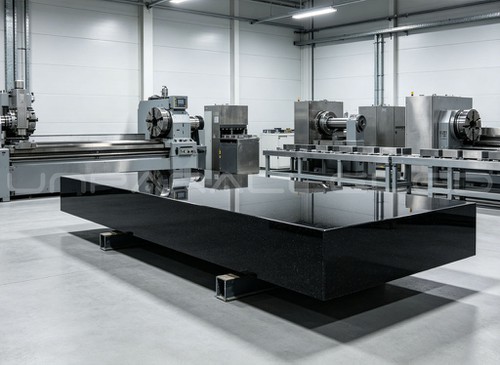
However, the true mark of export quality lies in the finishing and quality assurance processes. To achieve the "mirror finish" and sub-micron flatness required by international standards, components often undergo rigorous hand-scraping or automated lapping processes. This is where the skill of the technician plays a vital role, ensuring that the surface is not just flat, but free of the microscopic peaks and valleys that can affect air-bearing slides.
For global buyers, the verification of this quality is paramount. Reputable exporters provide comprehensive documentation, including material certification that traces the stone back to its quarry, and detailed inspection reports generated by laser interferometers or electronic level instruments. In an era of "Industry 4.0," the ability to provide digital twins or detailed 3D scans of the finished component alongside the physical product is becoming a standard expectation for high-value contracts.
Navigating the Supply Chain: From Factory to Floor
The logistics of exporting precision granite parts present unique challenges that separate amateur suppliers from industry leaders. Granite is heavy, brittle, and sensitive to impact. A minor shock during transit can compromise the internal integrity or the surface finish of a component. Therefore, export-quality service extends beyond the factory floor. It involves specialized packaging solutions designed to absorb shock and prevent moisture ingress during long sea voyages.
Furthermore, the most successful partnerships between manufacturers and global clients are built on a foundation of "solution selling." It is no longer enough to simply ship a block of stone. Clients look for suppliers who can offer design consultation, helping them optimize the ribbing structure of a machine base to maximize stiffness while minimizing weight. They seek partners who understand the nuances of international standards, whether it's DIN standards in Europe or specific ASTM requirements in the United States.
As we look toward the future of global manufacturing, the trajectory is clear: the demand for precision will only intensify. As industries push toward nanometer-level tolerances, the humble granite block is proving to be more relevant than ever. For procurement managers and engineers sourcing globally, choosing the right granite partner is not just a purchasing decision; it is a strategic move that impacts the accuracy, longevity, and reliability of their most critical machinery. In the high-stakes world of precision manufacturing, export-quality granite parts remain the bedrock upon which the world's most advanced technologies are built.