



In the relentless pursuit of technological advancement, the semiconductor and aerospace industries stand at the very pinnacle of human engineering. These sectors demand tolerances that push the boundaries of physics, operating at the nanometer and sub-micron levels. In this high-stakes environment, where a single microscopic vibration or a minuscule thermal drift can lead to catastrophic failures and astronomical financial losses, the choice of foundational materials becomes a critical engineering decision. While cutting-edge technology often conjures images of futuristic composites and exotic alloys, the backbone of modern ultra-precision machinery is increasingly built upon one of the oldest materials on Earth: high-precision granite.
The Material Science Behind Geological Stability
The supremacy of granite in high-tech applications is not accidental; it is rooted in its unique geological and physical properties. Unlike metals, which are cast, welded, or forged-processes that often introduce internal residual stresses-granite is a naturally aged material. Formed under immense pressure over millions of years, high-quality industrial granite (such as the renowned Jinan Green or Black granite) possesses an inherent structural stability that is nearly impossible to replicate artificially.
For manufacturers of precision components, the journey begins with the careful selection of raw stone. The ideal granite for semiconductor and aerospace use features a fine-grained, dense structure with an extremely low water absorption rate. Before it is ever cut into a machine base or a linear guide, the raw stone undergoes a rigorous natural aging process, often left outdoors for several years. This crucial step allows any geological stresses to dissipate completely, ensuring that the finished component will not warp or deform over time, even under the fluctuating temperatures of an industrial environment.
The physical characteristics of this material make it uniquely suited for extreme precision. Granite boasts a high compressive strength and a high modulus of elasticity, allowing it to support heavy loads-such as massive machine spindles or complex optical assemblies-without bending or deforming. Furthermore, its hardness provides exceptional wear resistance, ensuring that the geometric accuracy of the component is maintained over decades of use.
The Semiconductor Industry: A Battle Against Vibration and Heat
In the semiconductor industry, the mantra is stability. The fabrication of microchips involves photolithography and wafer inspection processes where features are measured in mere nanometers. At this scale, the environment is hostile to precision. High-frequency noise from the factory floor, slight temperature variations, and even the magnetic fields generated by motors can ruin a batch of wafers.
High-precision granite components have become the industry standard for wafer steppers, lithography machines, and chip testing equipment. The material's dense crystalline structure offers superior vibration damping compared to steel or aluminum. It acts as a passive vibration isolator, absorbing the high-frequency "noise" of the cleanroom environment and providing a perfectly still stage for sensitive optical systems.
Moreover, thermal stability is non-negotiable in chip manufacturing. High-power lasers and rapid processing cycles generate localized heat. Metals expand when heated, which can cause a machine frame to warp and throw off the focus of a laser or the alignment of a lens. Granite, however, has an exceptionally low coefficient of thermal expansion-roughly half that of cast iron. This thermal inertness ensures that the focal point of a laser or the position of a wafer probe remains absolute, regardless of the thermal cycles occurring within the machine. Additionally, granite is non-magnetic and electrically insulating, eliminating the risk of electromagnetic interference that could disrupt sensitive electronic processes.
Aerospace Applications: Rigidity Meets Complexity
The aerospace sector presents a different but equally demanding set of challenges. Manufacturing components for jet engines, airframes, and satellite systems requires machining large, complex parts from tough superalloys. This necessitates machine tools that are not only incredibly rigid but also capable of maintaining accuracy under aggressive acceleration and heavy cutting forces.
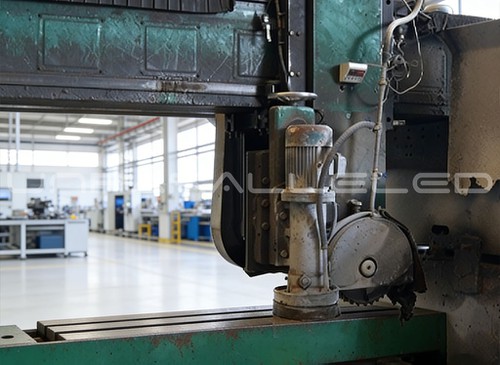
In aerospace manufacturing, granite is frequently used for large-scale Coordinate Measuring Machine (CMM) bridges, inspection surface plates, and the structural bases of high-end CNC machines. The high stiffness-to-weight ratio of granite allows for the construction of moving components, such as gantries and linear axes, that can accelerate rapidly without inducing structural resonance or "chatter." This ensures that the cutting tool follows the programmed path with absolute fidelity, resulting in the smooth, precise geometries required for aerodynamic efficiency.
Furthermore, the "homogeneity" of a full granite structure is a significant advantage. When the base, columns, and moving bridges of a machine are all made from the same material, the entire structure reacts to environmental changes as a single, unified unit. This eliminates the "bimetallic effect" seen in mixed-material machines, where steel rails bolted to an aluminum frame might expand at different rates, causing misalignment. For the assembly of aircraft structures, where thousands of holes must be drilled with perfect alignment, the unwavering accuracy of granite tooling is indispensable.
Engineering the Future on a Stone Foundation
The manufacturing of these components is a feat of engineering in itself. It involves transforming raw stone into complex mechanical parts with tight tolerances. Using advanced CNC grinding and lapping technologies, manufacturers can achieve flatness and straightness accuracies measured in fractions of a micron. Modern granite components are no longer just simple blocks; they are integrated structures featuring precision-drilled holes, T-slots, and embedded stainless steel inserts for mounting, seamlessly blending the stability of stone with the functionality of modern machinery.
While advanced technical ceramics offer an alternative for specific high-speed, lightweight applications, granite remains the king of large-scale structural stability and cost-effectiveness. Its ability to be naturally aged, its resistance to corrosion from coolants and chemicals, and its minimal maintenance requirements make it a sound long-term investment for any high-tech facility.
As the world moves toward the next frontiers of quantum computing, photonics, and deep-space exploration, the demand for precision will only intensify. In this era of nano-manufacturing, high-precision granite components provide the silent, unyielding foundation upon which the future of technology is built. They are the steadfast partners in innovation, ensuring that as we reach for the stars and shrink the microchip, our measurements remain true and our structures remain sound.