



When OEM equipment manufacturers search for a custom granite machine base, the project is usually already real: there is a machine under development, a structural layout on the drawing board, and a procurement plan with a delivery date. Unlike buyers searching for standard surface plates, these customers do not need a catalog product - they need a manufactured component that matches their equipment in size, accuracy, interface, and environment.
The good news is that you do not need to submit a complete manufacturing drawing to start the conversation. A concept sketch, a structural outline, the installation interfaces, equipment loads, motion travel, and your accuracy targets are enough for a meaningful first discussion. From there, an experienced engineering team can carry out a DFM (Design for Manufacturing) review together with you, evaluating manufacturability, inspection methods, and suitable granite-assembly solutions before any commitment is made.
This article walks through the 12 design parameters that matter most when specifying a custom granite machine base. Preparing answers to these questions - even rough ones - will dramatically shorten the quotation cycle and reduce the risk of redesign later in the project.
Why Custom Granite Machine Bases Require a Project-Based Approach
A granite machine base is not a commodity. It is the dimensional reference and structural foundation of the entire machine. Its flatness, straightness, and thermal behavior directly determine the accuracy of everything mounted on top of it - linear guides, linear motors, scales, air bearings, cameras, and measuring probes.
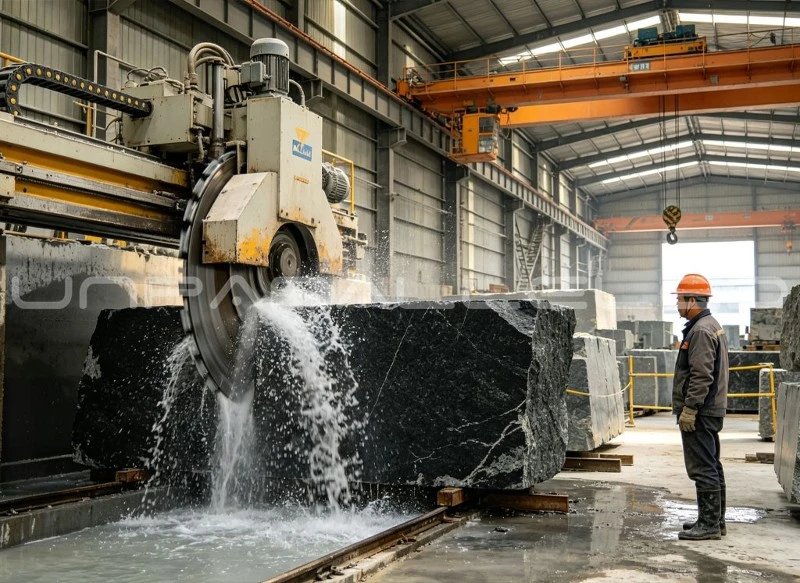
Because granite is processed by CNC milling, aging treatment, and hand lapping, every geometric requirement has a direct cost and lead-time implication. A well-prepared specification allows the supplier to quote accurately and to flag manufacturability issues early - for example, an overly tight flatness callout on a very large surface, or a threaded insert located too close to a slim edge.
This is exactly how we approach custom projects at Unparalleled. Our semiconductor equipment granite components and other precision granite parts are produced through CNC machining, stress-relief aging, and hand lapping to control flatness, parallelism, and straightness - and the same engineering logic applies to every OEM base we build.
The 12 Design Parameters to Confirm Before Requesting a Quotation
1. Overall Dimensions: Length × Width × Height
Start with the envelope. Overall dimensions determine granite block selection, machining strategy, handling equipment, and shipping method. If the design is not final, provide a target range and note which dimension is flexible. Tolerances on overall dimensions are usually far looser than on working surfaces - separating the two avoids unnecessary cost.
2. Unit Weight and Shipping Limitations
Granite weighs approximately 2,600–3,100 kg per cubic meter depending on the stone type. A single-piece base can easily exceed several tons, which affects crane availability at both factories, container loading, and installation on site. Confirm whether there are weight or size limits from your freight forwarder, your factory, or the final installation location - this often decides between a monolithic base and a segmented assembly.
3. Workpiece or Equipment Load
State the static load the base must carry (machine columns, stages, workpieces) and, where relevant, the dynamic loads from moving axes. Load distribution matters as much as total weight: point loads from leveling feet or concentrated equipment masses may require local reinforcement or a different support layout.
4. Location and Size of Critical Working Surfaces
Identify which surfaces are actual datum or mounting surfaces and which are non-critical. Only the critical surfaces need tight tolerance and fine lapping. Marking these clearly on the concept drawing is one of the simplest ways to keep the cost of a granite machine base under control.
5. Flatness Requirements
Flatness is usually the headline specification. Express it per relevant standards (for example, laboratory grade, grade AA, or a specific micron value over a given area), and distinguish between local flatness over a small pocket and overall flatness across the full surface. Unrealistic flatness on large areas is a common cause of inflated quotations.
6. Straightness, Parallelism, and Perpendicularity
Beyond flatness, most machine bases need controlled straightness of guide rails or reference edges, parallelism between mounting surfaces, and perpendicularity between faces. Specify which relationships are functional and which are cosmetic - this directly affects machining and lapping time.
7. Threaded Holes, Inserts, Dowel Holes, and Steel Sleeves
Granite itself cannot hold threads, so mounting points are realized with steel inserts, threaded bushings, or bonded sleeves. Provide the positions, thread sizes, depth, and torque requirements. Also indicate dowel holes and whether steel sleeves are needed for wear protection. These details are defined late in many projects, yet they drive drilling and fixture work - confirm them as early as possible.
8. Interfaces for Guides, Linear Motors, Scales, and Air Bearings
List the components that will be mounted on the base: linear guides, linear motor stators, linear encoders or scales, air bearing pads, camera brackets, drive units. Each has its own flatness, coplanarity, and hole-pattern requirements. For air bearing applications in particular, surface finish and local flatness in the bearing zone are critical and should be identified on the drawing.
9. Monolithic or Segmented Granite Assembly
If the base is large, decide whether a single-piece design or a bolted and bonded multi-piece granite assembly is preferred. Segmented designs ease transport and installation and can be re-lapped at the joints, but they require careful joint design and matching of mating surfaces. Communicating this decision early allows the supplier to plan block selection and machining accordingly.
10. Operating Environment: Temperature, Cleanliness, and Vibration
Granite is dimensionally stable, but the machine around it is not always. Tell the supplier the operating temperature range and gradient, the cleanliness class (especially for semiconductor and optical inspection equipment), and the vibration environment of the installation site. These factors influence material recommendations, thermal equilibrium requirements before inspection, and packaging design.
11. Inspection Method and Calibration Certificate Requirements
Specify how geometry will be verified: electronic levels, laser interferometry, autocollimator, or coordinate measuring. State whether a third-party or in-house calibration certificate is required, and at what temperature the inspection must be performed. Agreeing on the inspection method up front avoids disputes later, because different methods yield slightly different reported values.
12. Packaging, Transport, Installation, and On-Site Leveling
Finally, define the logistics: wooden case or crate packaging, shock and moisture protection, sea or air freight, unloading equipment at destination, and whether on-site installation and leveling support is needed. For overseas projects, providing the destination port and site access conditions allows realistic planning of the delivery chain.
Typical Applications for Custom Granite Bases
Custom granite machine bases and structures are widely used across precision equipment industries, including:
- CMM granite bases for coordinate measuring machines
- AOI equipment granite structures for automated optical inspection
- PCB drilling machine granite bases for high-speed drilling and routing
- Granite gantries for laser cutting, marking, and welding equipment
- Industrial CT granite bases for X-ray computed tomography systems
- Granite frames for optical inspection machines and microscopes
- Bases for lithium battery inspection equipment
- Linear motor stage granite bases for precision motion systems
- Granite beds for precision CNC machining centers
What these applications share is the need for a dimensionally stable, vibration-damping foundation with accuracy that survives years of operation - which is precisely where granite outperforms cast iron and welded steel structures.
How to Start Your Custom Granite Base Project
You do not need a final manufacturing drawing to get a technical assessment. Send us your concept sketch, target accuracy, load condition, installation interfaces, and application environment. Our engineering team will evaluate manufacturability, inspection requirements, and suitable granite-assembly solutions for your project - and respond with practical suggestions on tolerance allocation, insert design, and structure.
Whether your equipment is a CMM, an AOI system, a PCB drilling machine, a laser platform, a battery inspection line, or an industrial CT scanner, a short technical exchange at the concept stage is the most efficient way to secure both accuracy and lead time.
Ready to discuss your project? Request a custom granite base review and share your drawing or concept - our team will take it from there.