



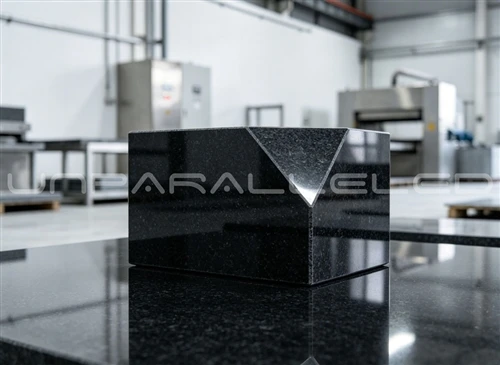
Choosing the material for a precision equipment base is easy to get wrong, because the loudest signals are the wrong ones. A black stone vanity top and a certificated granite base can look identical in a photograph yet satisfy completely different requirements. Material selection should be based on verified physical properties, intended operating conditions, dimensional requirements, inspection data and long-term stability, not on appearance, trade names or the lowest price. This guide compares the three and sets out what to ask a supplier before you buy.
Why a comparison of granite, marble and cast iron is worth doing properly
Buyers usually arrive with the question framed as a black granite for precision equipment choice, or as a direct granite vs marble machine base or granite vs cast iron machine base comparison. The useful comparison is not between names; it is between measured properties read against the job the base has to do. Two materials of the same colour can behave very differently once loaded, warmed and moved, and a claim such as an exact density figure should only stand when supported by a public third-party report naming the test method, sample source and batch.
Why "black stone" is not automatically precision granite
Black is a colour, not a specification. Decorative stone and precision granite can share the same dark appearance while differing in mineral structure, internal soundness and the geometry certified on them. Colour can also mislead where stone is dyed or a different lithology is sold under a familiar name. What matters is internal uniformity, the absence of cracks, seams and soft zones, and a lapped surface whose flatness has been measured and recorded.
Granite, marble and cast iron: three materials, three roles
Granite is an igneous rock, hard and internally stiff, with a low coefficient of thermal expansion and a naturally non-magnetic, corrosion-resistant surface. Dense grades are uniform and stable, which is why they are used for metrology reference surfaces and precision bases. Where a design calls for a high density granite machine base, the properties that matter are dimensional stability, damping and the ability to hold a lapped flat datum over a large area.
Marble is softer and more chemically reactive than granite and is prized mainly for its appearance in architecture and decoration. Its structure can be more variable and it is more sensitive to acids and moisture. Marble is rarely the first choice for a load-bearing precision datum, not because it cannot look the part, but because the certified physical properties a precision application needs are harder to guarantee consistently.
Cast iron offers high stiffness and load capacity and has long been used for machine tool beds and general industrial structures. Its limitations are thermal and environmental: its coefficient of thermal expansion is higher than granite's, so it moves more for a given temperature change, and it must be stress-relieved against dimensional drift and protected against corrosion. For a machine frame these are manageable with good foundry practice, but they are active design constraints rather than things to ignore.
| Evaluation dimension | High-performance precision granite | Decorative stone / marble | Cast iron base |
|---|---|---|---|
| Purchasing focus | Physical properties, structural uniformity, inspection data, geometric accuracy | Should not be judged on appearance or low price alone | Casting quality, ageing, machining and rust management |
| Common use | Metrology reference, precision equipment base, guideway face, structural component | More common in building and decorative work | Machine tool bed, general industrial equipment structure |
| What to request from the supplier | Material data, flatness report, calibration certificate, machining inspection records | Proof of the material's true identity and actual intended use | Material grade, casting inspection, ageing and dimensional reports |
| Risk control approach | Define tolerances and the measurement method | Avoid buying on colour or name alone | Assess thermal distortion, corrosion and stress-relief risk |
What a precision base actually demands
Before comparing materials, state what the base has to do. A precision base is a reference: it holds the guideways, motors, encoders and the workpiece or optics in a fixed relationship while loads move and the room temperature drifts. The properties that decide whether it does this well are measurable, and each should be requested as data rather than assumed from a product name.
Density, uniformity, thermal stability, damping, wear resistance and non-magnetic behaviour
These six properties sit behind what is loosely called precision granite material properties, and none of them is visible in a photograph.
| Property | What it means | Why it matters on a precision base |
|---|---|---|
| Density and uniformity | Mass per unit volume, and how evenly the structure is distributed | Even, higher density raises stiffness; voids and soft zones create uneven damping |
| Thermal stability | How little the material changes shape with temperature | A low coefficient of thermal expansion, measured for example to ASTM E228, keeps geometry stable as a room drifts |
| Vibration damping | How quickly internal vibration is absorbed | Good damping shortens settling time and keeps pumps out of a measurement |
| Wear resistance | How the datum face survives repeated motion | A hard, lapped surface holds flatness where rails, carriages or probes run |
| Non-magnetic behaviour | The material does not attract or retain magnetic fields | Useful near motors, sensors and magnetic clamping, and for cleanliness |
| Corrosion resistance | How the surface reacts to moisture and chemicals | Stone avoids the rust management cast iron needs, which matters in humid environments |
Why colour, price and marketing are not selection criteria
Three shortcuts cause most specification mistakes. Colour is the weakest signal, because it says nothing about internal soundness or certified flatness. Price reflects cost, not fitness: the cheapest block may suit a decorative role but fail at a metrology datum, while an expensive one may be over-specified. Grade labels and trade names are useful only when tied to documented data for the specific lot. The practical rule is that granite base material selection should follow the application's error budget and operating environment, then be confirmed against written material and inspection evidence.
How to ask a supplier for material and inspection evidence
A supplier should be able to answer specific questions with specific documents. Vague reassurance is not evidence.
| What to request | Why it matters |
|---|---|
| Material data sheet for the specific quarry and lot | Confirms density, structure and the grade actually supplied |
| Flatness and geometry report naming the measurement method | Shows how the datum was verified, not merely that it was |
| Calibration or traceability certificate for the reference used | Connects the measurement to a known standard |
| Machining and inspection records for holes, inserts and faces | Ties every feature back to the same datum |
| Statement of any filling, coating or treatment | Prevents a surprise in service |
From raw block to finished base: selection, ageing, machining, lapping and inspection
The reliability of a precision base is built in long before it is inspected. The sequence below is what a documented process looks like.
1. Raw material selection: the block is chosen for soundness and uniformity, since internal defects are the enemy of a stable datum. 2. Ageing and stress relief: the material settles before final machining; cast iron is stress-relieved after casting and stone is seasoned. 3. Rough machining: features are cut with a finishing allowance. 4. Precision machining: holes, inserts and interface faces are located to a single datum. 5. Lapping: working faces reach their final flatness. 6. Inspection: dimensions, flatness, parallelism and perpendicularity are measured on the datum at the 20 °C reference of ISO 1, with geometric tolerances stated to ISO 1101 and surface-plate grades referenced to DIN 876 or ISO 8512-2.
For a custom granite machine structure, the earlier this sequence is planned with the supplier, the fewer surprises reach the finished part.
A material acceptance checklist for buyers
When a base arrives, the checklist below separates a verified part from a hopeful one.
| Acceptance item | What it confirms |
|---|---|
| Material identified by quarry and lot, with a data sheet | The part is the material that was specified |
| Density, structure and finish matched to the specification | No substitution on visible or internal quality |
| Flatness report with the measurement method named | The datum is verified, not assumed |
| Traceable reference for the calibration | The measurement can be compared to a standard |
| Geometric tolerances stated to a standard, not verbally | Tolerances are enforceable and checkable |
| Holes, inserts and interfaces tied to one datum | Subsystems will align on assembly |
| Any filling or coating declared | No hidden material in the working surface |
UNPARALLELED machining and temperature-controlled inspection
UNPARALLELED supplies precision bases and structures in dense UNPARALLELED® black granite, selected for internal uniformity and stability. Blocks are seasoned, then machined, lapped and inspected in a temperature- and humidity-controlled workshop, with reference faces measured on the same monolithic datum they will use in service. We work from customer drawings and provide material and inspection documentation with the part. Our related writing on granite in semiconductor, CMM and laser equipment, on specifying a custom granite machine base, on choosing a granite surface plate and on granite air bearing systems covers the wider engineering context.
Frequently asked questions
Is granite always better than cast iron for a machine base?
No. Granite is strong where a stable, low-expansion, well-damped and non-magnetic reference is needed, and it avoids corrosion management. Cast iron is strong where stiffness and load capacity dominate. Assign material by function and error budget, not by habit.
Can marble be used for a precision base?
Marble can be flat and attractive, but it is softer and more chemically reactive than granite and more structurally variable, so the certified properties a precision datum needs are harder to guarantee. It suits decorative roles better than a load-bearing reference surface.
How do I compare two suppliers' granite blocks fairly?
Ask both for the same documents: material data for the specific lot, a flatness report naming the measurement method, a traceable calibration reference, and machining records. Compare the paperwork, not the colour.
What documentation should arrive with a precision base?
At minimum, a material data sheet for the lot, a flatness and geometry report, a calibration reference, machining and inspection records, and a statement of any filling or coating. These let the purchaser verify the part rather than trust a description.
Get the Precision Granite Material & Inspection Checklist
If you are selecting a base for a precision machine, a metrology frame or a custom structure, send the application, the loads, the operating environment and the drawing, and we will return material guidance and a manufacturing-feasibility assessment naming the tolerances and inspection evidence you should require. Start with our inquiry form, and review the background on specifying a custom granite machine base, on granite in semiconductor equipment and on granite air bearing systems.