



Many metrology engineers and procurement specialists have a common question. A granite surface plate delivers excellent precision inside a constant-temperature laboratory, yet measurement readings fluctuate once it is moved to a regular production workshop. Many simply attribute the issue to temperature changes. In reality, the gap between constant-temperature labs and ordinary workshops involves far more than temperature values. Superimposed thermal gradients, dust disturbances, vibration levels and humidity fluctuations will directly alter the reference state of the granite surface plate. Through numerous metrology projects, UNPARALLELED Group has found that granite's low thermal expansion property can mitigate deformation, yet it cannot fully eliminate measurement deviations caused by environmental differences between the two scenarios. Differentiated selection and application solutions should be designed according to working conditions.
1. Temperature: Deformation Driven by Thermal Gradients Rather Than Average Temperature
The core advantage of a constant-temperature laboratory is not merely maintaining the standard metrology temperature of 20°C, but achieving uniform temperature across the space. The whole plate reaches thermal equilibrium, with almost no local temperature difference. Under such conditions, indicators including flatness and straightness can steadily stay at calibrated factory accuracy, suitable for coordinate comparison, gauge block calibration and precision part sampling inspection.
Uniform constant temperature is rarely achievable in ordinary workshops. Heat generated by equipment, personnel movement, ventilation and welding motors creates local temperature differences on the surface of the plate. Even if the average workshop temperature is close to 20°C, one side of the plate may be warmer than the other. Although granite features a low thermal expansion coefficient, local temperature differences still trigger subtle bending deformation. This invisible distortion is enough to undermine micron-level detection repeatability. That explains why the same granite surface plate passes inspection in a temperature-controlled lab but delivers unstable readings in the workshop.
2. Vibration and Ground Disturbance: Distinct Interference Magnitudes in Two Scenarios
Constant-temperature laboratories are generally located away from stamping and cutting machines, with vibration-damped flooring. The ambient micro-vibration level remains low. Thanks to its mass and material damping, the granite surface plate easily suppresses tiny vibrations, producing stable readings when probes touch workpieces.
In ordinary production workshops, impacts from machine tools, conveyor operation and forklift traffic continuously transmit vibration through the ground to the base of the surface plate, causing instantaneous relative displacement between workpieces and probes. While granite outperforms cast iron in vibration damping, persistent low-frequency vibration in workshops extends stabilization waiting time and may even trigger data jumps. Granite surface plates deployed in workshops usually need matched vibration isolation supports, whereas only standard leveling feet are required in constant-temperature labs.
3. Dust, Oil and Humidity: Impacts on Long-Term Stability of Reference Surfaces
Constant-temperature laboratories normally feature clean environments with controlled humidity. The working surface of granite rarely accumulates metal chips or cutting fluid, so the reference surface stays intact with low maintenance workload.
Cutting dust, coolant mist and oil mist are commonplace in production workshops. Granite is a mineral stone with microscopic pores on its surface. When exposed to workshop environments for long periods, fine dust and oil may adhere to or seep into pores. This not only scratches the working surface but also changes surface contact conditions. Oil contamination worsens under volatile humidity. Such pollution will not degrade the bulk accuracy of the plate in the short term, yet accumulated contamination wears down the reference surface and shortens re-calibration cycles. Stable humidity in temperature-controlled labs avoids such erosion.
4. Plate Selection and Preprocessing Tailored to Application Scenarios
For constant-temperature laboratories, ultra-high precision grade granite surface plates are preferred, focusing on flatness and nano-level surface quality. The slabs undergo thorough stress relief to support reference value transfer in metrology rooms.
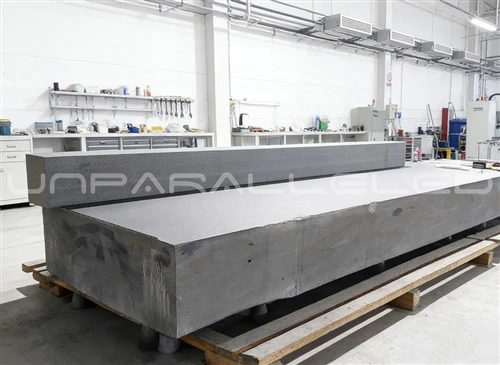
When used in ordinary workshops, adopting the same high-precision plate solution designed for constant-temperature labs is not recommended. UNPARALLELED optimizes workshop-oriented products: raw slabs go through secondary stress relief to reduce slow deformation under cyclic temperature changes; thicker cross-sections improve resistance to bending caused by temperature differences; working surfaces are sealed to reduce penetration of oil and dust; independent vibration isolation and leveling assemblies are equipped to isolate ground vibration from workshops. Instead of pursuing maximum factory precision, the process reserves sufficient safety margin to guarantee a reliable measurement benchmark amid harsh workshop conditions.
5. Often Overlooked Differences in Operation Management
Granite surface plates in constant-temperature labs are fixed in position with minimal handling and collision risks, requiring annual re-verification.
Workshop surface plates are often placed near production stations, facing higher risks of workpiece handling and tool collision. In workshop use, the working surface needs regular cleaning to prevent hard particles from remaining on the plate. Plates should be kept away from heat sources such as ovens and machine exhaust vents. Leveling status must be checked periodically, and metrology re-calibration cycles shortened. In many cases, inaccurate measurement results do not stem from failed plate precision but inadequate operation specifications in workshops.
Conclusion
Granite surface plates perform quite differently in constant-temperature laboratories versus ordinary workshops. The ideal environment inside a temperature-controlled lab unlocks the ultimate precision of granite plates. By contrast, ordinary workshops face multiple disturbances including thermal gradients, continuous vibration, dust and oil contamination, imposing stricter requirements on plate structure, surface treatment, supporting vibration reduction and daily maintenance. Granite's merits of low thermal expansion and high stability can only reduce environmental impacts instead of eliminating them entirely. UNPARALLELED Group distinguishes laboratory reference-grade and workshop field-grade granite surface plate solutions according to customers' actual working conditions. Precision allowance and supporting structures are properly configured to maintain reliable measurement benchmarks under respective operating environments.