



When an engineer starts specifying a precision machine, one of the first comparisons they run is rarely a brand search. It is a materials question: "granite vs cast iron machine base," or "granite vs mineral casting." That is the right question, because the base is not a passive support; it is part of the accuracy specification. Every linear guide, encoder scale and metrology frame is referenced to the base, so any drift, flexure or vibration in the base becomes an error in every axis at once. This article compares precision granite, cast iron and mineral casting for precision equipment using engineering properties and widely cited material data, and notes where ceramic and UHPC fit as extended options.
Why the base is part of the accuracy specification
A precision machine is a closed loop referenced to a single body. The guide rails, scales and measuring frame all sit on the base, so whatever the base does, the machine does. Two machines that look identical on paper can behave differently simply because their bases respond differently to heat, load and vibration. The useful question is not "which material is best in general" but "which material keeps the reference geometry stable under the conditions this machine actually runs in." Stated that way, granite, cast iron and mineral casting each have a defensible place, and the choice is a trade study rather than a hierarchy.
The three materials engineers actually compare
Most precision equipment is built on one of three structural families. Understanding what each one is, and is not, is the starting point before any table of numbers.
Precision granite
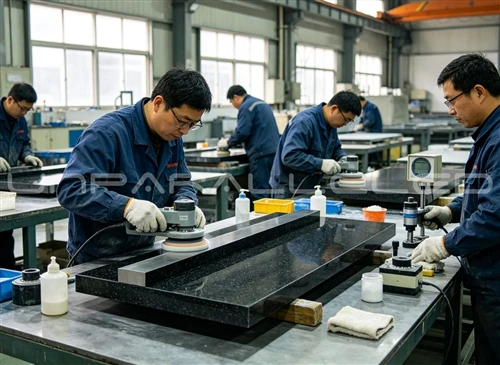
Granite used for machine structures is a natural, fine-grained stone that is quarried, rough-machined and then precision-ground and hand-lapped into a stable reference body. Because it was never molten, it carries no casting residual stress and is dimensionally stable from delivery. UNPARALLELED black granite, used for the company's precision bases, has a density of about 3100 kg/m³, roughly 40 percent lighter than steel for the same volume, which helps keep support loads and dynamic mass in check. Its flatness and straightness are graded to standards such as DIN 876 and ISO 8512.
Cast iron
Grey cast iron is the classic machine-tool bed material. It is poured into a pattern, aged to release internal stress, then machined. It offers good vibration damping and machinability, and can be cut, drilled and threaded in ways granite cannot. The trade-off is residual stress and a density around 7100 to 7300 kg/m³, which makes large cast beds heavy to support and to ship.
Mineral casting (polymer concrete)
Mineral casting, also called polymer concrete or epoxy granite, is a mix of mineral aggregate bound by a polymer resin. It is poured into a mould around pre-placed steel inserts, then cured. The resin absorbs energy, so it damps vibration extremely well, and moulding lets designers shape complex stiff sections that would be expensive to machine from metal. Its density is typically around 2400 to 2600 kg/m³. Engineering literature widely reports that a well-designed mineral casting can damp vibration several times more effectively than cast iron and an order of magnitude better than steel.
Side-by-side comparison
The table below summarizes how the three materials are usually rated for the properties that matter most in precision structures. The figures are representative engineering ranges from machine-tool design references and supplier data; the right choice still depends on the application and accuracy target.
| Property | Precision Granite | Cast Iron | Mineral Casting |
|---|---|---|---|
| Typical density (kg/m³) | ~3100 (UNPARALLELED black granite) | ~7100–7300 | ~2400–2600 |
| Thermal expansion (×10⁻₆/°C) | ~5–8 | ~10–12 | ~10–20 (formulation dependent) |
| Vibration damping | High | Medium–High | Very high |
| Specific stiffness (stiffness per mass) | High | Medium | High |
| Corrosion resistance | Excellent | Requires protection | Good |
| Machining / lead time | Long (quarried + ground) | Long (cast + aged + machined) | Moderate (moulded + cured) |
| Best-fit applications | Metrology, optics, semiconductor | General machine tools, heavy cutting | High-speed machining, damping-critical |
Thermal expansion and dimensional stability
Thermal expansion is often the largest source of slow positioning error. Steel and cast iron expand by roughly 11 to 12 micrometres per metre per degree Celsius, so a one-metre base that warms by one degree moves about 12 micrometres. Precision granite expands far less, typically around 5 to 8 ×10⁻₆/°C, roughly half, which is why it is specified for temperature-sensitive measurement. Cast iron and steel also carry internal casting stress that can release slowly over months, so a metal base correct at commissioning can drift. Granite carries no trapped casting stress and is stable from delivery, and mineral casting, cured rather than cooled from melt, avoids that ageing problem too. This does not make granite universally superior; it makes it predictable, which a metrology loop needs.
Vibration damping
Every drive, spindle and stage excites the structure, and what matters is how quickly that energy dies away. Steel is stiff but springy: vibration can circulate through a steel frame and reach the tool or the optics. Cast iron damps better than steel, and granite damps in the same order, which is why both have long histories in precision machines. Mineral casting sits at the top of the damping scale. In a high-speed stage accelerating several g, that damping keeps waviness and probe jitter out of the measurement, and no controller can recover that once the structure is chosen. For a granite vs cast iron vs mineral casting decision, damping usually separates the three most clearly.
Stiffness and rigidity: it is not only Young's modulus
Steel has the highest Young's modulus, about 200 GPa; cast iron is typically 100 to 150 GPa and granite and mineral casting 30 to 70 GPa. On modulus alone steel wins, but a real machine cares about stiffness per unit mass, where density matters. Steel and cast iron are two to three times denser than granite or mineral casting, so for a given mass budget granite and mineral casting can be built with far deeper, stiffer cross-sections. This is why a granite machine base can be both lighter and dynamically stiffer than a steel weldment of equal weight.
Corrosion resistance and maintenance
Cast iron and steel require protection. In a cleanroom, a humid environment or any coolant-using process, bare metal will rust unless coated, plated or sealed, and that protection adds maintenance and can change geometry if it wears unevenly. Granite is naturally corrosion resistant and needs no coating, and mineral casting resists coolants and moisture well because its binder is a polymer. For equipment that runs for years, that difference shows up in uptime rather than on the spec sheet.
Lead time and cost
Granite requires quarrying and rough machining before the precision grinding and lapping that define its accuracy, so lead time depends on stone supply and grinding capacity. Cast iron needs a pattern, a casting and a stress-relief cycle before machining, which can be long and risks a scrapped casting. Mineral casting needs a mould and a cure, after which only the embedded inserts are machined. Cost is rarely a simple ranking: granite avoids foundry risk, cast iron avoids grinding cost, and mineral casting trades mould cost for machining savings. The honest answer to "which is cheapest" is "it depends on the geometry and the volume."
Application scenarios: which material where
Granite is the right base material where stability, flatness and low vibration matter more than load capacity or machinability: coordinate measuring machines, optical inspection, semiconductor inspection and processing, laser equipment, air-bearing stages and metrology systems. Cast iron remains practical for general machine-tool beds, heavy cutting and structures that must be drilled, tapped and integrated with a moving metal carriage. Mineral casting suits high-speed machining centres and grinding machines where damping is paramount. Steel weldments still win for very large one-off gantry frames.
Beyond the big three: ceramic and UHPC
Two extended options are worth a note for specialist buyers. Technical ceramics and zero-expansion glass-ceramics (for example materials in the Zerodur class) offer thermal expansion near zero, on the order of 0 ±0.1 ×10⁻₆/°C, and are used where stability must hold across large temperature swings, such as astronomy and ultra-precision references. They are expensive and brittle, so they appear as reference elements rather than whole bases. Ultra-high-performance concrete (UHPC) is a high-strength cementitious material used for mass foundations and damping blocks rather than precision surfaces; its value is cheap, heavy, well-damped mass with a separate machined top face. Both can be combined with granite or metal, reinforcing the same idea: the base is an engineered system, not a single material.
Frequently asked questions
Is granite always better than cast iron for machine bases?
No. Granite is the stronger choice where thermal stability, vibration damping and a naturally flat, corrosion-free reference surface matter most, such as metrology and inspection. Cast iron remains practical where the structure must carry heavy cutting loads or integrate directly with moving metal carriages. The decision is an application trade study, not a ranking.
What is mineral casting best suited for?
Mineral casting, or polymer concrete, is best where vibration damping and thermal homogeneity are the priority and where complex stiff shapes can be moulded rather than machined. It is common in high-speed machining centres and precision grinding machines. Its damping is reported as several times that of cast iron and an order of magnitude better than steel.
How dense is UNPARALLELED black granite?
The black granite used by UNPARALLELED for precision bases has a density of about 3100 kg/m³. That is roughly 40 percent lighter than steel for the same volume, which helps reduce support loads and dynamic mass on large structures while still providing the stiffness and damping that precision equipment needs.
Can granite be machined to custom dimensions and accuracy?
Yes. Granite bases are routinely manufactured to customer drawings with custom dimensions, inserts, mounting holes and special geometry, then verified by Mahr, Mitutoyo, WYLER and Renishaw instruments in a temperature-controlled workshop. Grades follow standards such as DIN 876, ISO 8512, ASME B89.3.1, JIS, GB, BS and GOST, and achievable flatness, straightness and parallelism depend on the size and grade on the drawing.
UNPARALLELED capability and how to start a project
UNPARALLELED® machines single granite components up to 20,000 mm in length, 4,000 mm in width and 1,000 mm in thickness, with a capacity of around 100 tons, from a granite machine base to a granite CNC base built to your geometry and accuracy target. Specify the base material early in any new machine project.
Request a Quote: send us your drawing and the accuracy you need, and we will tell you whether a granite structure is the right foundation for it, and which grade and machining route fit your budget. You can also review our completed custom precision granite bases and granite CNC base pages for typical configurations and tolerances.