


Choosing a machine base looks like a mechanical afterthought, but it quietly decides the accuracy, repeatability, and service life of the entire equipment. For mechanical engineers running a new equipment selection, the base is the first structural decision and the hardest to reverse. Three materials dominate the field today: cast iron, precision granite, and mineral casting (also called polymer concrete). Each has champions and each has a ceiling. This guide compares them across six dimensions that actually matter on the shop floor, and then gives a selection rule you can apply the next time you write a bill of materials.
The Three Candidates at a Glance
Cast iron is the traditional default. It is well understood, easy to machine, and rigid in bending. Precision granite, usually fine-grain black granite, is geologically stable, thermally quiet, and an outstanding vibration damper. Mineral casting is a mixture of stone aggregates bound in epoxy resin, poured into a mold and cured, offering even higher damping than granite and complex monolithic shapes. All three are real, all three are in production, and all three are worth considering depending on what your machine must do.
Comparison Table: Cast Iron vs Granite vs Mineral Casting
The table below summarizes the practical differences for a machine base. Values are typical engineering ranges rather than exact specifications, because alloy, grade, and design details move the numbers.
| Dimension | Cast iron | Precision granite | Mineral casting |
| Vibration damping | Moderate, rings and transmits | High, several times better than steel | Highest, best of the three |
| Thermal stability | Moderate expansion, conducts heat | Low expansion, low conductivity | Very low conductivity, stable |
| Rigidity (bending) | High, excellent for heavy load | Good, lower modulus than iron | Good, depends on section design |
| Relative cost | Low to moderate | Moderate to high | Moderate, tooling dependent |
| Lead time | Short if standard, long if custom | Medium, needs lapping | Medium, needs mold for first part |
| Typical equipment | General CNC, heavy lathes | CMM, metrology, optical, semiconductor | High-speed milling, measuring, EDM |
Vibration Damping
Damping decides how quickly vibration from a spindle, a moving axis, or the floor decays inside the structure. Cast iron has decent damping but it still rings; hit it and it keeps vibrating for a measurable time, which shows up as chatter on the cut or noise on the measurement. A granite machine base damps vibration several times more effectively than steel or iron, which is why metrology equipment almost always sits on granite. Mineral casting damps even better than granite because the resin binder absorbs energy at the micro level, making it the favorite for high-speed machining centers where spindle-induced vibration must die fast.
Thermal Stability
Heat is the enemy of accuracy. Cast iron conducts heat well, so a warm motor or a sunny window creates a temperature gradient that bends the base and moves the tool point. Granite has roughly one third the thermal expansion of steel and very low thermal conductivity, so a granite base barely notices normal shop-floor temperature swings. Mineral casting is similarly quiet thermally and its low conductivity keeps heat local rather than spreading it across the structure. If your machine lives in a non-climate-controlled environment, granite or mineral casting will hold accuracy far longer than iron.
Rigidity
Rigidity is where cast iron still wins for pure bending stiffness per unit mass. If you need to support a ten-ton moving column with minimal deflection, cast iron or a thick welded steel frame is hard to beat. Granite has a lower elastic modulus than iron, so a granite base must be made thicker or wider to match the same deflection, which is perfectly achievable but costs material and space. Mineral casting can be ribbed and sectioned during the pour to reach high local rigidity where it matters. The practical rule: for high load and large overhang, iron; for high accuracy and low vibration, granite or mineral casting.
Cost and Lead Time
Cost is not a single number. Cast iron is cheap when you buy a standard size from stock, but a custom machined iron base with stress relief and finish grinding is not cheap and takes weeks. Granite starts moderate and rises with size and the required flatness grade, because lapping a large surface to micrometer accuracy is slow, skilled work. Mineral casting needs a mold for the first part, so prototyping is slower, but once the mold exists, reproduction is fast and consistent. For low volume or one-off precision machines, granite is often the simplest path; for serial production of a fixed shape, mineral casting amortizes well.
Suitable Equipment
The pattern is consistent across industries. Cast iron suits general-purpose CNC machining centers, heavy lathes, and structures where load dominates. Granite suits coordinate measuring machines, optical inspection, semiconductor lithography and metrology, and any equipment where sub-micrometer stability is the product. Mineral casting suits high-speed machining centers, measuring equipment, and electrical discharge machines where damping and thermal calm matter and the geometry is complex but repeated. Many advanced machines are hybrids: an iron frame for load, a granite or mineral casting inner structure for the precision axes.
How to Choose: A Practical Selection Rule
Start with the dominant error source in your machine. If accuracy loss comes from vibration, pick granite or mineral casting. If it comes from heat, pick granite or mineral casting. If it comes from heavy load and deflection, pick cast iron or a hybrid. Then weigh volume: one-off or low volume favors granite for its fast customization; high volume of a fixed shape favors mineral casting for mold amortization; standard load-bearing frames favor cast iron. Finally, check your floor: a climate-controlled metrology room forgives more materials, while a shop floor with temperature swings strongly favors the thermally quiet options.
For a quick decision, use this mapping. Metrology, optics, and semiconductor equipment: granite. High-speed machining and repeated complex shapes: mineral casting. Heavy, load-dominated general machining: cast iron. When two needs collide, separate them structurally: a granite mineral casting vs granite comparison is most useful when you already know load is handled elsewhere, and you are choosing only the precision layer.
Why Suppliers Who Offer Both Materials Help
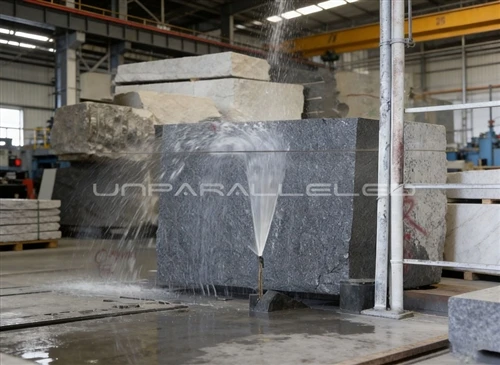
The cleanest selection process happens when one supplier can deliver either a granite base or a mineral casting base, because the advice is not skewed toward what is in stock. That is our position: we machine fine-grain granite bases up to monolithic sizes of 20 meters in length, 4,000 millimeters in width, and 1,000 millimeters in thickness, handled by overhead cranes and CNC equipment rated for single pieces up to 100 tons, and we also produce mineral casting structures with integrated ribs and inserts. Every surface is lapped in a constant temperature and humidity workshop and verified with Mahr, Renishaw, and WYLER instruments traceable to national metrology institutes. With ISO 9001 certified quality management and over 20 patents and international trademarks registered through CCPIT in the European Union, the United States, and Southeast Asian markets, we supply equipment builders serving customers such as GE, Samsung, Apple, ASMPT, STI, and 5th Axis.
Frequently Asked Questions
Q1: Can I mix materials in one machine?
Yes, and it is common. A cast iron or steel frame carries the heavy load, while a granite or mineral casting inner structure provides the precise, low-vibration, thermally stable working layer. The interface simply needs careful thermal and mechanical design.
Q2: Is mineral casting fragile?
No. Cured mineral casting is stiff and durable in compression; its weakness is impact and tension at thin edges, which is managed through section design and embedded steel inserts for bolting and load paths.
Q3: Which base needs the least maintenance?
Granite. It does not rust, needs no coating or oil, and its geometry is stable for decades. Cast iron needs corrosion protection, and mineral casting needs protection of exposed edges, but neither demands much once installed.
When your next equipment selection reaches the base, decide by the dominant error source rather than by habit. If vibration and thermal stability lead the list, a granite or mineral casting structure will outperform cast iron at the accuracy that matters. Contact our engineering team for material samples, stiffness and damping data, and a drawing review, and we will recommend the right base for your machine whether that base is granite, mineral casting, or a hybrid of both.