



When a machine cannot hold its tolerance, the cause is often assumed to be the control system, the bearings, or the operator. More often than people expect, the real problem is the base the machine was built on. And in a market where cost pressure never lets up, that base is increasingly where corners get cut - sometimes by selling ordinary marble as if it were precision granite.
This article sets out the real difference between the two materials, why it matters for precision equipment, and how a buyer can tell which one they are actually getting.
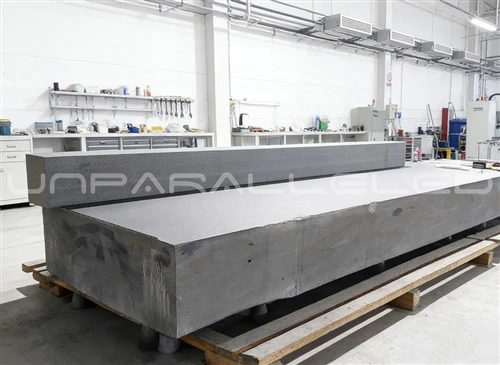
Marble and granite are not the same stone
To a casual eye, a polished marble slab and a piece of black granite can look almost identical. Geologically they are different materials. Granite is an igneous rock, formed when molten material cooled slowly underground, which gives it a fine, interlocking and highly uniform crystalline structure. Marble is a metamorphic rock, formed when limestone is altered by heat and pressure, and its structure is softer, more layered, and far less uniform.
Those differences are invisible on a showroom floor but decisive on a machine bed. Precision equipment does not care how a material looks; it cares how the material behaves under load, under temperature change, and over years of use.
Density: the first and clearest difference
The most direct measure of suitability is density. UNPARALLELED® precision granite is selected at approximately 3,100 kg/m³. Ordinary marble typically ranges from about 2,600 to 2,800 kg/m³, and some decorative marble is lower still. That gap is not a small detail: density gives a base its mass, and mass is what resists the reaction forces of a moving stage or a spinning spindle.
A denser base deflects less under load, absorbs vibration more effectively, and stays put when the machine accelerates. A lighter marble base of the same size simply has less material working in the machine's favour, which is why substituting one for the other is never a neutral choice. It changes how the machine behaves.
Stability and vibration damping
Vibration is the quiet enemy of accuracy. Every rapid move, every spindle rotation, and every external disturbance sends energy into the base, and a good base absorbs that energy instead of returning it to the tool. High-density granite dampens vibration well because of its mass and its internal homogeneity, which spreads energy rather than letting it resonate.
Marble is less effective for two reasons: its lower density means less mass to absorb energy, and its layered structure can allow internal movement and local weakness. In practice a marble base tends to ring and chatter where a granite base stays calm, and that difference shows up directly in surface finish and positional accuracy.
Thermal expansion: why the coefficient matters
Precision happens in a world where the temperature is never perfectly constant. What matters is how much the base changes shape when the temperature moves, and that is governed by the coefficient of thermal expansion. Granite has a low coefficient, typically around 5 to 7 × 10−⁶6 per °C, and its high mass means it also resists rapid temperature change, so its geometry moves slowly and predictably.
Marble has a higher coefficient and lower thermal inertia, so it expands and contracts more, and does so faster. For a machine that holds microns, a base that grows and shrinks with every temperature swing forces the control system to keep correcting for the machine's own drift.
Long-term accuracy retention
Buying a base is a long-term decision, because the base is the one part of a machine that is almost never replaced. Granite holds its geometry for decades: it does not rust, it does not release internal stress over time the way a metal casting can, and it resists wear and moisture. Marble is softer, more porous, and more susceptible to acid and moisture, so it is more likely to chip, stain, or slowly lose flatness in a working environment.
This is the hidden cost of a marble base. It may measure acceptably on delivery, but the question that matters is where it will be in five or ten years, after thousands of cycles and countless small temperature changes. Granite's answer to that question is the reason we build our custom precision granite components from a high-density stone rather than from whatever is easiest to source.
| Property | UNPARALLELED® precision granite | Ordinary marble |
|---|---|---|
| Density | about 3,100 kg/m³ | about 2,600–2,800 kg/m³ |
| Structure | Fine, uniform, interlocking | Softer, layered, less uniform |
| Vibration damping | High | Lower |
| Thermal expansion | Low (about 5–7 × 10−⁶6 per °C) | Higher |
| Hardness and wear | Hard, wear-resistant | Softer, easier to scratch |
| Moisture and acid | Resistant | More porous, reacts with acid |
| Long-term stability | Excellent, retains geometry for years | Degrades over time |
How to avoid being sold marble as granite
Because the two materials can look alike, the safest approach is to ask for evidence rather than to trust appearance. Request the density figure for the specific material supplied, not a general claim. Ask how flatness and geometry will be measured and certified. Look for a uniform, fine-grained structure with no visible layering, and be cautious of a base that feels unusually light for its size or that shows a strong, uneven pattern.
A supplier who answers those questions with numbers and certificates is a supplier who is selling granite. One who answers with adjectives is a supplier to treat carefully.
The UNPARALLELED standard
At UNPARALLELED the material is the starting point of the promise, not an afterthought. We select high-density granite at about 3,100 kg/m³, machine and hand-lap it to the required flatness, and verify it with traceable metrology before it ships. We would rather explain why the right material costs what it does than help a customer save money on a base that quietly limits the machine for years.
If you are specifying precision granite surface plates or a machine base that has to hold its accuracy, send us the drawing and the tolerance you need. We will tell you the material we would use and why, and you can compare that against anyone offering you something that only looks the part.