



When selecting granite reference components, many equipment integrators share one major concern. Since granite is a brittle stone material, will heavy machinery weighing several tons or even dozens of tons crack, chip or develop hidden internal fractures after long-term placement on granite support blocks, eventually leading to reference failure? This doubt often makes engineers hesitant to adopt granite support solutions for heavy-load precision equipment. Drawing on years of experience in heavy-load component projects, UNPARALLELED Group explains the underlying logic of granite load bearing and clarifies misunderstandings regarding the stone's load capacity.
Many people simply equate granite support blocks with ordinary stone, assuming brittle materials cannot withstand heavy loads. In fact, compressive resistance and impact resistance are two completely different indicators. Premium precision granite boasts extremely high compressive strength. Its weakness lies not in static load bearing, but in local impact and concentrated point loads. Under uniform static pressure, granite can bear far more weight than metal pads of the same volume. However, if load concentrates on tiny points or sharp edges, or if impact or hammering occurs, chipping and cracking may happen. This is the real cause of many on-site damage cases, rather than sheer equipment weight alone.
For heavy-duty applications, the safety of granite support blocks firstly depends on raw material quality. Low-grade marble features many internal pores and loosely bonded mineral structures, delivering poor compression resistance. It easily generates internal microcracks under heavy load, which gradually expand over time and result in final failure. In contrast, high-quality precision granite consists of tightly interwoven mineral crystals. Internal stress is fully released through sufficient aging treatment, delivering stable compressive performance for the whole block. During design, UNPARALLELED performs load calculation according to total equipment weight, force points and support distribution. We rationally plan the quantity, contact area, thickness and layout of support blocks to keep point pressure within a safe range and avoid excessive load concentration.
Besides the material itself, contact surface treatment directly affects the service life of heavy-load support blocks. Many project failures originate not from excessive equipment weight, but from hard contact between granite blocks and the equipment base, creating local stress peaks. The proper approach is to ensure both upper and lower contact surfaces are flat and fit evenly. If necessary, thin load-distribution shims can be used to spread pressure, so the full weight is evenly distributed across the contact surface and local high-pressure spots are eliminated. Poor flatness or partial hollowing of the machined surface will concentrate equipment weight on limited contact zones, creating hidden cracking risks over time.
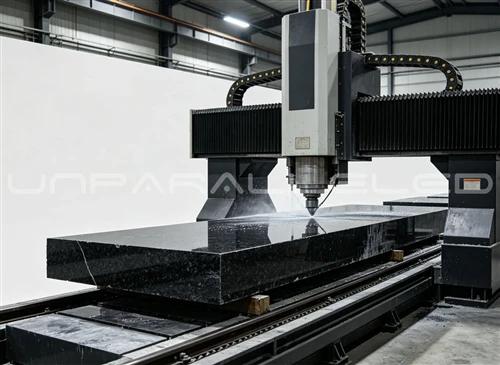
Another often overlooked risk factor is the installation foundation. Even with properly designed granite support blocks, foundation settlement or deformation will alter force conditions on the blocks. Originally evenly distributed loads turn into eccentric stress, which also raises the risk of damage. The foundation for heavy precision equipment needs advance evaluation to guarantee sufficient rigidity and reduce force deviation caused by settlement.
That said, granite support blocks have operational limits and cannot bear unlimited weight. Structural protection should be prepared in advance for impact loads, instantaneous shocks and eccentric heavy-load scenarios. At the scheme design stage, engineers need to take total load, support points, foundation conditions and impact during transportation and hoisting into full consideration instead of only focusing on total equipment weight. With proper load calculation, qualified raw material selection, precision lapping of contact surfaces and reasonable layout, granite support blocks can stably hold precision equipment weighing dozens of tons and maintain reference accuracy for long periods without being crushed by dead weight.
Granite support blocks are rarely crushed simply by equipment dead weight. Most failures stem from stress concentration, impact and inferior base materials. With preliminary mechanical assessment, dense and stable precision granite and properly arranged support points, granite support blocks can fully meet the reference bearing demands of heavy-load precision equipment. UNPARALLELED keeps optimizing force design in various heavy-duty precision component projects, balancing high load capacity and long-term precision stability to help customers confidently adopt granite reference solutions.