



For precision equipment during assembly and inspection, the material selected for base pads directly determines the long-term reference stability of the whole set of equipment. Many equipment engineers often face a dilemma in project selection. Traditional metal pads feature mature machining and wide procurement channels, while granite support blocks have gained rapid popularity in ultra-precision fields in recent years. Where exactly lie the performance gaps between the two? Starting from the underlying material properties and on-site working conditions, UNPARALLELED Group analyzes the applicable boundaries of these two types of reference pads.
Metal pads are mainly made of steel, cast iron and aluminum alloy. Thanks to favorable cutting performance, they can be rapidly shaped, and are widely used in equipment with ordinary precision requirements. However, inherent drawbacks of metals will be continuously magnified in micron and nanometer-level ultra-precision scenarios. Metals have obvious thermal expansion and contraction. Minor fluctuations in workshop temperature will lead to dimensional changes. Residual internal stress will release slowly over time, causing tiny deformation of pads. Meanwhile, metals are magnetically conductive. In environments for optical, semiconductor and precision electromagnetic inspection equipment, they may interfere with core electronic components. Under continuous vibration, metals show weak damping; vibrations decay slowly and micro-shocks keep transferring to measuring probes, amplifying inspection errors.
In contrast, the core competitiveness of granite support blocks lies in solving the stability problems that metal pads can hardly overcome. As dense natural crystalline stone, premium precision granite barely magnetizes and will not disturb optical sensors and precision semiconductor components. It features an ultra-low coefficient of thermal expansion. When ambient temperature slightly changes, its overall dimensional variation is negligible, so the reference plane can remain unchanged for a long time. Boasting excellent damping performance, granite quickly absorbs vibrations and restrains vibration transmission, delivering a quiet and stable reference platform for coordinate measuring machines, video measuring systems and laser processing equipment.
Many purchasers confuse ordinary stone with industrial precision granite. Ordinary marble has loose texture and cannot be used for precision reference parts. UNPARALLELED® black precision granite undergoes long-term natural aging treatment with fully released internal stress and uniform dense texture, resisting creep deformation under long-term load. This forms a sharp contrast with metal pads. Even after stress-relief annealing, metal pads will slowly release stress after years of continuous loading and temperature cycling, altering the reference plane and requiring frequent disassembly and recalibration.
Differences also exist in daily operation and maintenance of the two materials. Metal pads are prone to rust. Regular anti-corrosion maintenance is needed in humid environments. Once rust spots or impact pits appear on the surface, the reference plane fails directly and repairs are difficult. Granite support blocks resist acid and alkali corrosion, with high surface hardness and scratch resistance. No protective coating is required, and simple cleaning is enough for long-term placement in constant-temperature workshops.
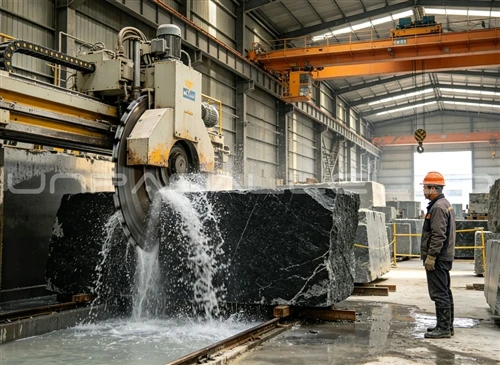
Of course, this does not mean granite support blocks can completely replace metal pads. Metals have higher toughness and outstanding impact resistance. They are suitable for heavy-load rough machining scenarios with lower cost thresholds and ordinary tooling positioning. Granite is brittle and vulnerable to heavy impact. It fits high-end precision scenarios demanding long-term reference stability, low vibration and non-magnetization, such as optical inspection, semiconductor equipment bases, precision metrology calibration platforms and femtosecond laser equipment.
To sum up, material selection is not about picking the superior material, but matching the accuracy requirements of your equipment. Metal pads are sufficient for general mechanical tooling positioning. However, when equipment requires long-term stable micron or even nanometer reference and is sensitive to temperature fluctuations, micro-vibration and electromagnetic interference, granite support blocks become the better option. UNPARALLELED Group keeps deepening the R&D of ultra-precision components. With material research and precision lapping technology, we provide stable and reliable granite reference support solutions for precision equipment manufacturers across various industries, helping them cut time and cost losses caused by repeated recalibration.