



Many people regard precision granite components as stone parts produced by simple cutting and polishing. In fact, granite components used in semiconductor, optical inspection and metrology equipment require a dedicated process flow different from ordinary stone machining. Conventional stone processing only pursues external dimensions, while precision granite components focus on continuous internal stress control and geometric accuracy locking. Each special process is designed to eliminate risks of micro-deformation. Drawing on years of ultra-precision component manufacturing experience, UNPARALLELED Group breaks down the essential special machining processes for precision granite components.
一,Raw stone inspection and directional material selection to avoid internal defects at source Different from ordinary stone cutting, precision granite blanks go through internal defect screening before machining. Tiny internal cracks, mineral segregation and loose interlayers invisible to naked eyes will gradually expand under temperature cycling and load, resulting in deformation of finished reference surfaces. UNPARALLELED Group conducts petrographic analysis and internal defect detection on UNPARALLELED® black granite raw stones, and determines machining orientation according to crystal texture of the stone. The cutting plan is arranged based on crystal alignment to avoid anisotropic deformation caused by crystal orientation. Unqualified stones are eliminated, and only screened raw stones proceed to subsequent cutting.
二,Multi-stage natural aging and constant-temperature static placement to release multi-layer residual stress Mining and sawing accumulate internal stress inside granite. Without sufficient stress relief, finished products will deform continuously after delivery and damage reference accuracy. This aging process is the most distinctive special procedure that differentiates precision granite from ordinary stone products. UNPARALLELED Group places rough-sawn blanks in a dedicated stockyard for long-term natural aging to release surface stress from sawing. After rough milling, slotting, drilling and other structural machining, workpieces are transferred to constant-temperature workshops for static placement again to release new stress generated by cutting. Multiple rounds of static storage are arranged. Machining proceeds only after material deformation stabilizes, preventing stress rebound after subsequent ultra-precision grinding.
三,Integrated CNC rough and finish machining to control subsurface damage Ordinary stone processing only focuses on outer contours. The core challenge of CNC machining for precision granite is to control invisible subsurface microcracks caused by machining. Granite is highly brittle. Improper cutting parameters will form invisible damaged layers beneath the plate surface, triggering accuracy degradation in later use. UNPARALLELED Group adopts diamond cutting tools suitable for granite, applies layered progressive cutting strategy, and properly controls cutting load and cooling schemes. Multi-surface structures, holes and grooves can be formed in one clamping. Multi-feature machining finished under a unified clamping benchmark ensures geometric tolerances between functional surfaces and reduces positioning errors from repeated re-clamping.
四,Combined gradient ultra-precision grinding and manual shaping to form reference surfaces Grinding is more than flattening plate surfaces. It is divided into multi-stage gradient grinding to gradually reduce surface roughness and remove machining damage left by previous procedures. After mechanical grinding, workpieces enter a special manual fine-shaping process. Craftsmen with decades of grinding experience perform local nano-scale shaping on reference surfaces. With abundant experience, craftsmen identify tiny height differences on the plate and remove material in micro amounts to correct contour deviation from mechanical grinding. This combined process balances uniformity of large-area plates and local high-precision requirements, delivering stable reference planes for metrology and optical equipment. After grinding, micropore sealing treatment is carried out to block tiny pores on stone surfaces and prevent dust and moisture from corroding the stone substrate.
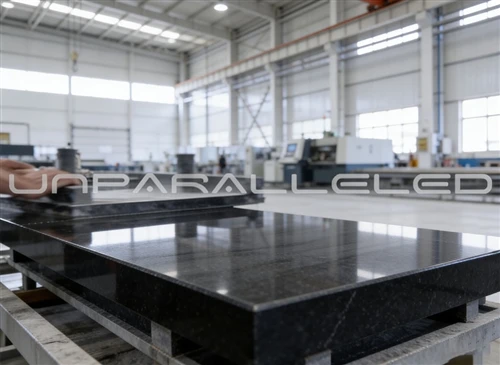
五,Full-area grid metrology and calibration to build traceable accuracy files Inspection of precision granite components is not simple spot sampling, but an independent metrology process. Workpieces are moved into constant-temperature & humidity workshops. After workpieces reach full thermal balance with the environment, imported measuring equipment including laser interferometers and high-precision electronic levels are used for full-area grid sampling and mapping on reference surfaces, holes, grooves and steps. Full contour deviation data are recorded. All measuring instruments of UNPARALLELED Group can be traced back to national metrology institutions. A dedicated inspection file is generated for every component, recording flatness, perpendicularity, position tolerance and other geometric tolerances. It ensures authentic and repeatable precision data to support calibration of complete equipment.
六,Finished product protection and stress recheck to guarantee stable accuracy after delivery Completion of machining does not mark the end of procedures. Finished products go through an easily overlooked stress recheck and protection process. After grinding and metrology, workpieces stay in constant-temperature environment for another period. Reference surface accuracy is rechecked to detect any minor subsequent deformation. After stable accuracy is confirmed, special protection is applied to edges and reference surfaces to avoid collision damage during transportation and hoisting. Only after all procedures are completed can packaging and delivery start. This step screens out workpieces with potential hidden stress risks in advance and prevents accuracy drift after products arrive at customers' sites.