



1. Ultimate Dimensional Thermal Stability: The Precision Bottom Line to Avoid Temperature Drift
Optical systems are far more sensitive to temperature changes than ordinary industrial equipment. Diurnal temperature differences in workshops, thermal radiation from operating equipment and fluctuating ambient airflow can trigger micro-deformation of the base, directly resulting in optical path shift, focusing deviation and distorted measurement data. This stands as the primary cause of optical precision failure. Therefore, an ultra-low coefficient of thermal expansion ranks as the top priority property for optical stage base material selection.
Ordinary metals and low-grade stone are prone to irreversible micro-deformation under heat. Even micron-level dimensional errors can completely invalidate nano-scale optical inspection and high-precision laser processing. UNPARALLELED® self-developed black granite substrate delivers outstanding adaptive thermal stability. Within normal industrial temperature control ranges, it achieves nearly controllable micro-deformation and eliminates benchmark displacement caused by thermal expansion and contraction. Such thermal stability is not merely an inherent material characteristic. It is a fundamental prerequisite to guarantee long-duration continuous operation of optical equipment and repeatable data consistency. It also forms the key dividing line between UNPARALLELED high-end optical bases and ordinary industrial bases available on the market.
2. High-density Rigidity and Vibration Damping Performance: Locking the Dynamic Optical Benchmark
Vibration tolerance is zero throughout optical operations. Minor vibrations including oscillation from workshop machinery, ground micro-resonance, slight movement by operators and airflow disturbance transmit through the base to optical lenses and inspection modules, leading to blurred imaging, jittered optical paths and measurement errors. Hence, the second core indicator for material selection is high-density homogeneous rigidity and natural vibration damping capacity.
Material density directly determines the self-weight stability and deformation resistance of the base. UNPARALLELED® black granite reaches a density of approximately 3100kg/m³. The high-density homogeneous material suppresses subtle external vibrations by its own mass, while possessing excellent vibration damping properties to rapidly absorb and attenuate high-frequency and low-frequency vibrations and prevent residual vibration superposition. Unlike metals, which tend to resonate and conduct vibrations, substrates adopted by UNPARALLELED feature a uniform solid structure without pores, cracks or material delamination. They bear stress evenly and maintain sufficient rigidity. They can sustain long-term loads from large optical modules and precision inspection equipment without micro-structural deformation, and quickly dissipate vibration to keep the dynamic benchmark of optical systems stable. It is suitable for dynamic optical applications such as high-speed laser processing, precision scanning and real-time imaging.
3. Nano-level Flatness and Wear Stability: Core Assurance of Permanent Benchmark
The optical stage base acts as the reference plane for assembly, calibration and inspection of all optical components. Flatness accuracy directly governs the precision of optical path layout, while long-term precision retention is critical for sustained equipment operation. Accordingly, ultra-high machined flatness and long-term wear & fatigue resistance rank third among the core material selection properties.
After short-term service, friction loads and environmental oxidation, ordinary stone and metal substrates easily suffer surface abrasion, flatness collapse and precision degradation, shifting the optical benchmark and requiring frequent calibration and maintenance. Backed by a team of artisans with over 30 years of hand lapping experience and ultra-large precision grinders, UNPARALLELED can process black granite substrates to nano-level flatness. The material boasts superior surface density and mechanical stability, delivering remarkable wear resistance and anti-fatigue performance. When continuously subjected to sliding optical equipment, module assembly and disassembly, and precision inspection tasks, its surface accuracy remains intact without deformation or scratches. It permanently retains original benchmark precision, fundamentally preventing equipment malfunctions and measurement errors induced by base precision degradation, and satisfying the high-precision operation requirements of optical equipment for years or even decades.
4. Physicochemical Inertness and Weather Resistance: Adaptation to Complex Precision Operating Environments
Optical working conditions in semiconductor, optoelectronics and new energy sectors generally involve trace dust, moisture, chemical volatile substances and alternating temperature & humidity. The environmental adaptability of base materials directly affects the stability and service life of optical systems. Ultimate physicochemical inertness and corrosion resistance constitute the indispensable fourth core indicator for optical base material selection.
Low-quality substrates are vulnerable to environmental erosion, leading to oxidation, weathering, deformation and discoloration. Microscopic material corrosion will damage the flatness of the reference plane and interfere with optical signal transmission. UNPARALLELED® black granite features complete chemical inertness: non-oxidizing, non-rusting, and resistant to acids, alkalis, oil stains and moisture. It withstands temperature and humidity fluctuations in workshops and harsh conditions in cleanrooms. Meanwhile, the material has uniform properties throughout the bulk with no internal stress. It will not spontaneously deform, warp or crack over time, enabling stable operation under all-weather and all-condition scenarios. It is especially applicable to demanding environments such as semiconductor clean workshops, precision laser processing laboratories and high-precision new energy inspection sites. UNPARALLELED has also built a constant-temperature & constant-humidity dust-free assembly workshop simulating semiconductor manufacturing environments to ensure stable delivery status of finished optical bases.
5. High-precision Machinability: Meeting Custom Ultra-precision Fabrication Requirements
High-end optical equipment has complex structures. Stage bases need customized features including integrated guide rails, bearings, module mounting seats, hollow slots and spliced structures, and all machined areas must maintain micron and nano-scale precision. Therefore, excellent ultra-precision machinability and structural stability become the fifth core material selection property.
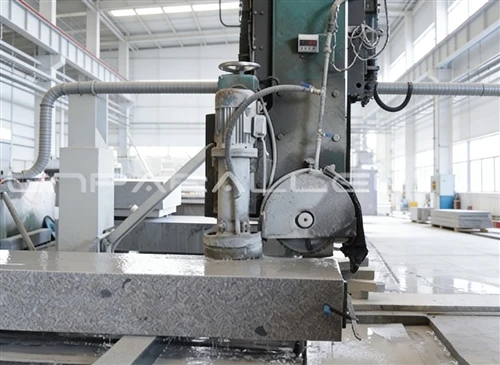
Conventional materials tend to suffer stress rebound, dimensional deviation and edge deformation after machining, failing to meet fabrication requirements for complex precision structures. With two manufacturing sites, a large stone stockyard and heavy-duty CNC equipment, UNPARALLELED can undertake integrated processing of oversized and heavy optical stage bases, with individual components reaching up to 20 meters in length. The material features controllable internal stress and supports nano-scale forming of micropores, narrow grooves and precision assembly surfaces. Compatible with ultra-precision lapping, CNC finishing and dust-free assembly processes, the finished parts have no residual stress or precision rebound. It perfectly meets customized base demands for optical comparators, CMMs, femtosecond laser systems, semiconductor optical inspection equipment and other high-end devices.
Conclusion: Defining the Upper Limit of Optical Precision via Core Substrate Properties
The logic behind optical stage base material selection essentially relies on fundamental material properties to underpin optical system accuracy and long-term stability to guarantee equipment reliability. The five core properties - thermal stability, vibration damping capacity, flatness & wear resistance, physicochemical weather resistance and ultra-precision machinability - advance progressively and complement one another. Together they determine measurement accuracy, imaging quality, operational stability and service life of optical equipment.
Amid iterative upgrades of the ultra-precision optics industry, we must abandon the crude practice of substituting precision granite with ordinary marble and cutting corners on materials. Only by adhering to stringent standards for the five core properties can we fundamentally resolve industry pain points including optical path drift, precision attenuation and environmental interference. Upholding the quality policy that "For precision work, no amount of rigor is excessive", UNPARALLELED Group continues to supply trusted ultra-precision optical stage base solutions for global customers in semiconductor optoelectronics, precision laser, high-level metrology and new energy sectors, consolidating the core benchmark of the ultra-precision industry.